

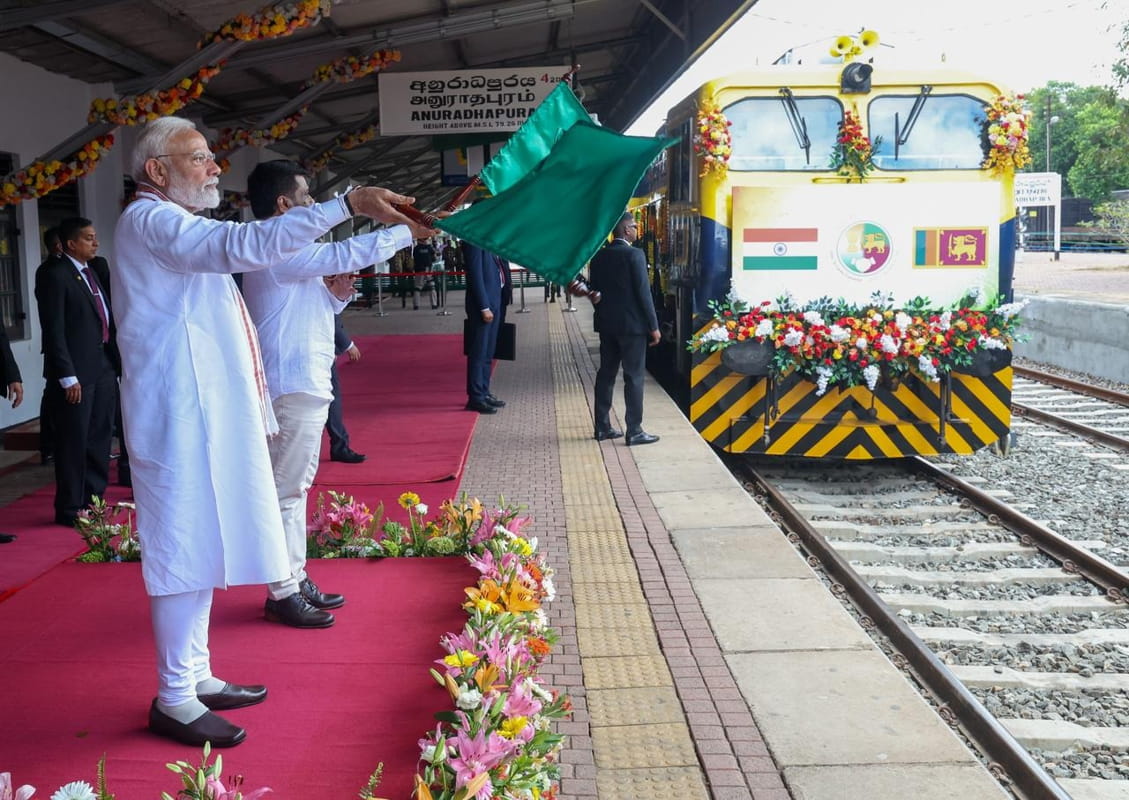
Prime Minister Narendra Modi at an Event in Anuradhapura, Sri Lanka (2025)| Akashvani News

A stable neighbourhood is in India’s interests as it is also a more predictable strategic environment. India can also leverage its diplomacy, credibility and speed, while minimising long-term financial exposure. However, the role of stabiliser can also create expectations in which neighbours internalise the idea that India is the first responder, and if India does not respond, it will be perceived as India retreating. Also, a stabiliser role will expand India’s responsibility; while it is in debt to other nations and entities that caused the crisis, India will have to do the clean-up.
Introduction
This article explores the growing concerns for India as it faces a neighbourhood that is the most debt-prone in the developing world. High debt results in its neighbours reaching out to Washington-dominated multilateral institutions and/or Beijing, the world’s largest bilateral lender in the world. It highlights the options India has and what would be the best option for India.
An increasingly glaring fact when looking at India’s neighbours is that they are almost entirely in debt distress. By 2022, the debt-to-GDP ratio for South Asia averaged 86%, higher than that of any other emerging or developing region. India has emerged as a bilateral lender, and its $4 billion lifeline to Sri Lanka in 2022 has also established it as a rescue lender. But India’s neighbours’ external debt is largely dominated by Washington-dominated multilateral institutions and by China as a bilateral lender. Creditor nations use credit and grants for geopolitical means.
The more debt-prone India’s neighbours are, the stronger the influence of Washington and Beijing in India’s backyard. This can compel India to adopt a hybrid role of being a creditor, stabiliser, and geopolitical counterweight, knowing that if India does not step forward, another geopolitical rival will step in to gain influence. How can India strategise?
Debt Landscape of India’s Neighbourhood
South Asia has the highest debt-to-GDP ratio among emerging and developing regions worldwide. Sri Lanka, Bhutan and the Maldives have debt-to-GDP ratios of over 100%, making them vulnerable. Although Pakistan has a lower debt-to-GDP ratio, its gross financing needs are over 20% of GDP, making the nation vulnerable to external and internal shocks. While Nepal’s debt and gross financing needs are low, it is approaching middle-income status, at which point it will lose access to concessionary financing, and it is seeing a trend toward switching from grants to loans. Bangladesh’s debt-to-GDP ratio of around 40% is good, but its government revenue-to-GDP is also below 10%, making it vulnerable to debt stress down the road.
Sri Lanka was the first nation in the Asia-Pacific region to default in the 21st century, and Pakistan and the Maldives came close to default. India’s $4 billion lifeline in 2022 prevented further chaos in Sri Lanka; though Sri Lanka defaulted, India did save the Maldives in 2025 from a possible default. Given that South Asia accounts for 84 International Monetary Fund (IMF) engagements, the region is highly vulnerable to debt stress.
As far as debt composition is concerned, it is dominated by multilaterals in South Asia. Multilateral debt (excluding the IMF) is almost half of all debt at over $200 billion as of 2022, with bilateral and commercial debt amounting to 34% and 19%, respectively. Japan and China remain the largest bilateral lenders to South Asian nations, while US influence comes through multilateral institutions.
What is at Stake for India?
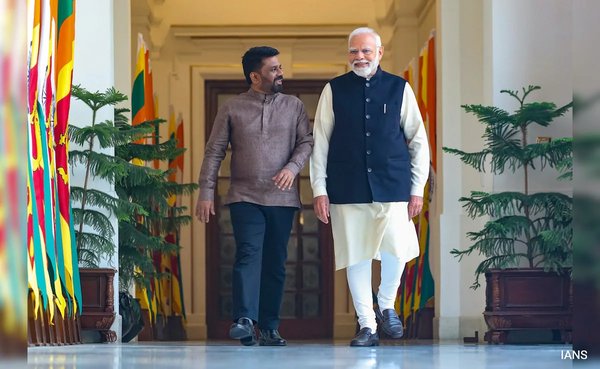
Sri Lankan President Anura Kumara Dissanayake with Indian Prime Minister Narendra Modi | IANS
Firstly, South Asia is uniquely sensitive to India because of its geographical proximity and security interests. The debt crisis opens the doors of India’s neighbours to other powers, especially China, which would step in with emergency financing and currency swaps. So India will be put in a position of either stepping in and helping its neighbours or stepping back and letting other world powers step in. Debt stress will also cause these nations to seek the IMF, which is dominated by the United States, to exert influence in India’s neighbourhood. Two cases are Sri Lanka and the Maldives, where India stepped in to help.
Secondly, there would be maritime and security exposure for its neighbours. Maldives and Sri Lanka matter for India’s influence in the Indian Ocean, where over two-thirds of the world’s oil shipments and one-third of the world’s bulk cargo move. 90% of India’s oil imports and 80% of its trade volumes come from the Indian Ocean.
Strategic influence is vital for India in the Indian Ocean. A debt-stressed nation may also be compelled to sell strategic assets to India’s rivals. Sri Lanka’s decision to lease out the Hambantota Port to a Chinese firm in 2017, which has been perceived as a debt-to-equity swap, is an example of India’s rivals stepping into its neighbours. This can lead to rival powers controlling strategic chokepoints in the Indian Ocean.
Thirdly, India’s credibility as a regional lender. With India being projected to become the third-largest economy by as early as 2028, it does not help India’s image to see other world powers coming to the aid of its neighbours instead of India. India did exemplary work in the case of Sri Lanka, where it threw a lifeline to Sri Lanka in 2022 with $4 billion. It was the first to give financing assurances for Sri Lanka to enter an IMF program, and India, along with France and Japan, formed the official creditor committee to speed up Sri Lanka’s debt restructuring. India’s willingness to act first for its neighbours also goes well with its Neighbourhood First Policy.
Lastly, domestic spillovers are also a major concern. Border instability, especially with Nepal and Bangladesh and trade disruption are key issues. Also, when debt stress is high, there will be political instability in India’s neighbourhood, resulting in India being unable to establish stable and long-term relationships with its neighbours.
Why Traditional Non-Intervention is no Longer Viable?
India has been a very helpful neighbour for decades in the region, financially. It has provided financial assistance through grants and concessional forms of financial support to most of its neighbours. Countries that have received Indian assistance are Bhutan, Bangladesh, the Maldives, Nepal and Sri Lanka. India has even offered financial assistance to Pakistan.
Since the mid 2000s, China’s rise has transformed the global debt landscape, making it out to be the largest bilateral lender in the world to developing countries. China provides more bilateral lending to many developing countries than all the Paris Club Members combined, significantly increasing Beijing’s influence. In the region, Japan and China remain the largest bilateral creditors.
Though China is a large bilateral lender to the region, when looking at the overall debt composition of the region, multilateral debt still accounts for nearly half of all external debt. Multilateral debt is largely from the World Bank, where the largest shareholder is the US, and the Asian Development Bank, where Japan and the US are jointly the largest shareholders. The United States dominates the multilateral debt.
The most influential economic institution in the world, the IMF, the global lender of last resort, is dominated by Washington. The US holds the largest voting share within the IMF with 16.49%, but with the IMF requiring an 85% vote share for major decisions, the United States has a virtual veto at the IMF on all major decisions. But China is also involved in rescuing debt-ridden nations, where in 2021, China lent almost $40 billion in this regard.
As the US and China increasingly compete, the region, which is debt-ridden, will see debt being used as a geopolitical instrument. Sri Lanka took almost a year to start its IMF program, as China withheld financing assurances to the IMF, demanding that multilateral debt be restructured as well. Washington pushed back, and China finally gave in, but this highlights the geopolitical angle in South Asia. India cannot stand aside largely, as rising debt in the region gives Washington and Beijing increasing influence in its neighbourhood. Debt also creates political leverage.
Historically, major powers have used loans and grants as instruments of geopolitical influence. Washington and Beijing will have influence over the foreign and trade policies of India’s neighbours. If any South Asian nation defaults, as Sri Lanka did in 2022, it will bring its own geopolitical manoeuvring, as seen in Sri Lanka’s case. With a few nations in India’s neighbourhood in debt stress, a debt default can bring geopolitics into India’s backyard. IMF programs also come with conditions that are drafted out of Washington. It is in India's interest to have a stable neighbourhood to keep other world powers’ influence to a minimum.
India’s Strategic Dilemma: Creditor or Stabiliser
India can play the role of the dominant creditor in the region by extending bilateral loans, project-linked financing and credit lines. This can increase India’s influence in the region and also rearrange the debt composition of its neighbours with India as the dominant bilateral lender. This will prevent other world powers from influencing its neighbours during the debt crisis, and more importantly, during debt restructuring. This can strengthen political goodwill and help integrate the region better. This will also establish India as a regional financial power and position India to become a world power with financial clout. This strategy can, however, expose India to repayment risks, rollover pressures and repeated bailouts for its neighbours, which will not be popular domestically as India is still a developing nation. The more India lends, the more it is exposed to its neighbours' financial vulnerabilities.
India can also take on the role of a stabiliser, where it does not necessarily need to be the dominant lender in the region but assume regional responsibility. This can be achieved by providing emergency liquidity, coordinating with creditors, preventing spillovers, and enabling IMF programs. India performed this role during Sri Lanka's crisis in 2022. This will mean that India is contributing to regional stability, but with less exposure to its financial well-being. Regional instability directly affects India through trade disruption, migration pressures and other security concerns.
A stable neighbourhood is in India’s interests as it is also a more predictable strategic environment. India can also leverage its diplomacy, credibility and speed, while minimising long-term financial exposure. However, the role of stabiliser can also create expectations in which neighbours internalise the idea that India is the first responder, and if India does not respond, it will be perceived as India retreating. Also, a stabiliser role will expand India’s responsibility; while it is in debt to other nations and entities that caused the crisis, India will have to do the clean-up.
Way Forward for India
Firstly, bilateral support for its neighbours in moments of debt crisis should come with conditions from India, with assurances from the neighbour that they will adopt better fiscal discipline to prevent this from recurring. This will not only place India as a responsible regional power but also ensure the region is stable.
Secondly, India can work with the IMF rather than trying to substitute it. Although the IMF is dominated by the United States, it is still globally recognised as the lender of last resort, with even China and Russia as members. Providing bilateral assistance on the condition that neighbouring nations adhere to IMF programs can help India push for fiscal discipline among its neighbours without becoming unpopular in the neighbourhood.
Finally, India should advocate for a regional framework for debt restructuring similar to the 2020 G20 Common Framework for Debt Treatments for low-income countries, which formally commits creditors, including China, to the principle of comparable treatment. A debt restructuring framework will also limit the ability of world powers to gain an unfair advantage over India’s neighbours, ensuring a predictable environment that is beneficial to India and the rest of the region.
WTO Trade Policy Review for India: Strengthening Competitive Advantage
Building India's National Cyber Reserve Force: Feasibility, Models, and Strategic Value
From Summits to Structures: Rethinking the India-Africa Partnership

Cyber Deterrence in the Indian Context: Constraints, Credibility and Escalation Risks
A National Economic Security Doctrine: Defining India’s External Engagement