



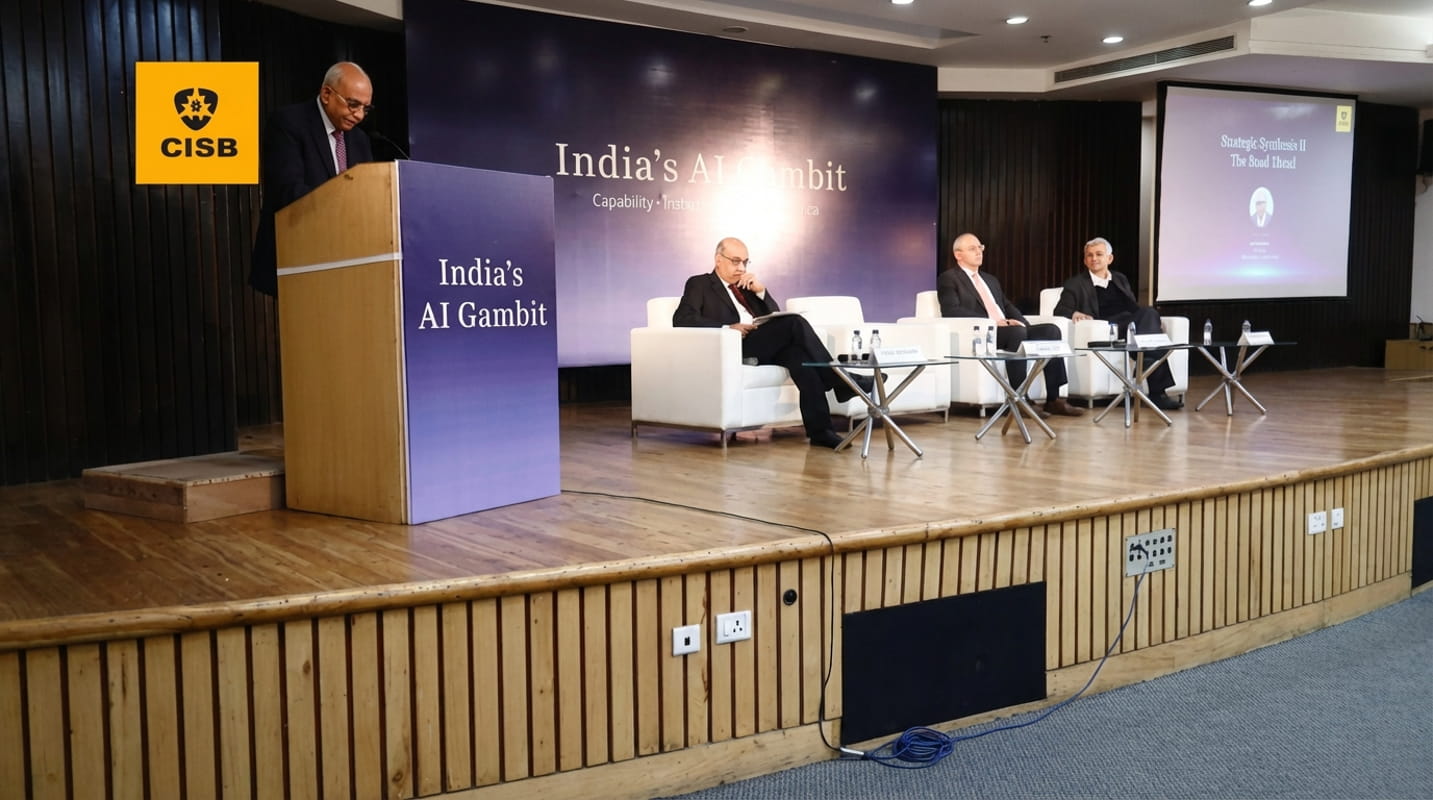
Shri Alok Joshi, Chairman, National Security Advisory Board of India, delivers the Closing Address at the strategic dialogue “India’s AI Gambit: Navigating the Global Race”, New Delhi, January 2026.

As major powers deploy artificial intelligence to advance scientific discovery and strategic capability – India must broaden its vision – from AI for All to AI for Sovereignty, Science and Security.
India will host the India AI Summit 2026 in New Delhi in February. It is likely to be accompanied by announcements of significant investments in data centres and cloud infrastructure. These developments are welcome and underscore India’s growing importance as a global hub for AI deployment and applications.
Yet, as India consolidates its position as a leading ‘use-case capital’ for artificial intelligence, it is important to reflect on a deeper strategic shift underway elsewhere, one with profound implications for science, national security and global influence.
In both the United States and China, the centre of gravity in artificial intelligence is moving beyond consumer-facing applications and productivity tools. Increasing emphasis is being placed on advanced AI systems designed to accelerate scientific discovery and strengthen national security. This shift reflects a growing recognition that AI’s most consequential impact may lie not merely in efficiency gains but in shaping the future of knowledge, strategic capability and power.
In the United States, this thinking has taken shape through initiatives such as the Genesis Mission, coordinated by the Department of Energy, which seeks to harness AI for discovery science while addressing national security concerns. China, through programmes led by the Chinese Academy of Sciences and other institutions, is pursuing similar objectives, often through tightly integrated efforts across science and security establishments.
A recently-released report by the Strategic Foresight Group, India’s AI Gambit: Navigating the Global Race, argues that India’s long-term AI strategy must be viewed through this wider lens. The report cautions that an exclusive focus on large language models to boost productivity and creativity risks overlooking a more consequential transformation: the use of advanced AI systems to drive breakthroughs in science and to reshape the strategic balance between nations.
India can develop a confident strategic framework building on its own experience. Our achievements in space, atomic energy and vaccine development demonstrate an ability to pursue cutting-edge science and technology with limited resources, guided by responsibility and public purpose. These experiences offer valuable lessons as India seeks to apply artificial intelligence to scientific advancement in areas ranging from materials and energy to health and climate.
Recognising the importance of research-led innovation, the Indian Government has announced a Research Development and Innovation Scheme Fund of USD12 billion, covering AI, quantum technologies and other emerging fields. While industry will play a vital role in leveraging these investments, India’s diplomatic and national security institutions must also help shape a coherent national vision that balances opportunity with responsibility.
Artificial intelligence raises concerns that extend beyond misuse by individuals or groups. Advanced AI systems have already demonstrated the potential to generate hazardous chemical or biological knowledge, undermine cyber resilience and interact with critical decision-support systems. As these technologies evolve, questions of control, accountability and unintended escalation become increasingly salient. These are strategic challenges that demand careful, sober assessment rather than alarmist responses.
Internationally, there is growing recognition of these risks. Scientists, technologists and policymakers have called for stronger safeguards and clearer norms governing the development of advanced AI systems. India – as a major source of talent, data and markets – has both the standing and the responsibility to advocate responsible global behaviour in this domain.
At the national level, the implications of artificial intelligence for sovereignty and security merit sustained attention.
The National Security Council Secretariat is well placed to examine these issues in a structured manner, including the case for national security impact assessments of advanced AI technologies, whether developed domestically or imported. Scenario exercises exploring AI-enabled risks, from biosecurity threats to recursive self-improvement, would help policymakers anticipate challenges rather than respond to them after the fact.
The government’s AI governance guidelines, issued in November 2025 acknowledge these concerns. The task ahead is to translate intent into operational practice, including safeguards in public procurement and clearer thresholds for risk management.
India stands at an important crossroads in the global AI race. Social inclusion and economic transformation will rightly remain central to our approach. But they are not sufficient on their own.
As major powers deploy artificial intelligence to advance scientific discovery and strategic capability – India must broaden its vision – from AI for All to AI for Sovereignty, Science and Security.
The choices we make now will shape not only our technological future but our place in the world.
(Exclusive to NatStrat)

WTO Trade Policy Review for India: Strengthening Competitive Advantage

Building India's National Cyber Reserve Force: Feasibility, Models, and Strategic Value

How Neighbouring Countries' Debt Crises Are Reshaping India's Foreign Policy

From Summits to Structures: Rethinking the India-Africa Partnership

Cyber Deterrence in the Indian Context: Constraints, Credibility and Escalation Risks


A National Economic Security Doctrine: Defining India’s External Engagement

