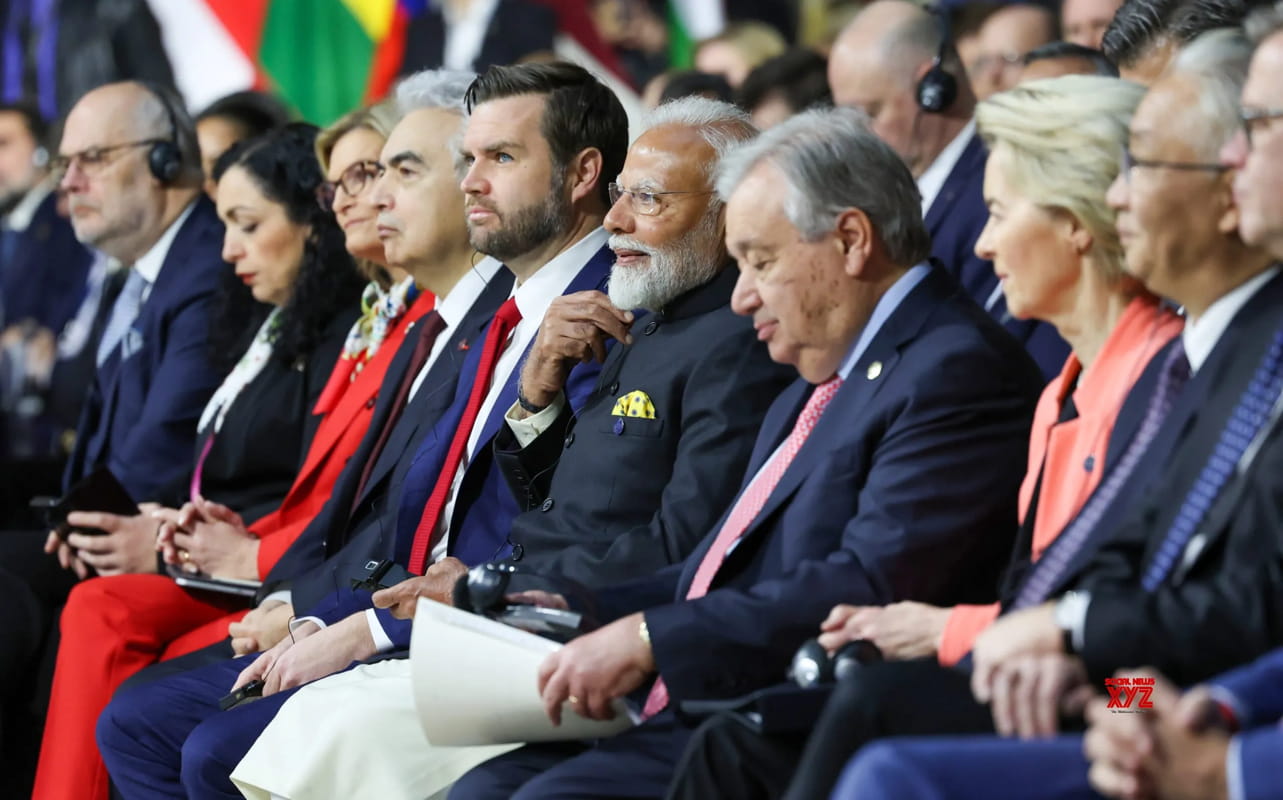


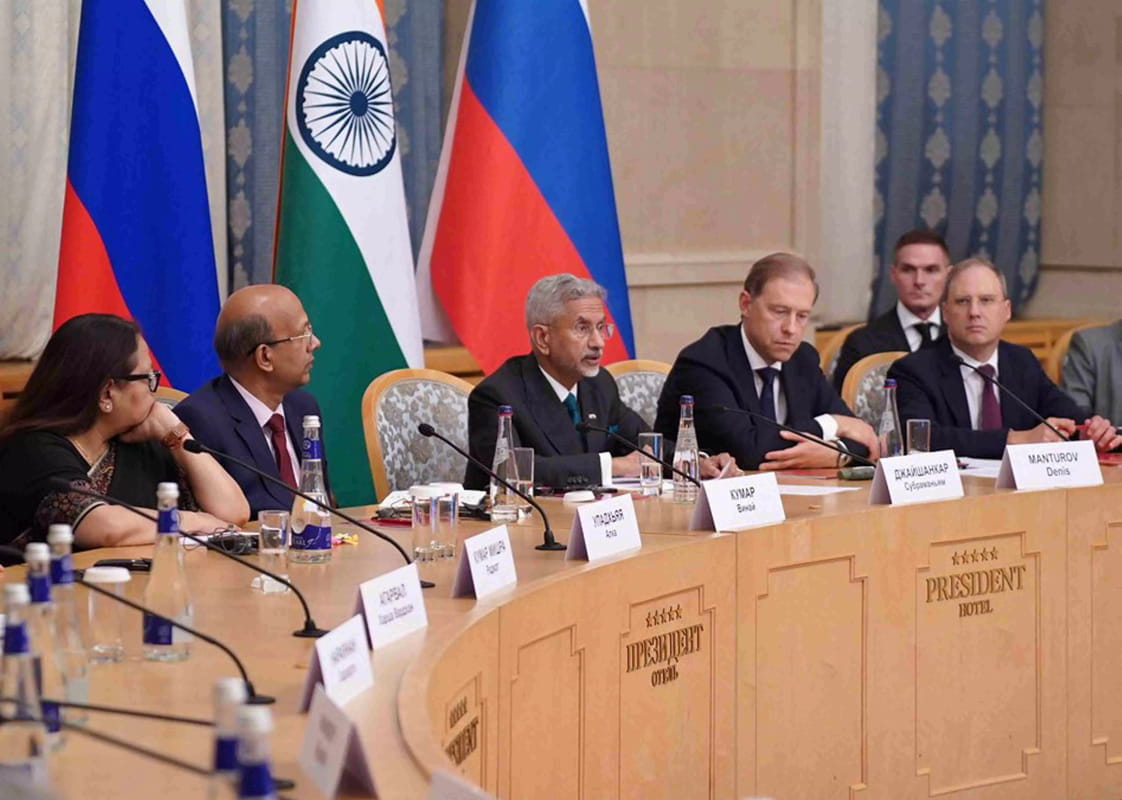
Meeting in Moscow between India and Russia to increase trade cooperation, August 2025. | X: @DrJaishankar

The India state visit of Russian President Vladimir Putin on 4-5 December 2025 at the invitation of Prime Minister Shri Narendra Modi yielded strong optics and reiterated the special and privileged strategic partnership between the two countries, marking 25 years of their strategic partnership.
Introduction
The India state visit of Russian President Vladimir Putin on 4-5 December 2025 at the invitation of Prime Minister Shri Narendra Modi yielded strong optics and reiterated the special and privileged strategic partnership between the two countries, marking 25 years of their strategic partnership.
In the joint statement of the two leaders, the first point covered trade and economic partnership and emphasised the target of USD 100 billion in bilateral trade by 2030.
India-Russia Trade
On trade, the joint statement makes a succinct reference to faster work on the free trade agreement between India and the Eurasian Economic Union (EAEU), addressing tariff and non-tariff barriers, resolving logistics bottlenecks, promoting connectivity, ensuring smooth payment mechanisms, covering issues of insurance and enhancing business interaction. While the Programme for the Development of Strategic Areas of India-Russia Economic Cooperation till 2030 (Programme 2030) was adopted, its details are as yet not available. The joint statement brought out during Prime Minister Narendra Modi’s visit to Russia in July 2024 identified nine areas of cooperation, covering much the same ground as the most recent one.
As the United States and the European Union tighten restrictions on Russian oil, India is navigating a delicate diplomatic and commercial balancing act between its largest export markets and Russia. India’s high imports of Russian crude have sharply declined following US sanctions on two major Russian oil companies, the EU’s ban on Russian-origin refined products, and additional 25 per cent US tariffs aimed at discouraging India’s continued purchases of Russian oil. To sustain and deepen the broader economic relationship once the oil trade diminishes, India and Russia will need to make concerted efforts to expand and diversify two-way trade in non-energy sectors.
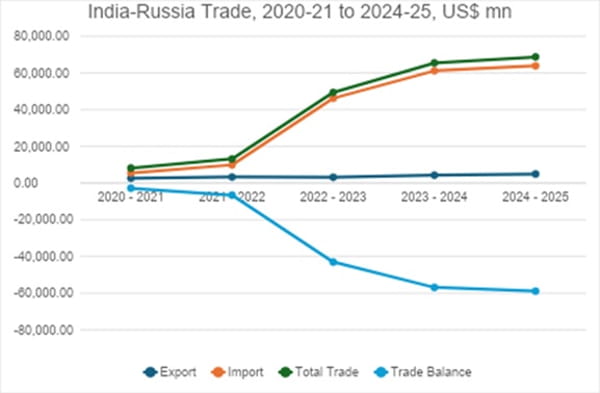
Stripping oil imports out of the equation, India’s total trade with Russia aggregated just about USD 12 billion in 2024-25. Data from the Russian central bank show its total exports at USD 434 billion and total imports at USD 302 billion in 2024. Similarly, India’s trade in 2024-25 stood at USD 438 billion for exports and USD 721 billion for imports. Given the low shares of each country in the other’s trade, both countries must attempt to build the basket of exchange goods.
India’s purchases of crude oil from Russia surged in 2022, driving its overall trade with the country from USD 8.7 billion in 2021 to over USD 64 billion in 2024, as per data from International Trade Centre. Crude oil comprised about USD 57 billion of this, with vegetable oils and fertilisers coming a distant second and third in its import basket. Diversifying this import portfolio requires a granular examination of potential trade items based on the trade profiles of both countries, as well as addressing non-tariff barriers in these products.
Apart from crude oil, fertilisers and vegetable oils, India buys diamonds, vegetables items, iron and steel, and newsprint from Russia. However, the values of these imports are relatively low, despite the fact that India purchases significant amounts from other countries. Russia has also traditionally been the largest supplier of defence equipment to India, although its share in India’s total arms purchases has declined over the years.
Examining the products where India has low imports from Russia and aligning them with Russian exports to the world, it is found that India can considerably increase imports in goods such as electronics, machinery, organic chemicals, plastics and others.
Department of Commerce, India
On the export side, the Indian Commerce Ministry pegs India’s exports at just USD 4.9 billion in 2024-25. This is a growth of about 88 per cent over the level in 2020-21; however, Russia ranked 25th among India’s export destinations and accounted for just 1.1 per cent of its total exports. Clearly, there is high potential for India to increase its sales to the country.
In the first half of the current financial year, India’s exports to Russia saw a drop of over 14 per cent. The major export items for this period included machinery and parts, pharmaceuticals, organic chemicals and electronics. These correspond well with the top items in India’s export basket. However, India’s export strength in goods such as apparel, vehicles and parts, gems and jewellery, and marine products are inadequately represented in the Russian market. Other Indian exports to Russia are widely diversified but low in value, indicating that Russian demand for these goods could potentially be scaled up.
Regarding services trade, the two countries have barely engaged in sectors such as tourism, IT, transportation and others. Bilateral services trade stood at USD 1 billion in 2021 with the balance of trade in favour of Russia. This is not commensurate with India’s overall services exports of USD 387 billion and imports of USD 195 billion.
India and Russia setup the Inter-governmental Commission on Trade, Economic, Scientific, Technological and Cultural Commission (IRIGC-TEC) as a mechanism for promoting and monitoring bilateral trade and economic cooperation in 1992. Meetings of the Commission have been held regularly since then with the most recent 26th meeting taking place between External Affairs Minister of India and First Deputy Prime Minister of Russia in August 2025 in Moscow. The Commission currently operates through 17 working groups and six sub-groups which cover a range of sectors including agriculture, banking and financial matters, road transport and modernisation and industrial cooperation, among others. A sub-group to address trade barriers is part of the deliberations.
A multi-pronged approach to promoting trade with Russia would unlock the potential in key sectors.
Challenges and Recommendations
Resolving non-tariff barriers is the first step to boosting bilateral trade. For example, about 65 issues have been identified in marine exports to Russia. Similarly, a line-by-line examination of barriers to high-potential exports in sectors such as electronics, automotives, pharmaceuticals, among others, would need to be addressed in partnership with the concerned Russian agencies.
In a recent visit to Russia by the Indian commerce secretary, the two sides agreed to undertake quarterly regulatory engagement to discuss certifications, listings of agricultural and marine enterprises and other non-tariff issues. Better branding and marketing could help expand exports of garments, leather items and other consumer products.
India and Russia are part of the India-Eurasian Economic Union free trade agreement (FTA) negotiations which also include Armenia, Belarus, Kazakhstan and Kyrgyzstan. The terms of reference were inked in August 2025 with an 18-month plan. The early conclusion of this agreement would help to address tariff and non-tariff issues in bilateral trade and both sides must attempt to adhere to the timelines as reiterated in the December joint statement.
Further, the payment mechanisms have been affected by sanctions and a major proportion of bilateral trade is being settled in national currencies. However, India’s high oil imports have led to Russian banks holding large rupee values in special vostro accounts in India. The Reserve Bank of India has recently allowed authorised dealers to open special rupee vostro accounts without requiring its approval and permitted these holdings to be invested in Indian government securities and treasury bills. The two countries are also taking forward interbank cooperation, interoperability of payment systems, integration of financial messaging systems and central bank digital currency platforms as mentioned in the joint statement, which must be a priority going forward.
Services trade emerges as a potentially significant driver of bilateral trade. India’s IT exports have not taken root in Russia as yet. The two sides can cooperate in areas such as cybersecurity, artificial intelligence and enterprise software. One of the working groups under IRIGC-TEC is focused on ICT which could drive future engagement. The agreement on free e-visas for Russian tourists will help boost tourism, provided that better infrastructure and connectivity is made available parallelly.
A successful expansion of bilateral trade will significantly hinge on building confidence among Indian businesses regarding certainty and predictability in engaging with Russia. Several Indian companies have already been sanctioned by the US and EU, while wider sanctions have crippled Russia’s access to global financial systems. Government guarantees could help derisk trade with Russia and encourage businesses.
Moreover, the two governments should strenuously encourage and support private sector interactions, including by adding businesses in the dialogue process.
A resolution to the Russia-Ukraine conflict would likely pave the way for India to revive its oil trade with Russia. While reports of a potential US-Russia plan are circulating, the end of the conflict remains uncertain. Even under restored normalcy, India would face significant obstacles to resuming high-volume Russian oil imports including the probable erosion of current discounted pricing, the imperative to offset trade imbalances with the US through increased purchases of American fuel, and the potential decline in EU demand for Indian refined petroleum products.
President Putin’s India visit imparts a renewed vigour to the trade pillar of the special and strategic India-Russia partnership, and both nations must intensify their economic collaboration at policy and business levels with focused attention and innovations to meet their ambitious bilateral targets.
(Exclusive to NatStrat)

WTO Trade Policy Review for India: Strengthening Competitive Advantage
Building India's National Cyber Reserve Force: Feasibility, Models, and Strategic Value
How Neighbouring Countries' Debt Crises Are Reshaping India's Foreign Policy
From Summits to Structures: Rethinking the India-Africa Partnership

Cyber Deterrence in the Indian Context: Constraints, Credibility and Escalation Risks