



India's Digital Connectivity| Moneycontrol News
India’s thought leadership in DPIs can offer the world, especially the Global South, a way to build their national citizen-facing systems in a sovereignty-preserving, trusted, vendor-country-technology-neutral manner.
Background
The so-called rules-based order that defined and governed, however imperfectly, how the world was run has been turned on its head over the last few years. Today, geopolitical groupings, economic partnerships and regulatory frameworks are increasingly instrumental for states in safeguarding their national interests and forging alliances to achieve strategic objectives.
The ongoing geopolitical upheavals, including the Russia-Ukraine conflict, the Iran-Israel-US war in the Middle East, and the increasing weaponisation of rules, capabilities, supply chains and technology in pursuit of the strategic interests of states and their companies, have fundamentally upended traditional notions of strategic autonomy and sovereignty.
A New Strategic Landscape
The developed economies have already begun recalibrating and shaping their approaches to this rapidly changing world. The United States clearly stated its strategic priorities, seeking to “write the rules of the next economy,” as put forth by Treasury Secretary Scott Bessent on June 23, 2026. China, the formidable rival to the US in technology, manufacturing, and supply chains, has responded through Decrees 834, 835, and 837 by establishing legal and regulatory mechanisms to protect itself and its companies against foreign sanctions and supply chain restrictions.
Sandwiched between the strategic competition of the US and China, the European Union is pursuing greater strategic autonomy and resilience - independent of the US, China, and Russia- in technology, defence, energy, and economic resilience..
Rethinking India’s Strategy
India too needs to recalibrate its position on the interconnected ideas of strategic autonomy and sovereignty, keeping in mind Professor Stephen Krasner’s observation that sovereignty is “organised hypocrisy”.
Former Foreign Secretary Shyam Saran, credited with using the term “strategic autonomy” for the first time about 20 years ago, in a piece in March 2026, described it as “the capacity of a state to take relatively autonomous decisions on matters of vital interest to the state” well beyond the “non-aligned” term used earlier.
One cannot be truly sovereign if it remains dependent on others, especially rivals and adversaries, for critical technologies, supply chains, or other strategic inputs. The international order in the 21st century is being driven by economic and technological capabilities and overwhelmingly shaped by the interests of the countries with national power. Consequently, sovereignty and strategic autonomy need to move beyond their current formulations. They must serve not only to protect national interests but also to be the basis for pragmatic economic statecraft that advances a country’s strategic interests internationally. It is in this context that the concept of strategic persuasion comes in.
From Strategic Autonomy to Strategic Persuasion
Strategic persuasion, therefore, is the capacity of a state to make autonomous decisions on matters of vital interest not just for itself but also for others like it, i.e., states with similar socio-economic trajectories, histories, concerns, and interests. It builds this using its unique comparative advantages, its goodwill earned over the decades as a trusted, reliable friend in need, recognising the asymmetry of capacities in specific areas, and enabling and empowering others. It is not through coercion or by imposing conditions, but through partnership, collaboration and cooperation for mutual benefit.
Digital Public Infrastructure: India's Strategic Advantage
India, as a four-trillion-dollar economy with aspirations to become a developed country by 2047, cannot be reactive or merely respond to the fast-changing global situation. It needs to strategically persuade others while setting the agenda in areas it has pioneered globally, such as Digital Public Infrastructure (DPI), to offer socio-economic benefits to countries.
India has built an enormous national capacity in DPI: platforms, systems and protocols. These are of vital interest to India and to countries in the Global South. For example, the globally recognised and regarded national digital ID system Aadhaar, with 1.44 billion issued, inspired, in turn, the world’s largest deployment of digital public good for countries, namely the open source digital ID platform, modular open source ID platform (MOSIP), with over 193 million residents registered across 13 national rollouts from 29 country engagements. The ubiquitous 10-year-old UPI payment system, the world’s largest, with over 700 banks connected, did 23 billion transactions worth almost Rs 30 lakh crore in May 2026 alone.
The Open Credit Enablement Architecture (OCEN) for consent-based finance, which was recently approved as a Self-Regulatory Organisation (SRO) by the RBI, has over 272 million accounts connected across almost 1000 participants. Each of these systems has its own institutional and funding architecture. Yet, barring MOSIP, which is a private philanthropic initiative, India has not been successful in making, say, UPI widely accepted and perhaps even a standard across countries.
India’s Role in Building a Global DPI Ecosystem
India’s thought leadership in DPIs can offer the world, especially the Global South, a way to build their national citizen-facing systems in a sovereignty-preserving, trusted, vendor-country-technology-neutral manner.
Such initiative will require a coherent confident national goal involving the government, public and private players (“whole of country” approach), with an external facing entity chartered with creating awareness, building communities of practice, partnering with countries in co-designing and delivering country specific programmes, coordinating with various relevant DPI ecosystem participants in India and in countries, enabling funding, training, research, institution building in other countries, advising them on policy while working to create standards.
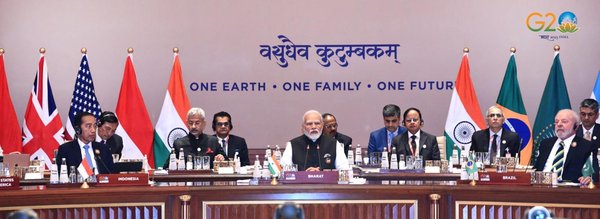
Prime Minister Narendra Modi at the G20 Leaders' Summit in New Delhi (2023) | Press Information Bureau, India
Seizing India's Strategic Moment
Meanwhile, the EU is racing ahead with its eIDAS 2.0 system. China is integrating its CIPS (Cross-border Interbank Payment System) with 19 African banking systems, and the UN is pushing for principles for ID sovereignty. A small window remains for India to set the agenda rather than be forced to follow or become part of an agenda set by others.
According to Foreign Secretary Shyam Saran, strategic autonomy draws “inspiration from the country’s civilizational identity, its geographical location, its history and culture, and, above all, the sensibilities of its people”. Chanakya’s Arthashastra and Vasudhaiva Kutumbakam, “the world is one family”, from the Upanishads, offer a blueprint to India for exercising non-hegemonic economic statecraft.
Seizing the moment to bring India’s DPI to life around the world will lay the path for India in this century.
[The article is exclusive to NatStrat. The views expressed by the author(s) are personal and do not necessarily reflect the views of the organisation.]

WTO Trade Policy Review for India: Strengthening Competitive Advantage
Building India's National Cyber Reserve Force: Feasibility, Models, and Strategic Value

How Neighbouring Countries' Debt Crises Are Reshaping India's Foreign Policy
From Summits to Structures: Rethinking the India-Africa Partnership

Cyber Deterrence in the Indian Context: Constraints, Credibility and Escalation Risks

A National Economic Security Doctrine: Defining India’s External Engagement

