




Source: Currency Transfers

A Global Currency
A global currency is trusted by the world as a unit of account, medium of exchange and store of wealth when it is backed by economic size, military strength, presence in global trade, depth of financial markets, and geopolitical influence. The strength of a currency also depends on geographical proximity and geopolitical alliances.[i]
Safety, liquidity, network effects, trade links, and financial connections are economic considerations that shape the use of sovereign currencies in international transactions. In addition, strategic, diplomatic, and military factors also shape the choice of reserve currencies, which helps explain why certain countries hold dollars even when their own currencies are strong. Advanced economies with stronger currencies, such as Japan, Canada, and Australia, may rely less on the Euro and Dollar. An analysis comparing nuclear-weapon states and states that depend on the US for security suggests that the difference in the share of the US dollar in their foreign reserve holdings is about 35 percentage points.[ii]
As a unit of account, a global currency’s presence is visible in trade invoicing, international debt and foreign exchange turnover. An increase of one percentage point in trade share promotes the use of the Dollar and Euro by 0.1 and 0.08 percentage points, respectively, while use of RMB sees a weaker linkage at 0.02. As a medium of exchange, a currency is reflected in global payments and flows. Finally, a currency’s presence in foreign exchange reserves reflects its function as a store of value.
More than 150 currencies are deemed legal tender worldwide, but only a few qualify as international currencies that are pervasive across the international monetary system in all three functions. Currency use is sticky, meaning that historic patterns influence a country’s preferred currency for transactions and store.
Rise of the dollar
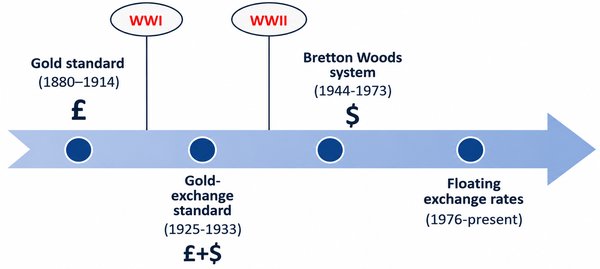
Prior to World War I, the international monetary system rested on the gold standard with gold as the backing for a currency. The pound sterling was the primary currency for global trade, shaped by the British colonial empire’s reach and its wealth. As the availability of gold was limited, countries held rising reserves of the pound sterling, along with the US dollar.
In the mid-1930s, the international monetary system comprised three blocs: countries using the gold standard, including the US; countries pegged to the sterling; and Central and Eastern European countries linked to Germany’s currency. This system was driven primarily by geopolitical alliances and factors. World War II cemented US dollar dominance, arising from its military and economic strength, as Britain’s global power and economic size waned.
The rise of the USD was formalised through the Bretton Woods agreement in July 1944, under which 44 nations agreed to a new international monetary system deriving from lessons from the two World Wars and the Great Depression. Earlier, in 1913, the dollar was legally fixed to a gold standard, mandating the Federal Reserve to hold gold equal to 40% of the value of the currency it issued.[iii]
The Bretton Woods meeting established the International Monetary Fund and the World Bank. Participating countries agreed to keep their currencies pegged to the dollar within a narrow band, and the dollar itself was pegged to gold. This system helped post-War recovery; however, in the 1960s, persistent US current account deficits and lack of adequate global safe assets led to systemic strains. In 1969, the IMF set up Special Drawing Rights (SDRs) as an alternative reserve asset for countries to hold.
In 1971, global dollar stocks exceeded matching stocks of gold held by the US. G10 countries entered into the Smithsonian Agreement to devalue the dollar and support the US current account deficit.[iv] However, the Bretton Woods system disintegrated by 1973, and dollar convertibility to gold was fully ended in 1976.[v]
Source: https://www.elibrary.imf.org/view/journals/001/2024/189/article-A001-en.xml
As the US economy remained the largest in the world, confidence in the dollar helps maintain its status as the world’s primary reserve currency. This enables the US to run large fiscal and trade deficits, financed by US government debt through US Treasury securities, that other countries buy for liquidity and reserves.
The holding of the USD as a reserve currency rose to 65 per cent by 2016, but has been sequentially declining since then, reaching 56 per cent in 2025. However, a few large countries account for this shift and it is not a generalised trend, according to the New York Fed.[vi]
Creation of the Euro: The European Union from the late 1960s wished to create an economic and monetary union which involved a common currency. Such a currency would make it easier to trade across European borders, facilitate movement of workers, and help keep prices stable. However, progress was slow.
Following instability in international currency markets and oil shocks, the European Monetary System was initiated in 1979, keeping exchange rates of participating currencies in a narrow band. In 1989, the Delors report proposed a three-stage preparatory period for a monetary union, which was accepted by European leaders.
In December 1991, the European Council agree on the Maastricht Treaty, which also made progress on the monetary union. It launched the euro on January 1, 1999, and the new currency immediately became the second-most important in the world. Today, it is the currency for 21 EU countries.[vii]
Initially, Euro internationalisation was not an explicit goal, and it was not promoted as such.[viii] The Global Financial Crisis, the Greek financial issues, and other shocks directed flows towards the dollar as a safe haven.[ix]
Since 2019, the European Central Bank has revised its stance in alignment with the EU’s Open Strategic Autonomy Agenda and geopolitical considerations and aims to reduce dollar dependence. Despite this intent, the Euro’s use in foreign exchange reserves and as a global payment currency has declined since 2020 (tables below).
Role of Special Drawing Rights (SDRs): The IMF created the SDR as an international reserve asset to supplement official foreign exchange reserves. It is defined by five currencies – the US Dollar, Euro, RMB, yen and pound sterling – whose weights are determined from time to time, with the US dollar accorded the highest weight. It represents a potential claim on the freely usable currencies of IMF members and adds to their liquidity in times of need.
The IMF allocates SDRs to countries with a total allocation of SDR 660 billion, equivalent to USD 935 billion. The largest allocation came in 2021, in the wake of COVID. It also supports interest-free loans for poor countries, committing USD 39 billion up to March 2026 to 57 countries.[x]
SDR is not a currency by itself and cannot be a medium of exchange. Only central banks and certain international organisations can hold it, and it must be exchanged for hard currencies for use. Expanding its use runs into issues of global consensus, central bank resistance, and legislative barriers.[xi]
Role of the US dollar
Historically, the US dollar has held a pre-eminent position in the global economy as a preferred medium for payment transactions, trade, investments and funding, and as a global reserve currency. The USD cements the international monetary system through three key roles: an international unit of account, a medium of exchange and a store of value for insurance and managing economic shocks.
Factors behind its global power include the size, stability, and strength of the US economy and its deep, extensive financial system, which builds trust in its currency. The intricate integration between the greenback and other currencies has continued since the Bretton Woods agreement in 1944, despite multiple global economic shocks that could have derailed the system.
In the first quarter of 2026, the share of US dollar holdings in foreign exchange reserves by all countries stood at 56-57 per cent, according to IMF COFER data[xii]. As much as 89 per cent of foreign exchange transactions and about 46 per cent of exports took place in this dominant currency[xiii]. The dollar plays a significant role in India’s own trade, reserves and investment.
The US has leveraged the power of its global currency to enforce or discourage certain actions by other countries several times since the 1960s by denying access to the dollar. It does this under Section 311 of the Patriot Act and the Specially Designated Nationals and Blocked Persons (SDN) List. US banks can be prohibited from providing corresponding banking services to identified entities, cutting them off from dollar-denominated transactions.[xiv]
The current US administration simultaneously wants to maintain the dollar as a reserve currency and discourage diversification yet weaken its value. It states that the dollar’s status contributes to unsustainable US trade deficits and comes at a cost. Other countries are able to keep their exports competitive through currency manipulation, and pump dollars into the US economy. This leads to economic vulnerabilities and crises situations. The US would like other countries to share the costs of dollar use by helping reduce the US trade deficit through more imports from the US, investments in the US or accepting high tariffs. [xv]
Unsurprisingly, global confidence in the dollar has eroded. In the first half of 2025, the US Dollar Index, measuring it against other major currencies, saw the steepest 6-month fall in more than 50 years, and as of April 2026, it was down 10 per cent. [xvi] Global holdings of the dollar have declined and major economies including India are making efforts to reduce their dependence on the greenback.
Other currencies also play significant roles in the international monetary system. The Euro is widely used in Europe and parts of Africa. The Renminbi is widening its presence. The British Pound continues to be used in various regions of the world, while the Canadian and Australian Dollars and the Japanese Yen too find place for transactions and foreign exchange reserves.
IMF Official Foreign Exchange Reserves, 2012-2025, Per cent Share
| 2012 | 2021 | 2022 | 2023 | 2024 | 2025 | |
|---|---|---|---|---|---|---|
| All | 100 | 100 | 100 | 100 | 100 | 100 |
| USD | 61.8 | 59.4 | 59.0 | 59.0 | 58.4 | 56.4 |
| Euro | 21.4 | 19.8 | 19.7 | 19.2 | 18.9 | 20.4 |
| Other currencies | 3.6 | 2.9 | 3.3 | 4.4 | 5.3 | 6.2 |
| JPY | 4.3 | 5.5 | 5.4 | 5.4 | 5.6 | 5.8 |
| GBP | 4.7 | 4.9 | 5.0 | 4.8 | 4.6 | 4.4 |
| CAD | 2.1 | 2.4 | 2.5 | 2.5 | 2.8 | 2.5 |
| AUD | 1.7 | 2.0 | 2.2 | 2.1 | 2.0 | 2.0 |
| CNY | 2.9 | 2.6 | 2.3 | 2.1 | 2.0 | |
| CHF | 0.3 | 0.2 | 0.2 | 0.2 | 0.2 | 0.2 |
| Total reserves in USD million | 10,964,218 | 12,914,128 | 11,884,460 | 12,315,031 | 12,330,174 | 13,146,663 |
Source: IMF Currency Composition of Official Foreign Exchange Reserves (COFER)
Share of currencies in key parameters
| Share As Global Payments Currency | |||
|---|---|---|---|
| Sep 2020 | Sep 2022 | Jul 2026 | |
| USD | 38.45 | 42.31 | 50.99 |
| EUR | 36.29 | 35.15 | 21.78 |
| GBP | 7.04 | 6.54 | 6.97 |
| JPY | 3.43 | 2.88 | 3.35 |
| CNY | 1.97 | 2.44 | 3.1 |
| Global Currency In Trade Finance Market | |||
| USD | 86.86 | 85.27 | 79.86 |
| CNY | 1.91 | 4.25 | 8.43 |
| EUR | 6.51 | 5.58 | 6.24 |
| JPY | 1.55 | 1.13 | 1.4 |
Source: SWIFT Global Currency Tracker, Monthly reporting and statistics, various editions
Geopolitical risks in dollar dependency
A country’s currency of choice for cross-border transactions and as a reserve currency is linked to geopolitical proximities. An IMF paper shows that geopolitical proximity (as determined by voting in the UN) can boost the use of alternative reserve currencies of the Euro and RMB, especially in emerging and developing economies (EMDEs). However, even EMDEs that are less aligned to the US hold higher dollar reserves as it is credible, liquid and widely used.[xvii]
In the last few years, the dollar’s ‘exorbitant privilege’ is weakening, with its weaponisation. Geopolitical vulnerabilities linked to the dollar relate to its use for financial sanctions, restricting key payment routes, and freezing dollar assets, apart from affecting its role as lender in times of crisis. In addition, US monetary policies carry significant ripple effects across the world, compounding economic complexities for developing economies such as India in particular.
Financial system and sanctions: The dollar’s pre-eminence permits the US to deploy policies to curtail or deny access to the global financial system to sanctioned countries. This limits the ability of sanctioned banks in target countries to conduct international transactions, which destabilises their currencies, restricts trade and impacts market confidence. Bans have also been imposed on the use of Society for Worldwide Interbank Financial Telecommunication (SWIFT), a messaging network for money transfers by banks, for countries like North Korea, Iran and Russia[xviii].
Sanctioned countries have taken recourse to using the Chinese Cross-Border Interbank Payment System (CIPS) or undertaking trade in other currencies. Russia and Iran have set up their own domestic alternatives, with about 60-70% of Russia’s foreign trade operating outside of the dollar.
Following the Ukraine war, Russian central bank foreign currency reserves of about USD 350 billion were frozen by the European Commission, France, Germany, Italy, the UK, Canada and the US, along with the private property of identified Russian citizens. This was a wake-up call for nations that their foreign exchange reserves held in dollars could be subject to confiscation or blockades if sanctioned.[xix]
Currency swaps: Historically, the US Treasury or the Federal Reserve system has offered dollar liquidity to allied countries facing financial distress. This is apart from the currency swaps used by banks and private investors. Recently, the US has leveraged this facility for meeting political objectives, as in the case of Argentina and under consideration for the UAE. This risks its position as a global lender and recourse in times of economic troubles.[xx] India has not been part of such swap arrangements in the past.
US monetary policy impact: Interest rate changes and monetary policies in the US significantly affect all economies in the world. The spillovers relate to exchange rates, fund outflows, the value of foreign exchange reserves and debt levels, and macroeconomic stability in general.[xxi]
This was starkly evident during 2012-13 when the US Federal Reserve pulled back from its policy of liquidity infusion following the global economic crisis. In India, this led to the so-called Taper Tantrum, which considerably vitiated its growth path.
Strategic autonomy: With heightened volatility and unpredictability in the US, the possibility of the dollar being used for economic coercion and foreign policy goals cannot be overlooked. This could constrain foreign policy options among countries that hold dollar reserves or have significant dollar holdings overseas. The threat of exclusion from the dollar-dominated SWIFT payments system may also need to be factored in when a country goes against what the US considers its interests.
Due to such factors, some countries are attempting to move away from dollar reserves. Perceived risks in the safety and stability of the dollar as a safe haven could rise from further political disruptions in the US, undermining confidence.
Petrodollars and oil trade dependency[xxii]
With the dollar as the reserve currency under the Bretton Woods system, oil pricing was largely in dollars. While US inflation increased in the late 1960s and the gold standard was disbanded, the country’s support for Israel during the Yom Kippur War incited Middle Eastern countries to halt oil exports to the US, and oil prices surged. In 1973, a strategic agreement between the US and Saudi Arabia restored oil exports to be priced exclusively in dollars in return for US military protection. This was later adopted by all Gulf oil producers and cemented the dollar as the primary reserve currency.
The system of petrodollars and its recycling became increasingly entrenched: oil was purchased in dollars, and the oil-exporting countries reinvested dollars into US financial assets and investments in the US. Other countries were forced to hold dollars to purchase oil as well. This added liquidity and strength to the dollar and helped the US economy with higher deficits, lower borrowing costs and greater global influence, including sanctions.
However, many developments over the 21st century, including the rise of US oil production and its self-sufficiency in oil, erosion of Saudi Arabia’s surplus, presence of oil producers outside of the Gulf, rise of the Chinese economy and others, are changing the central position of the petrodollar.
The conflict in the Middle East since February 2026 severely restricts oil trade through the Strait of Hormuz. Oil and gas infrastructure in the region is being targeted, with repairs expected to take years. With China’s foreign exchange reserves around USD 3.5 trillion and its aim to make RMB a global currency, the erosion of the petrodollar system may accelerate.
Going forward, analysts expect three scenarios. First, managed evolution with other currencies gaining and the petrodollar system remaining central; second, external shock leading to either devaluation or intensification of the system; and third, faster shift towards Chinese systems.[xxiii]
For India, the imperative to earn more foreign exchange to finance its fuel purchases will remain intact. India imports half of its oil requirements from Russia currently, scaling Rupee settlements, and also using alternative currencies like the Rouble and Yuan. The US threat of 100 per cent tariffs on imports from India as a punitive action against its oil purchases from Russia thrusts India into a play-off between energy security and trade flows. Only diplomatic agility can secure India’s interests in this regard.
Future prospects
Whatever be the risks of dollar dominance, the fact is that no alternative of sufficient weight is so far available.
Alternative currencies: The Euro retains its position as second in most parameters, but its share has not noticeably shifted. It does not offer swap arrangements and its payments system depends on US service providers. Moreover, it is hobbled by the presence of a multiplicity of domestic institutions in EU member countries and a lack of integration of their capital markets.[xxiv]
The renminbi is actively being promoted by China as an alternative payment mechanism through CIPS. Its share is going up in the various parameters from a low base, with the largest change seen in its use as trade finance. The country is also settling its own trade in yuan, with transactions exceeding dollar cross-border payments.[xxv] However, it may be losing momentum as an international payment currency [xxvi]. The lack of capital account convertibility restricts its usage as a global reserve currency. Capital controls, inadequate market transparency, unpredictable policies, and lack of deep and liquid financial markets are inherent constraints that China must overcome for greater global acceptability of its currency.
Other countries too are establishing non-dollar financial architecture – Pix by Brazil, Pan-African Payment and Settlement System in 18 countries, Digital Retail Payments Platform by the Common Market for Eastern and Southern Africa. The success of these is limited outside of their countries.
Digital currencies: Digital currencies are being considered as a possible alternative to the dollar in the form of Bitcoin, stablecoins and central bank digital currencies such as the e-CNY.[xxvii] Each of these has limitations as a viable and liquid replacement for the dollar.
Gold: Gold comprises about 17 per cent of global foreign reserves. [xxviii] It is considered a store of value and a way to de-risk against geopolitical developments due to an increase in its value during crises. The precious metal is emerging as a preferred store of value, and recent record demand from central banks is taking its pricing to new peaks. It is increasingly being seen as a safe haven and as a means of diversification, particularly since the Ukraine war and sanctions.[xxix] Although it is being used for reserves, it cannot be a medium of exchange or unit of account for international transactions.
De-dollarisation efforts: De-dollarisation efforts have yet to affect the inherent demand for the dollar for foreign exchange transactions, trade, international payments, and international debt issuance. While national foreign exchange reserves are seen to be diversifying, US dollar holdings by the private financial sector are rising.
The US remains the world’s largest economy with a strong and stable financial system, liquidity and capital buffers and unparalleled confidence and trust. Its deep and liquid capital markets reinforce its attractiveness, and countries prefer to park surplus cash in its financial instruments. It is also the only currency capable of supporting the global financial system. Thus, while its apex position may be weakening, it will take time before alternative arrangements can replace it, unless there are cataclysmic developments.
Implications and Options for India
As a large economy, India is significantly impacted by global fluctuations in the dollar. In recent times, US actions on tariffs and the threat of secondary sanctions further complicate its dependence on the dollar. However, India has explicitly rejected replacing the dollar as a reserve currency.[xxx]
The Reserve Bank of India (RBI) does not disclose the currency composition of its foreign exchange reserves, and holds a mix of foreign currency assets, gold and SDR. Its reserves dropped in the wake of the Ukraine war in February. In June, it announced measures to attract foreign capital, including a facility for concessional foreign exchange swaps for bearing the full hedging cost provided to authorised dealer banks for raising fresh FCNR(B) deposits. This raised an unexpected US$ 127 billion before being closed in August.
Given geopolitical uncertainties and rising use of the international monetary system for sanctions, India has undertaken a definitive path towards de-risking and diversifying its options with respect to the dollar, even while accepting it as the world currency.
Rupee internationalisation: India is constrained in using alternative payment systems which are being heavily promoted by China due to geopolitical considerations. Its own UPI, a success domestically, is live in 11 countries, but is limited to retail consumer transactions. However, it marks a step toward closer integration with global payment systems.
India is working on international acceptance of the Rupee and attempting to trade more in its own currency. The RBI instituted a system to settle payments in local currencies by allowing 22 countries to set up Special Vostro Rupee Accounts for Indian exports and imports.[xxxi]
An RBI group[xxxii] report in 2022 suggested that greater capital account convertibility would be required for fostering internationalisation of the Rupee, which in turn needs improved macroeconomic fundamentals, deepened financial market infrastructure and enhanced capital account convertibility. Sufficient Rupee liquidity would also need to be made available to domestic and central banks using local currency settlements and local currency swap arrangements.
India would also need a much higher share of global exports from the current 1.8% for goods and 4.3% for services for wider acceptance of the Rupee.
Central Bank Digital Currency: The RBI is currently testing the e-rupee as a central bank digital currency (CBDC). [xxxiii] The Digital Rupee or e-rupee is issued by the RBI in digital form and is at par with physical currency for use in regular transactions. It is at present restricted to authorised banks designated as pilot banks.
The digital currency is being used in the initial stages for funds settlement of secondary market transactions in government securities, settlement of inter-bank lending and borrowing in call money market, and tokenised issuances and settlements of Certificates of Deposit.
The RBI is working to link the e-rupee with other countries’ CBDCs, especially those of BRICS members, to enable faster, more efficient cross-border payments.[xxxiv] Discussions are underway with Thailand, Malaysia, Vietnam and other countries.
The BRICS grouping is attempting to link its central bank digital currencies and find ways to enhance cross-border trade and investment. [xxxv] Brazil had suggested an alternative trade currency for BRICS, but India has stayed away from pursuing de-dollarisation of its financial system.[xxxvi]
While these efforts represent the beginnings of building greater acceptability of the Rupee, they would be limited by continued high global use of the dollar.
Conclusion
De-dollarisation has a long way to go, and countries can best attempt to boost resilience to shocks arising from dollar dominance.
Like the rest of the world, India too will be challenged in shifting away from dependence on the dollar, given that it rests on extensive US economic and financial architecture as well as pervasive and sticky use in global transactions. India’s own economy, global trade presence and financial sector is not sufficiently enabled to contemplate a significant shift towards Rupee internationalisation and its acceptability across the world.
To strengthen resilience against possible dollar-related threats, India’s road ahead would involve rapid economic reforms, faster economic growth, dedicated trade competitiveness efforts, accelerated technology and R&D, and access to supportive growth inputs such as critical minerals and advanced technologies. Capital market and financial sector reforms will be essential along with continued measures to support Rupee internationalisation.
India’s use of the dollar rests ultimately on other countries’ dollar usage for trade and financial flows and it cannot, and does not wish to, isolate itself from the dollar unilaterally, even as it might diversify its holdings of the dollar as a reserve currency. If a global trend towards de-dollarisation continues to strengthen, India would in general be less vulnerable to the weaponisation of the dollar.
Endnotes
WTO Trade Policy Review for India: Strengthening Competitive Advantage
Building India's National Cyber Reserve Force: Feasibility, Models, and Strategic Value
How Neighbouring Countries' Debt Crises Are Reshaping India's Foreign Policy

From Summits to Structures: Rethinking the India-Africa Partnership

Cyber Deterrence in the Indian Context: Constraints, Credibility and Escalation Risks
A National Economic Security Doctrine: Defining India’s External Engagement

