

mapsofworld.com

“To know a country’s geography is to be able to predict its foreign policy”, French Emperor Napoleon is believed to have said. And yet, this most fundamental basis for the course India has charted over eighty years, is often ignored - whether it is referred to as non-alignment, multipolarity, Global South solidarity, or strategic autonomy.
India’s Geography Defines its History
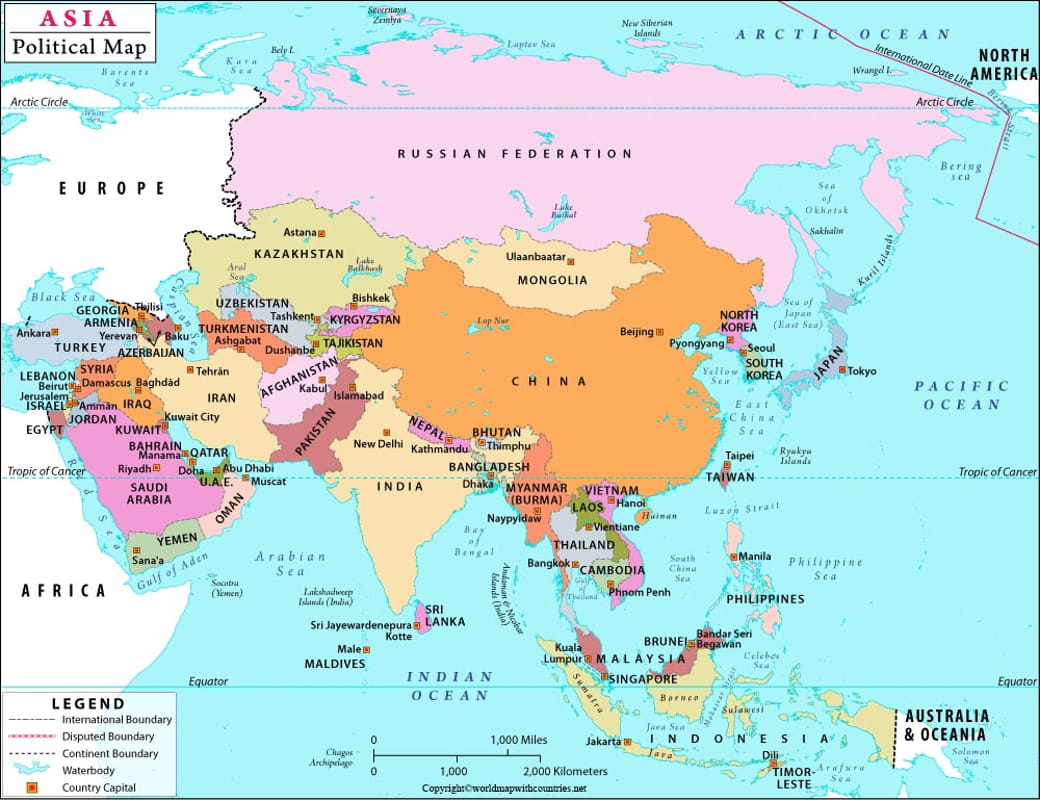
India’s considerable landmass and population mean that it will always be a significant participant in global discourse. The Indian peninsula, which narrows to the south and is surrounded on three sides by sea, has given it a rich maritime heritage and sustained engagement with South East Asia and the Gulf that continues to this day. Its continental neighbourhood, however, contains its biggest challenges, as India is hemmed in by China to its North and East and Pakistan to its North and West.
Adding to this challenge is the fact that while India’s maritime neighbourhood eastward to the Indo-Pacific contains several key allies of the US, its continental neighbourhood does not. Finally, the geographical features that form the boundaries of South Asia - the Hindukush and Himalayas to the North and the Indian Ocean to the South - ensure that India cannot take decisions in isolation. Its sustained quest for a place at the global high table frequently faces headwinds or requires New Delhi to divert its attention due to crises in the neighbourhood.
As a result, the planners of Indian foreign policy have, since the beginning, valued strategic autonomy. This was India’s choice - not, as some believe, merely because of the creation of the Non-Aligned Movement (NAM) after the Bandung Conference in 1955, but even before India’s independence, before the Cold War began, and before India’s first post-independence wars with Pakistan and China.
In an address to the Constituent Assembly in 1946, then Interim Prime Minister Jawaharlal Nehru first referred to the tenets that would guide independent India’s foreign policy. Broadly, India’s pitch to the rest of the developing world was three-fold: an aversion to bloc politics (non-alignment), solidarity with countries battling colonial, imperialist and racist powers, and India’s intention to speak up, and be the ‘voice of the voiceless’.
“We propose, as far as possible, to keep away from the power politics of groups, aligned against one another, which have led in the past to wars and which may again lead to disasters on an even vaster scale…. It is for this ‘One World’ that free India will work, a world in which there is the free cooperation of free peoples, and no class group exploits another,” Mr. Nehru said in his speech broadcast over All India Radio in September 1946.
A decade later, the Non-Aligned Movement was born, based on the Bandung Conference’s ten principles, which included respect for sovereignty and territorial integrity, equality, non-interference, as well as an adherence to the United Nations Charter.
As a founding member and leader of the Movement, India had a strong role in formulating these tenets. Over the next few decades, India was at the forefront of building groupings of countries with a similar post-colonial outlook. The establishment of the United Nations Conference on Trade and Development (UNCTAD) for developing nations in 1964, followed by the decision of Latin American countries to join African and Asian countries to create the Group of 77 (G-77 now includes 134 nations, but retains its original name) as well as the conception of the “Global South” and the need for “South-South Cooperation” were all expressions of India’s independence, non-alignment and strategic autonomy in foreign policy.
From Idealism to Realpolitik
Since that era, the global Non-Aligned Movement may have lost its relevance, but Indian non-alignment has survived, precisely because it has continuously evolved and adapted, giving Indian foreign policy more flexibility when required. In 1991, after the twin shocks to the market and energy supplies from the collapse of the Soviet Union and the Gulf War (the US invasion of Iraq) sent the Indian economy into a full spiral, Prime Minister P V Narasimha Rao took a number of steps that brought major changes to certain aspects of diplomacy - economic reforms, the ‘Look East’ policy, a renewed engagement with the US in a unipolar world, and the establishment of full diplomatic relations with Israel, and others. These steps were essentially driven by the need to diversify defence suppliers, secure energy supply chains, and shore up the economy, and rather than abandoning non-alignment, represented an assertion of India’s strategic autonomy.
“As classically formulated, Non-Alignment probably assumes a different significance from the one it had in the third quarter of our century,” said Former Prime Minister P V Narasimha Rao giving the Mahatma Gandhi Memorial Lecture in 1995 on ‘Gandhi in the Global Village’. “But as a principle of equity and sanity, which enabled the developing nations to speak with a voice of dignity in the fora of the world, Non-Alignment is as relevant today as it was when it was enunciated ... and pre-dated Indian independence,” Rao added.
The Gujral-Vajpayee-Singh era that followed was consistent in following the foreign policy trends that Rao began - a growing closeness with the US, growing concerns over China’s aggressive rise, a lower dependence on Russia, and attempts to keep improving ties in the neighbourhood and regional cooperation despite growing terror attacks backed by Pakistan.
A Detour from Non-Alignment
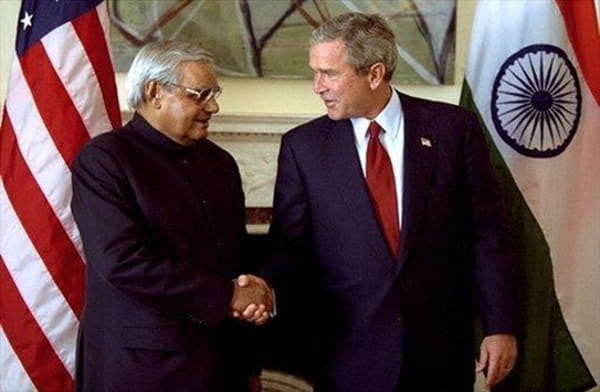
Indian Prime Minister Atal Bihari Vajpayee meets President of the US, George W Bush in New York on September 24, 2003. | White House/Paul Morse.
A declaration of change, came however, in 2014. Prime Minister Narendra Modi made it clear in the first few months of his tenure, that he would helm a more muscular, ‘realpolitik’ version of foreign policy, one that would engage more intensely with global powers as India would seek to be a “leading power”. Addressing the US Congress in 2016, PM Modi said that the “hesitations of history” in the India-US relationship had been overcome.
Later that year, Modi became the first Indian PM to miss the NAM summit, being held in Venezuela, a country at loggerheads with the US. In 2017, India also decided to zero out its oil imports from Iran and Venezuela under pressure from the US, and the US-India-Australia-Japan Quad was resumed, giving the impression that India was moving closer towards an alliance-like relationship with the US. India’s decision to sign three “Foundational Agreements” with the US on military cooperation - LEMOA (2016), COMCASA (2018) and BECA (2020) further added to this impression.
While distancing from non-alignment, PM Modi and External Affairs Minister Dr. S Jaishankar spoke now of the need for ‘multi-alignment’, or aligning to more than one power.
More recently, however, New Delhi has reverted to a stance less focused on alignment and more on autonomy, in a “multipolar world”. PM Modi has skipped all NAM summits during his tenure but has begun a new engagement pitching the “Voice of the Global South” and hosted a number of online summits, where most of the developing nations that attend are also members of the NAM, to discuss prevalent issues.
“Imagine if [India were] not today adopting strategic autonomy. Please tell me, which country in the world would you like to join up with and put our future in their hands?” External Affairs Minister S Jaishankar asked at a seminar recently. “I can’t think of anybody. [India’s] interest is best secured by maximising its options, maintaining its freedom of choices,” he added.
Five Shocks between 2020 and 2025
This turnaround has been affected by five developments spurring geopolitical turmoil between 2020-2025, that have changed India’s foreign policy considerations:
❖ The Covid Pandemic that wrecked India’s health security, as well as its dependence on supply chains, as nations turned more protectionist.
❖ China’s transgressions at the Line of Actual Control, Galwan clashes and the four-year military standoff that tested India’s conflict resourcing priorities away from the maritime to its continental conflicts.
❖ Russian invasion of Ukrainethat imperilled India’s food, fuel and fertiliser security and brought in heavy sanctions. Already hampered by its decision to give up cheaper Iranian oil, New Delhi is now considering the cost of giving up heavily discounted Russian oil as well.
❖ Israel’s destruction of Gaza after the October 7 attacks and the devastating impact of regional tensions on India’s connectivity plans over India–Middle East–Europe Economic Corridor (IMEEC), the India, Israel, the UAE and the United States (I2U2) grouping, use of Chabahar Port and the International North South Transport Corridor (INSTC) running through the region.
❖ Trump shock - a number of steps taken by US President Donald Trump in his second term - including 50% tariffs and trade bullying, closer ties with Pakistan, and plans for a “G-2” with China. Above all, as India launched Operation Sindoor in the wake of the Pahalgam terror attack, the US countered its narrative with claims of having mediated the ceasefire.
Conclusion
Each of these shocks has reinforced the message that India must continue to follow the original, albeit lonely path that the founders of the Republic decided on. Foreign policy may be about geography and other immutable factors, but strategy in Indian foreign policy must expand its options without narrowing India’s vision for its future.
In a world where global powers are themselves breaking the rules-based order and testing India’s security matrix and path towards prosperity for its people, strategic autonomy becomes less a choice than a necessity — almost a Hobson’s choice.
(Exclusive to NatStrat)
Separating Reality from the Rhetoric: Facts, Fiction, and the Indus Waters Treaty