

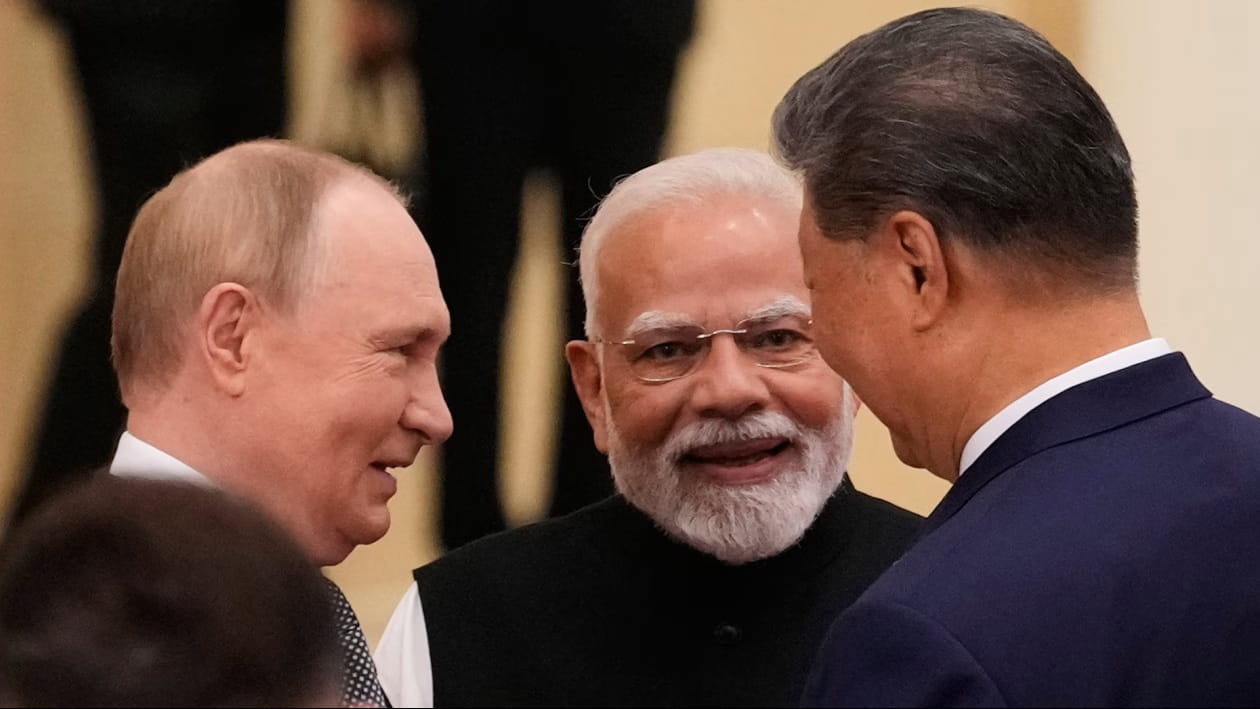
Russian President Vladimir Putin (left), Indian Prime Minister Narendra Modi and Chinese President Xi Jinping in Tianjin on September 1, 2025. | AP/PTI.
Introduction
It is generally acknowledged that global governance is under severe strain at present. Geopolitical and technological disruption, apart from climate risks, pandemics, and widening inequalities, are among several causes of this. How this will shape future developments is uncertain as of now, but that it certainly would, is without a shadow of doubt.
As 2026 beckons, a look at the world would confirm the premise that seldom has there been a period of greater flux in the global, specially the global security environment. The list of conflicts and tensions across the globe well confirms this hypothesis. 2026 could well-nigh set a new record for deaths in wars. The ongoing Russia-Ukraine conflict and the Israel-Hamas war have not abated and are continuing.
Lurking in the background are both ongoing and potential conflicts on the Horn of Africa, in Sudan, Ethiopia, Congo, Myanmar, Thailand-Cambodia, China-Taiwan and more. Consequently, the world may well need to look beyond the immediate present, to try to determine what shape the future will take. Concepts such as multipolarity and strategic autonomy are both set to play distinct roles in this regard.
The present period marks a profound transformation from the immediate post-1945 world, which had given rise to a ‘liberal unipolar movement’, presided over by the US. In the eight decades since, this unipolar world has had to give way to a more complex, competitive and fluid multi-polar environment. Concepts such as strategic autonomy – the ability to make policy decisions independent of undue external influence – and multipolarity have since gained in popularity and significance in this fluid situation.
Strategic Autonomy and Multipolarity
Strategic autonomy and multipolarity are very dissimilar, though they may contain certain common attributes, and accommodate some of the same ideas. Strategic autonomy is rooted in the principles of the original Non-Aligned Movement, and reflects a neo-modern pragmatic doctrine for navigating a multi-polar world. On the other hand, multipolarity lacks similar ideological clarity. While both strategic autonomy and multipolarity derive their roots from common civilisational beliefs and concepts, there are fundamental differences between the two. These are not merely differences of degree, but are more fundamental.
Strategic autonomy is a vibrant concept guiding policy and anchoring decisions in ways better suited to a differentiated world such as the one that exists today. Multipolarity lacks ideological coherence and is subject to changes in extant situations. It is, hence, quite unlike strategic autonomy. Multipolarity could, in some senses, appear akin to ‘tilting at the windmills’ when it comes to changes and shifts in the international arena.
The inherent weakness of a concept such as strategic autonomy is becoming increasingly evident today. Few countries practice strategic autonomy, viz., independently formulating and executing policies in alignment with their national interests per se. While it remains a prime objective, most nations find it difficult to avoid falling back on easier options such as multipolarity. This is specifically true of areas and concepts such as security and defence; technology and digital systems; foreign policy; and energy and critical supply chains. Geopolitical uncertainties greatly aggravate this situation.
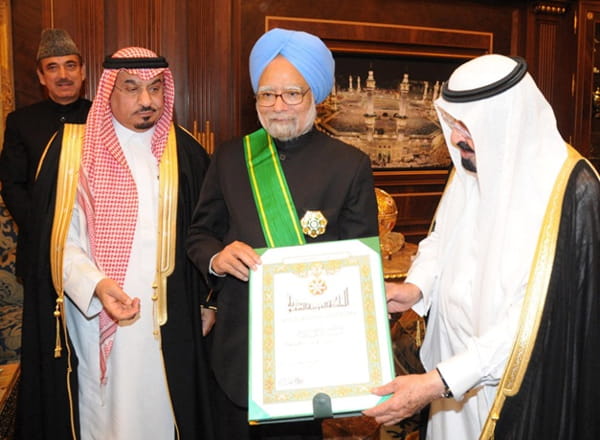
Indian Prime Minister, Dr Manmohan Singh felicitated by the King of Saudi Arabia Abdullah bin Abdul Aziz Al Saud, in Riyadh on February 28, 2010.
Currently, the most striking aspect of world affairs is the absence of a unified ideological framework, such as the one that previously existed under the label of a ‘Liberal World Order’, rebranded thereafter as the ‘Rules-Based Liberal Order’. The US played a leading role in this framework, and most of the rules were written and shaped by the West. Survival within the ‘Rules-Based Liberal Order’, however, depended on acceptance of US hegemony in world affairs. As US hegemony weakened and other powers emerged, the nature of the liberal world order underwent certain fundamental changes.
This has become even more apparent with the US, of late, pursuing a highly personalised, bilateral, and transactional foreign policy – in effect abandoning the unified ideological framework it had relied on for decades. Alongside this, and following the end of so-called US hegemony in global affairs, several other countries, notably China and Russia emerged in a leadership role.
China’s rise, in particular its rapid economic growth, military modernisation, technological developments in AI and cyber, and some of its global initiatives, has elevated it to near-peer status with the US. Russia, despite its economic constraints, has lately reasserted its influence through its military capabilities and energy diplomacy, and, notwithstanding the long-drawn-out Ukraine conflict, is a power to be reckoned with, at least in the regional context.
The decline of Europe, and of countries like the UK, has, meanwhile, become an evident sign of declining Western hegemony and influence. The rise of middle powers such as Turkey and India have accentuated this process of decline in Western hegemony. Technological diffusion, newer digital technologies, cyber capabilities, and AI tools have also reduced barriers of entry for power projection by many more powers across the world.
India and China represent two different poles in this respect. India emphasises a wider dispersion, preferring strategic autonomy in this respect to multipolarity to help manage and assist in its choices. China follows what could be termed the pursuit of comprehensive national power, independent of Western-controlled systems. Mid-level countries are currently seeking to exploit one or other framework, thus providing greater scope for multipolarity in contradistinction to strategic autonomy.
Conclusion
We are living in a hybrid world where a pluralistic global landscape is emerging, or has emerged, and coexists with older institutions. Neither, however, has the ability to impose its diktat on the other. With erstwhile global institutions declining in influence and capabilities, a global reordering is in the works. China is today an active actor and a provider of global public goods, benefiting from the decline of the US.
Other players, including some new regional actors, have emerged, but their ability to shape a more stable and cooperative global order is uncertain. Strategic autonomy and multipolarity are terms which are constantly being employed to denote policy choices; what is, however, evident is that while countries across the world are seeking new pathways of cooperation, global institutions continue to decline, and a global reordering has become essential.
In their effort to shape a more stable and cooperative world order, nations must, hence, explore more choices and demonstrate better flexibility. This is still a work in progress. Terms such as strategic autonomy and multipolarity used to explain or justify choices cannot cloak the fact that the world today is far more uncertain and unsure than at any time since the end of the Cold War in the mid-20th Century.
(Exclusive to NatStrat)
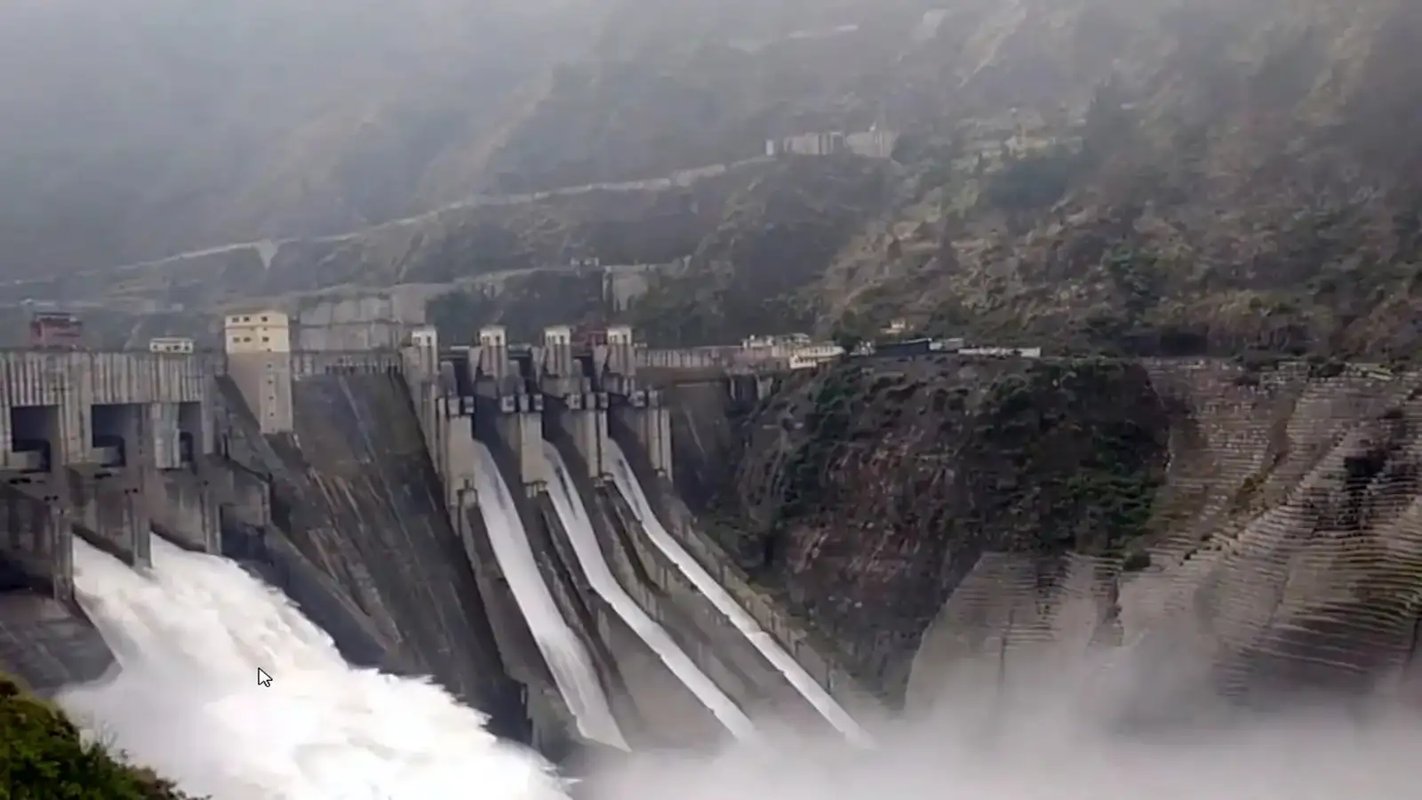
Separating Reality from the Rhetoric: Facts, Fiction, and the Indus Waters Treaty