


Representative image. | International Crisis Group.

Modern conflict has shifted from decisive war termination to bounded, continuous strategic competition, where escalation management, economic interdependence and legitimacy constraints are as decisive as military force.
The End of the WWII Strategic Template
The Churchill-Roosevelt model of war emerged from a unique era of total mobilisation, industrial supremacy and the possibility of unconditional victory. It was a strategy designed not merely to defeat adversaries but to break and reconstruct states.
Those conditions no longer exist.
The grand strategy of the Second World War combined coalition warfare, maritime blockade, strategic bombing and covert and proxy operations to achieve decisive political outcomes. It assumed that war could end in absolute terms: through the defeat, occupation and reconstruction of enemy states.
This essay argues that such a model has limited applicability in the contemporary international system. Modern conflict has shifted from decisive war termination to bounded, continuous strategic competition, where escalation management, economic interdependence and legitimacy constraints are as decisive as military force.
The Logic of WWII Strategy: Total Mobilisation and Decisive Ends
Allied strategy in the Second World War was built around coalition warfare, maritime and economic blockade, strategic bombing, and covert resistance networks across occupied territories.
These instruments were effective because they were ultimately designed to break states, not manage their endurance. The termination of war was not negotiated equilibrium but unconditional surrender and regime collapse.
However, this effectiveness came at extraordinary human cost. The Second World War involved tens of millions of civilian deaths across theatres, including famine conditions and systemic disruption of food and supply networks under blockade and wartime collapse. These outcomes were not incidental but structurally embedded in the logic of total war, where entire societies became legitimate targets of coercive strategy. The political acceptance of such costs defined that historical moment, and is no longer compatible with contemporary normative and legal constraints on the use of force.
The Post-1945 Order: Built on Total Victory
The post-war international order was not merely constructed after victory, it was made possible only because victory was total.
The United States, through figures such as George C. Marshall, implemented the Marshall Plan, combining economic reconstruction with geopolitical consolidation. In Japan, General Douglas MacArthur oversaw institutional redesign under conditions of unconditional surrender and state collapse.
The Bretton Woods system established the International Monetary Fund and World Bank, embedding a dollar-centric financial order. The United Nations system provided a framework for collective security while Western Europe was integrated into a US-led alliance structure.
These outcomes depended on a critical condition: defeated states had undergone systemic breakdown, enabling external reconstruction without meaningful resistance. That condition is no longer reproducible in most contemporary conflicts.
Why the WWII Model No Longer Holds
Four structural transformations have altered the character of war.
First, nuclear deterrence imposes absolute escalation ceilings between major powers. Second, global economic interdependence makes coercion mutually damaging. Third, information saturation and global media scrutiny constrain political and military action. Fourth, the experience of Iraq and Afghanistan demonstrated the limits of military superiority in producing stable political order.
As a result, even severe military asymmetry no longer guarantees decisive political outcomes.
Russia-Ukraine: The Contemporary Validation
The Russia-Ukraine War illustrates these structural constraints with particular clarity.
Despite sustained high-intensity warfare, partial mobilisation and extensive external support to Ukraine, the conflict has not produced a decisive political settlement. Instead, it has evolved into a prolonged and adaptive confrontation shaped by attrition, coalition support and shifting operational objectives.
Military force has not translated into political closure. Escalation management dominates strategic behaviour, shaped by nuclear deterrence and the avoidance of direct great-power confrontation. Economic warfare - through sanctions, energy disruption, and financial restrictions - functions as sustained pressure rather than decisive coercion. Information and narrative competition operate continuously alongside kinetic operations.
The result is a conflict defined not by termination but by managed strategic ambiguity, reinforcing the broader shift away from decisive war outcomes.
A Parallel Lesson for the United States
There is, within this transformation, a parallel lesson for the United States itself. Much of American strategic practice in the post-Cold War period implicitly retained elements of the WWII template: the assumption that overwhelming military superiority, coalition support, and technological dominance could reliably translate into political outcomes. Yet experiences from Iraq, Afghanistan, and more recently Ukraine-related escalation dynamics suggest that even the pre-eminent global power operates within tighter structural constraints than during the mid-20th Century. The United States retains unmatched capabilities but it too confronts the limits of translating battlefield dominance into stable political end-states in an environment shaped by nuclear deterrence, economic interdependence and contested legitimacy.
From Total War to Continuous Competition
These cases collectively indicate a structural transformation in the nature of conflict.
Where WWII represented terminal war aimed at decisive victory, contemporary conflict operates as continuous competition under constraint. The boundary between war and peace has blurred into hybrid domains: cyber operations, economic coercion, proxy warfare and information strategy.
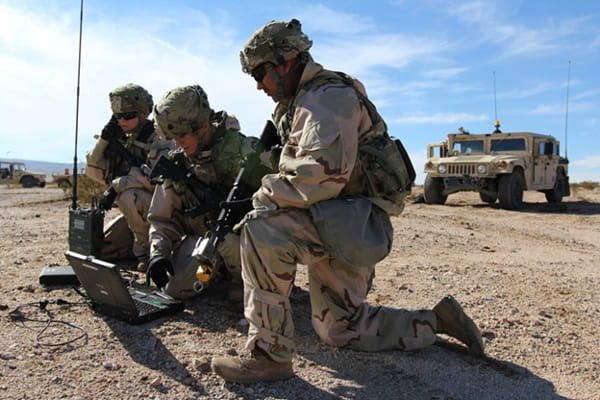
US Army cyber warfare specialists, 2019. | US Cyber Command.
In this environment, victory is rarely absolute. States pursue limited and adaptive objectives: deterrence, denial, resilience and incremental advantage. Conflict becomes a condition to be managed rather than resolved.
Implications for a Hypothetical Iran Confrontation
A hypothetical confrontation involving Iran further demonstrates these limits.
Even overwhelming military superiority would not guarantee political resolution; it would more likely transform the conflict into a prolonged equilibrium of coercion, retaliation and containment. Regional escalation risks, asymmetric responses, and energy market disruption would constrain strategic options.
As in other contemporary conflicts, the central challenge would not be battlefield success but the absence of a stable political endpoint.
Lessons for India: Strategy in a Multipolar Era
India’s key takeaway goes beyond merely adjusting to global changes; it must also realise that profound geopolitical shifts are no longer driven by single, major wars or sweeping overhauls of the global order.
Achieving long-term geopolitical success will require continuously building national strength by developing a robust industrial base, ensuring reliable energy, becoming technologically independent and securing dependable supply networks.
Naval strategy in the Indian Ocean must focus on securing vital sea lanes of communication and countering enemy influence rather than territorial dominance. Diplomatically, strategic autonomy must be balanced with adaptable alliances with different rival global powers.
Information and narrative capability has to be considered as an instrument of power rather than a
Controlling information and shaping global narratives must be viewed as essential forms of national power rather than as secondary tools. Global influence will not come from completely rebuilding the world order; rather, it will develop by slowly molding existing institutions and maintaining continuous diplomatic efforts.
However, the breakdown of the global system established after the Second World War also presents new advantages. As global power becomes distributed among nations like the US, China, India, Russia and various middle powers, India is in a strong position to help design new models for international partnerships and rules. As Indian External Affairs Minister Dr. S. Jaishankar has observed, “multiple poles provide multiple opportunities.”
The aftermath of the Second World War and the Cold War still influences Western strategic institutions through their intellectual and institutional legacy. India’s absent historical commitments to traditional alliances allows it to enter the emerging multipolar world order with a clean slate, ready to establish new mechanisms of international coordination.
Instead of trying to revive the system built after World War II, India can host dialogues between global powers, much like the foundational talks that birthed the UN but adapted for today’s world. The ancient Nalanda University serves as a perfect symbol for this: not just as a historical landmark but as a model for sharing ideas across different cultures and political systems. In our currently divided world, this tradition of open dialogue is becoming a highly valuable strategic tool.
Power, Constraint and Order
This transformation can be understood through the intersection of realism, liberal institutionalism and strategic theory.
Realism remains relevant in the persistence of power competition. Liberal institutionalism highlights how economic interdependence and institutions constrain the use of force. Strategic theory emphasises the shift from direct decisive engagement to distributed, indirect and adaptive forms of coercion.
Even during the Cold War, exemplified by strategies such as containment as articulated by George F. Kennan, conflict increasingly shifted away from direct decisive confrontation toward managed, indirect competition under nuclear constraint. The Cold War thus appears not as an extension of WWII logic but as an early transition phase toward the structurally constrained system that defines contemporary international relations.
Together, these perspectives suggest a system in which power remains central but its expression is increasingly mediated by structural and normative constraints.
From Victory to Management
The Churchill-Roosevelt model of war emerged from a world where decisive victory was possible, adversaries could collapse entirely, and new international systems could be constructed through post-war reconstruction.
That world has ended.
The contemporary international system is defined by nuclear deterrence, economic interdependence and informational saturation. Within it, war has shifted from a mechanism of termination to a condition of managed persistence.
The central challenge for states today is no longer how to win wars in the classical sense but how to operate effectively in a world where conflict is continuous, outcomes are partial and escalation is constrained.
In such a system, power still determines hierarchy but no longer guarantees finality.
(Exclusive to NatStrat)
Separating Reality from the Rhetoric: Facts, Fiction, and the Indus Waters Treaty