

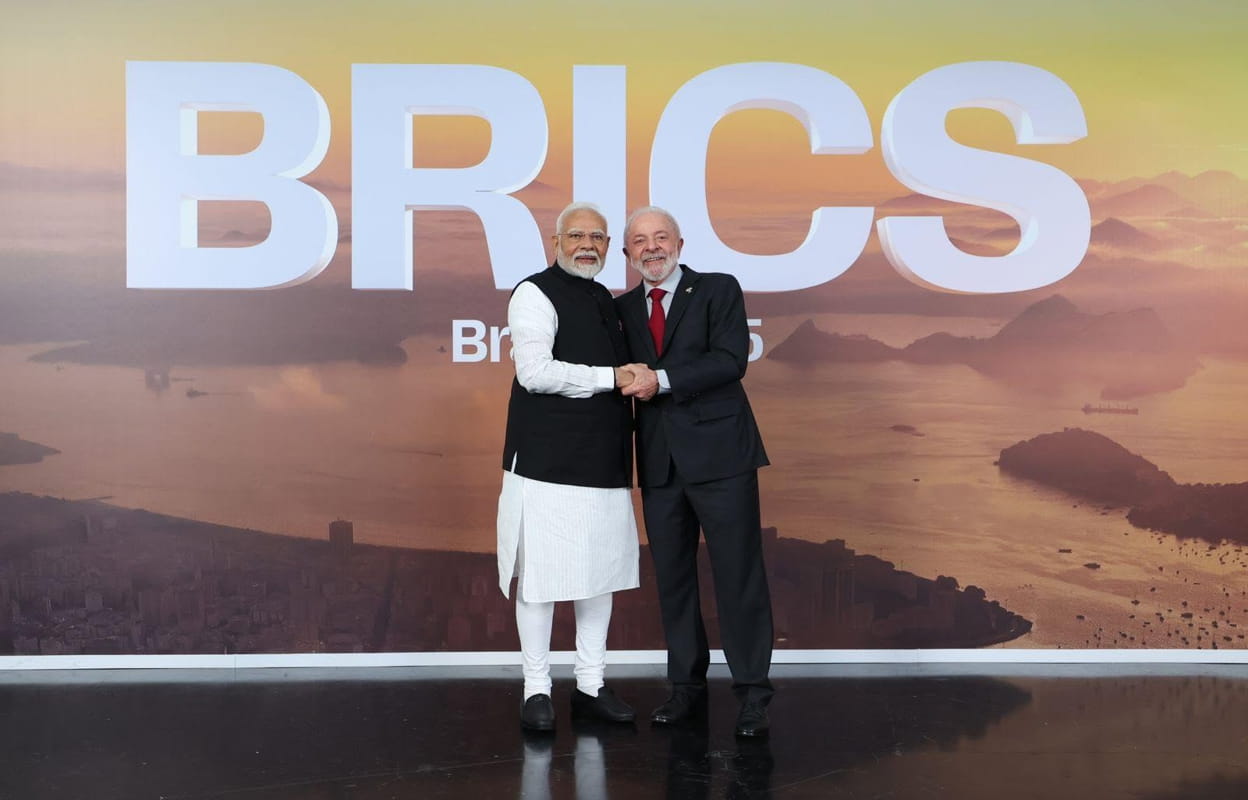
Indian Prime Minister Narendra Modi meets Brazilian President Luiz Inacio Lula da Silva at the Museum of Modern Art to participate in BRICS Summit, in Brazil on July 6, 2025. | News Arena India.

BRICS enables India to engage with major non-Western powers without entering into formal alliances. By maintaining a non-Western rather than an anti-Western posture within BRICS, India is able to simultaneously deepen partnerships with Western countries while adhering to its policy of multialignment.
Strategic Autonomy and Multilateralism
After successfully hosting the 2023 G20 Summit, India has assumed the presidency of another important multilateral institution, BRICS, in 2026 for the fourth time, having previously hosted the BRICS summits in 2012, 2016, and 2021. Multilateralism has been a key feature of India’s foreign policy, through which New Delhi seeks to balance its national interests with its global commitments as a responsible rising power.
There have been three distinct phases in the evolution of multilateralism in India’s foreign policy. The first phase (1947–61) was marked by universalism, idealism, and morality. In the second phase (1961–91), India opted for the creation of parallel institutions to the UN, such as the Non-Aligned Movement (NAM) and the G-77. The third phase began with the end of the Cold War in 1991, during which India embraced organisations such as the G20, BRICS, the Quadrilateral Security Dialogue (Quad) and the Shanghai Cooperation Organisation (SCO), reflecting the onset of multialignment in India’s foreign policy.[1]
This evolution also highlights India’s desire, as an emerging power, to exert its influence at the multilateral level, in contrast to newly independent India, whose multilateral strategy was more defensive in nature.[2] India’s strategic autonomy is deeply embedded in its policy of multilateralism as it enables India to participate simultaneously in diverse multilateral forums such as BRICS and the Quad, primarily to safeguard its national interest without getting entangled in alliance commitments.
This approach helps India enhance its strategic autonomy by building flexible, interest-based coalitions. Thus, multilateralism becomes a tool to preserve and expand India’s strategic autonomy. At the same time, multilateralism provides India with an opportunity to foreground issues that are important for the Global South. India’s Global South identity provides moral foundation and legitimacy to its strategic autonomy[3] and both are mutually reinforcing.
Compared to Shanghai Cooperation Organisation (SCO), the other international institution where India and China are members, BRICS is better positioned to promote India’s strategic autonomy. SCO has a narrow agenda, mainly focused on security issues and is regional in its approach. In comparison, BRICS is global in outlook with a wider agenda including issues of the Global South and reform of global institutions. Power is more diffused within the BRICS unlike the SCO where China’s influence is more pronounced due to lack of members which can balance Beijing. Hence, BRICS facilitates better flexibility and strategic autonomy for India.
Non-Alignment, Multialignment and the Emergence of BRICS
Both the Non-Aligned Movement and BRICS are examples of multilateral groupings in which India has been a founding member; however, there are key differences between the two. The Non-Aligned Movement was primarily about navigating Cold War geopolitical rivalry between the United States and the former Soviet Union, at a time when newly independent India lacked the capacity to influence global events.
In contrast, through BRICS, a rising and confident India, in concert with other major powers, seeks to shape the agenda of global governance. The presence of two veto-wielding countries—Russia and China—within BRICS gives the grouping greater leverage in global governance matters, unlike the Non-Aligned Movement, which consisted largely of newly independent states.
In addition, non-alignment was influenced significantly by ideology, whereas in BRICS, it is shared interests among member states that bind the grouping together. It is also pertinent to note that BRICS membership allows India to de-hyphenate itself from the India–Pakistan binary, projecting India as a responsible global power with interests extending beyond South Asia.
When BRICS was established in 2010 (BRIC was formed in 2009 which became BRICS after South Africa joined in 2010) coincided with an early phase of India–US strategic convergence. As highlighted by Ambassador Shyam Saran in this edition, it was important to convey that India would not align with the United States on all issues. The Left parties argued that India would risk losing its strategic autonomy due to the India–US civil nuclear deal.[4] In response, the Indian government clarified that India would not compromise its decision-making independence and would continue to uphold its strategic autonomy.[5]
It was in this context that India articulated the policy of multialignment, a strategy aimed at forging and managing shifting coalitions of interests, requiring skilful handling of complex relationships and emerging opportunities. Multialignment addresses India’s dilemma of reconciling strategic autonomy with closer engagement with major powers.[6] For India, the objective has been to leverage relationships with rival blocs and diverse groups of countries to advance its national interest.
As the India–US nuclear deal marked the beginning of closer strategic and economic ties between India and the West, New Delhi’s continued participation in BRICS signalled its intent to maintain parallel relationships with non-Western countries, thereby safeguarding and strengthening its strategic autonomy.
BRICS and India’s Strategic Autonomy
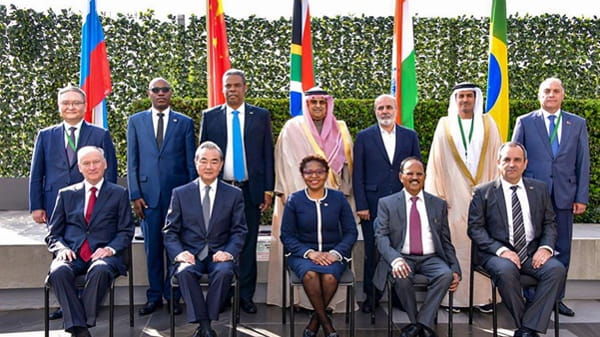
Indian National Security Advisor Ajit Doval (2nd from right, sitting) with other BRICS National Security Advisors in Johannesburg, South Africa, on July 24, 2023. | PTI.
BRICS expands India’s institutional, economic, and diplomatic options in an increasingly uncertain global order and, in doing so, reinforces India’s strategic autonomy.
❖ Global Governance Reform: BRICS provides a platform through which India advocates reforms of global governance institutions, including the UN Security Council (UNSC), the World Bank (WB), and the International Monetary Fund (IMF). There are internal divisions within BRICS members over the issue of UNSC reform which prevents decisive action in this regard. However, for India, BRICS membership helps to keep the UNSC reform on global agenda, mobilise international support and shape global opinion. A permanent seat on the UNSC would significantly strengthen India’s strategic autonomy by enhancing its voice in global decision-making and foreign policy independence.
❖ Non-Western Identity: BRICS underscores India’s identity as a ‘non-Western’ rather than an ‘anti-Western’ power. This distinction reflects India’s desire to maintain constructive relations with the West, with BRICS serving as a platform for cooperation rather than confrontation. India has consistently resisted unnecessary anti-West rhetoric within BRICS, emphasising that the grouping is not a formal alliance but an informal and flexible arrangement. This flexibility allows India to balance relationships across geopolitical divides without formal alignment, thereby preserving its strategic autonomy.[7] Even during BRICS expansion, India has remained cautious that the grouping should not evolve into an anti-West platform dominated by China[8]; as such an outcome would constrain India’s flexibility and freedom of action.
❖ Alternative Financing Mechanism: The New Development Bank (NDB), proposed under the BRICS framework, serves as an alternative financing mechanism for India’s sustainable development and infrastructure needs. The NDB has approved loans worth approximately USD10 billion for 28 major infrastructure projects in India, including Namo Bharat high-speed trains, metro rail projects in Mumbai, Indore, and Chennai, and the Delhi–Ghaziabad–Meerut Regional Rapid Transit System.[9] Unlike loans from Western-dominated institutions such as the WB and IMF, NDB financing does not carry stringent conditionalities, thereby expanding India’s economic autonomy and bargaining power.
❖ Facilitates Multialignment: BRICS aligns well with India’s multialignment strategy by enabling engagement with major non-Western powers, including Russia, China, South Africa, and Brazil, as well as newer members such as Saudi Arabia, Egypt, the UAE, Ethiopia, Indonesia, and Iran. Simultaneously, India sustains strong ties with the West through platforms like the Quad, G20, and G7 outreach mechanisms. This approach facilitates strategic diversification without excessive dependence on any single partner.
❖ Normative Influence: BRICS enhances India’s agenda-setting capacity and normative influence, allowing New Delhi to shape debates on global governance reform, digital public infrastructure, and the priorities of the Global South. This positions India as a rule-shaper rather than a passive rule-taker. Despite the fact that Russia and China would want to shape BRICS into a geopolitical rival to the West, India has consistently sought to align the BRICS agenda with Global South priorities.
This reflects India’s strategic autonomy in BRICS despite great power pressure. Here, India is able to cast itself as a bridge between the West and the East and aligns its strategic autonomy with the global responsibility to ensure that the interests of the Global South are protected.
❖ Independent Engagement with China and Russia: India’s engagement with both China and Russia through BRICS exemplifies its strategic autonomy. Despite ongoing tensions with China, New Delhi still maintains a working relationship with Beijing. India remains comfortable utilising NDB-funded infrastructure projects, even as China plays a significant role in the institution.[10] A similar approach is evident in India’s engagement with Russia: while India has neither condemned nor supported Russia’s actions in Ukraine, it has consistently emphasised dialogue and diplomacy. At the 2024 Kazan BRICS Summit, India reiterated its position in favour of peaceful resolution rather than war.
Conclusion
The US was always critical of BRICS, however, its hostility towards the group has acquired a new edge with US President Donald Trump threatening BRICS countries with a hundred percent tariff if they take steps towards de-dollarisation. This is despite the fact that the biggest expansion of BRICS took place just a year before he was sworn in. Regardless of this, India is going ahead with preparations to host the next BRICS Summit in India in 2026.
Trump’s threats are unlikely to put a stop to BRICS’s activities or its continuation as a grouping, but they will make many of its members more cautious about moving away from the dollar. As far as India is concerned, it is not an advocate of de-dollarisation, unlike Russia or China. India has also been quite clear that BRICS is not a political, let alone military bloc against the United States. It has major stakes in preserving its ties with the US and will not jeopardise them for gains that are less than certain.
India has taken over the BRICS Chairship in 2026. In the words of India’s External Affairs Minister Dr S Jaishankar, BRICS has “evolved into a significant platform for cooperation among emerging markets and developing economies.” India approaches its BRICS Chairship with a ‘humanity first’ and a ‘people-centric’ approach. India’s theme - "Building for Resilience, Innovation, Cooperation and Sustainability”- underscores the importance of strengthening capacities, promoting innovation, and ensuring sustainable development for the benefit of all”.
BRICS enables India to engage with major non-Western powers without entering into formal alliances. By maintaining a non-Western rather than an anti-Western posture within BRICS, India is able to simultaneously deepen partnerships with Western countries while adhering to its policy of multialignment.
Its broader strategic challenges with China impose limits to how much cooperation is possible within the BRICS framework. Despite the many contradictions, BRICS will continue to be a vital element of India’s foreign policy and exercise of strategic autonomy. It is in that sense a good example of India balancing its different relationships as it emerges as a power in the coming years.
(Exclusive to NatStrat)
Endnotes
Separating Reality from the Rhetoric: Facts, Fiction, and the Indus Waters Treaty
Hedging Without Punishment: Vietnam, India, and the Unequal Burden of Strategic Autonomy