

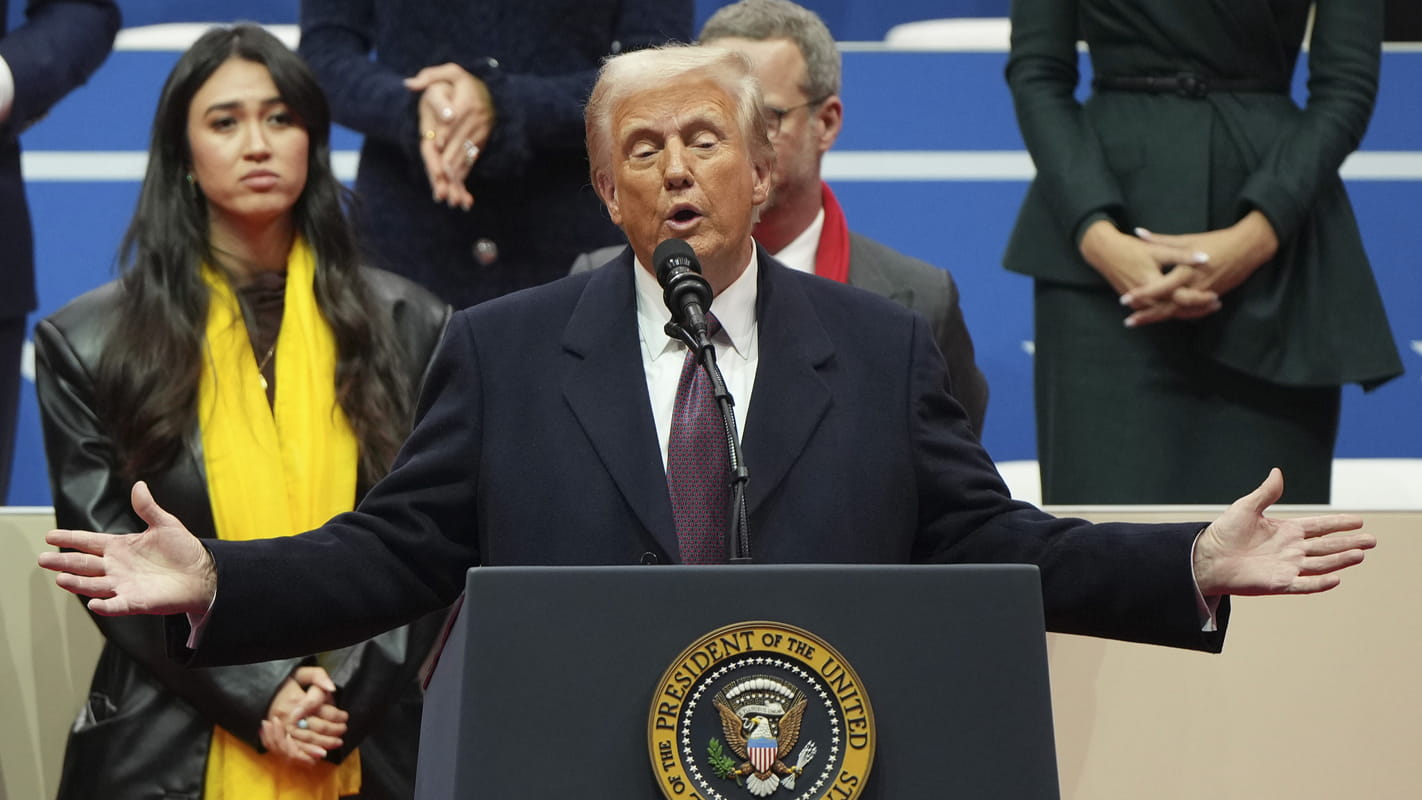
President Donald Trump at a Presidential Inauguration in Washington DC. | Associated Press.
Facing rising competition from #China and mounting fiscal constraints, the Trump Administration pursued strategic retrenchment by shifting more defence responsibilities to allies, reducing some overseas commitments, and concentrating resources on sustaining US military superiority.
The United States, which emerged from the Second World War as a global superpower, remains the only superpower even after more than eight decades of the post-war era. Its strategic cohort – the Soviet Union – collapsed in December 1991. Although China has risen as a credible challenger to the United States, it is yet to be regarded as a global superpower.
Through decades of the Cold War between the United States and the erstwhile Soviet Union, the former maintained an enormous edge over the latter in terms of economic wealth and technological prowess. However, the fast-expanding Soviet political influence in different parts of the globe prevented the United States from claiming a global presence and kept it engaged in Cold War confrontations.
The US ambition to be a global hegemon was dashed when it could not win the Korean War, lost the Vietnam War, and had to roll back its military presence in Iran after the Islamic Revolution in 1979. The Vietnamese military intervention in Cambodia in 1978, the Soviet military intervention in Afghanistan in 1979, and the Sandinista Revolution in its strategic backyard, Nicaragua, in 1979 were some developments that exemplified the American retreat from global affairs and punctured its hegemony.
Origins of American Strategic Retrenchment
US strategic planners, however, while anticipating the approaching changes had begun to implement a policy of strategic retrenchment in late 1960s and early 1970s. The Nixon Doctrine called for Asian allies to assume responsibility for their defense; Kissinger’s secret visit to China in the late 1960s to begin a process of Sino-American détente and the US-USSR détente in the early 1970s set the stage for American strategic retrenchment. This era also witnessed efforts to promote arms control agreements to cut defence budgets.
There were apprehensions that the strategic void created by US retrenchment would be filled by its adversaries and that US allies could shift their alignments and befriend rival countries. Alternatively, some allies could lose their trust in US security commitments and could search for new partners. However, none of these apprehensions turned out to be accurate. The Soviet intervention in Afghanistan sparked a new round of Cold War and US alliance systems began to work against the Soviet military presence.
What is noteworthy is the fact that Communist China had embarked upon a series of reforms about a year before the Soviet troops marched into Afghanistan in 1979. These reforms slowly enabled China to keep its doors open for trade and business with the outside world. China was not yet a power that could challenge the United States. Beijing had fallen out with the Soviet Union. Consequently, Sino-American détente paved the way for all US allies to open economic engagement with China. Over the subsequent decades, China’s rapid economic and military rise fundamentally reshaped the strategic environment and revived debates over the global role of the United States.
Trump and the Return of Strategic Retrenchment
When President Donald Trump entered office for the first time in 2017, there was already an ongoing debate about the relative decline of the United States, China was perceived as a fast-emerging superpower, and then there was a noticeable “rise of the rest” in the global power hierarchy. The imperial overstretch of the United States was remarkably visible in the Global War on Terror (GWOT), the US war against the Taliban in Afghanistan showing no sign of victory and the negative consequences of US military intervention in Iraq and the withdrawal of US troops from Iraq in 2011. Trump’s predecessor, President Barack Obama, had already begun a process of strategic retrenchment reflected in his ‘pivot to Asia’ policy.
Trump’s policy of ‘America First’ during his first term which continued under his current term in office has appeared to be a kind of retrenchment from globalism. It encompasses both domestic policy and foreign policy and it aims at prioritising policies that would give more emphasis to US interests and less on promoting liberalism abroad. When President Trump led the MAGA (Make America Great Again) movement, it was clear that he and his advisors were convinced that the United States had lost its greatness largely due to the policies of several of his predecessors.
In the face of increasing competition and rivalry from China, and the inability of the US to financially sustain its global presence and security commitments, the Trump Administration seems to have adopted a policy of strategic retrenchment, where it would demand greater defence expenditure and responsibilities from allies, draw down US presence and commitments in some regions and strengthen its involvement in core areas; and simultaneously generate funds to sustain the strongest military in the world.
Policies aimed at reducing the foreign policy budget, downsizing the foreign policy bureaucracy, reducing US diplomatic staff from various embassies, closing United States Agency for International Aid (USAID) and cutting down foreign assistance programmes are all indicative of American strategic retrenchment.
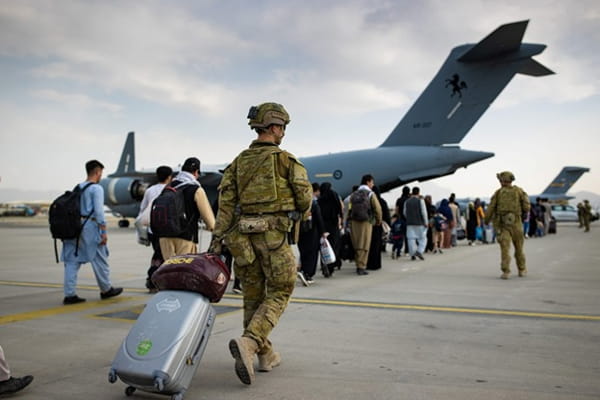
US withdrawal from Afghanistan, August 2021. | Atlantic Council.
In December 2025, the Trump Administration released the National Security Strategy Report and in January 2026, it released the National Defense Strategy. Even a cursory glance at these reports can draw one’s attention to the intention of the Trump 2.0 presidency to give effect to strategic retrenchment. A careful reading of these two documents makes it amply clear why the Trump White House has undermined the importance of NATO, pressured NATO members for enhancing their respective defence expenditures to the tune of five percent of GDP, threatened the reduction of US troops from the region and made unfriendly and offensive remarks against the organisation altogether.
Likewise, President Trump’s disinterest in the QUAD, the recent change in the name of the US Indo-Pacific Command to the Pacific Command, repeatedly asking Japan and South Korea to increase their defence expenditure and hinting at limiting US security commitments in the region can better be understood in the light of President Trump’s inclination towards strategic retrenchment.
Strategic Retrenchment is not Strategic Retreat
Significantly, this policy of strategic retrenchment should not be confused with the inability of the United States to get involved in world affairs. It is not isolationism. It is not a reflection of a weak United States. It is not ceding areas of influence to adversaries and rivals. It is aimed at curtailing expenditures that do not serve US interests, at least in the short run. President Trump has faulted his predecessors for adopting policies that bring no financial benefits to the country and are based on belief that all those policies would safeguard long-term national interests of sustaining the country’s global hegemony. Trump is well-disposed towards short-term gain for the country and he seems to be convinced that the allies and strategic partners of the United States have taken advantage and are responsible for its relative decline.
By reducing the level of US security commitment in Europe and nudging NATO members to assume greater burdens and responsibilities, Trump does not appear to be actually interested in withdrawing from European geopolitics. He has threatened to reduce US troops from Germany but has shown interest in enhancing military presence in Poland. The US Department of War recently responded positively to the Polish Government’s request for a permanent American military presence in Poland.
By giving inadequate attention to the QUAD, dropping the word ‘Indo’ from the Indo-Pacific Command, and showing little interest in actively participating in the recent Asia-Pacific Economic Cooperation (APEC) Summit in South Korea, Trump seems to have a reduced interest or commitment to the peace and stability issues in the Indo-Pacific. But in reality, his deep interest in the Indo-Pacific region is spelt out in greater detail in the National Security Strategy Report of 2025. In the Trump Administration’s priority list, the Indo-Pacific assumes greater importance than Europe! America’s economic lifeline passes through the Indo-Pacific region and the future prosperity of the United States is conditional upon peace and prosperity in this region.
At the moment, the big picture of Trumpian foreign policy appears to be picking fights with allies and partners on economic as well as security issues and pursuing mollifying policies towards adversaries and rivals. Trump’s outreach to China to establish ‘strategic stability’ and conciliatory approach towards Russia are tactical measures. In addition, President Trump has withdrawn US membership in scores of international organisations, sidelined the United Nations and bypassed the World Trade Organization in trade and tariff policies. All such policies are aimed at buying time, enriching the United States and maintaining the strongest ever military and technological dexterity of the United States.
As part of the strategy to Make America Great Again and run a global hegemonic order, the Trump Administration has signalled the world that its strategic retrenchment should not be read as the country’s retreat from global affairs. His tariff war against the rest of the world highlights the economic leverage of the US in the global political economy.
His unchallenged demonstration of unilateralism is reflected in kidnapping the head of state of Venezuela and bringing him to New York to be tried under American law, his threats to Colombia and Cuba to toe the American line or risk a regime overthrow; his repeated desire to take over Greenland, and his military strikes against half a dozen countries and heavy bombardment of Iran do not indicate the strategic retrenchment of a superpower in the literal sense.
[The article is exclusive to NatStrat. The views expressed by the author(s) are personal and do not necessarily reflect the views of the organisation.]
Separating Reality from the Rhetoric: Facts, Fiction, and the Indus Waters Treaty