

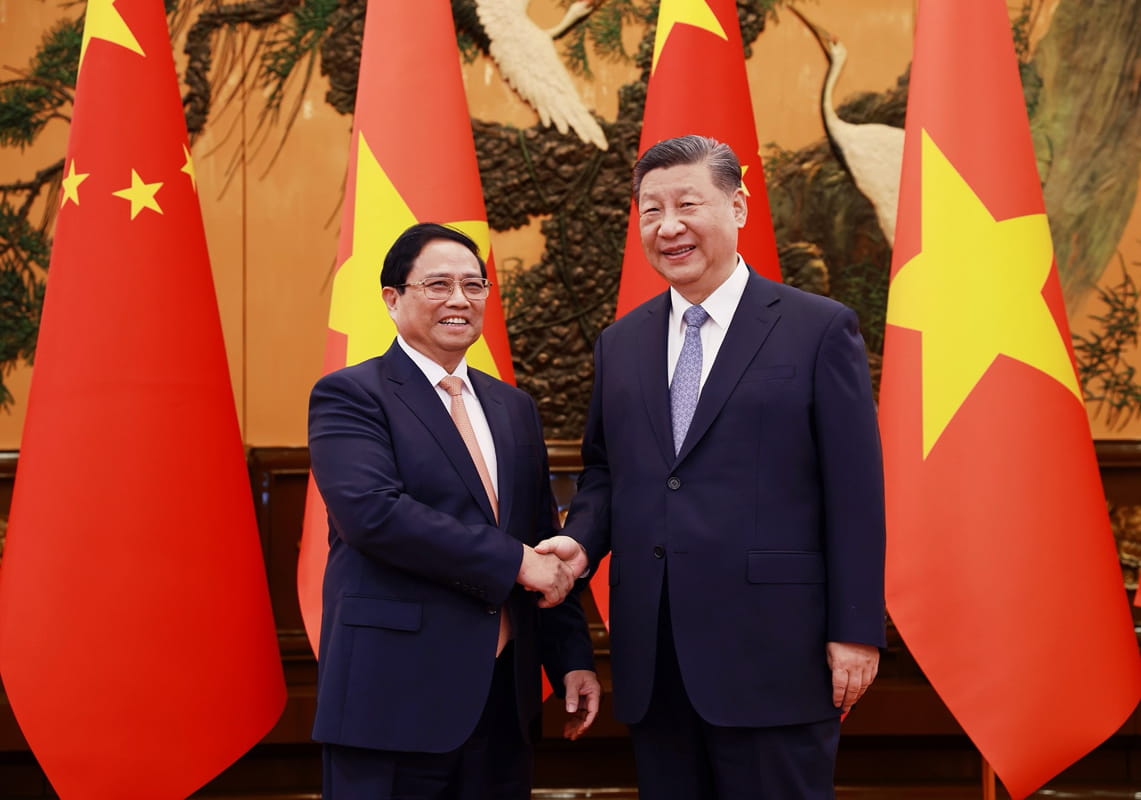
Prime Minister of Vietnam, Phạm Minh Chính (left) meets President of China Xi Jinping in Beijing on June 27, 2023. | VGP.

While Vietnam leverages ASEAN to diffuse tension and risks, India operates largely alone as a continental and maritime power. Moreover, India’s limited ability to translate diplomatic posture into sustained capability accumulation has remained uneven. This weakens the material foundation of its autonomy. Therefore, India’s policy space is narrowing not because its doctrine is flawed, but because its structural position generates expectations that its material power has not yet fully matched.
Introduction
The international order is undergoing a profound, if quiet, transformation as the unipolar moment of American preponderance gives way to a fragmented multipolar system. At the core of this shift lies China’s rise and the intensifying great-power competition between the United States and China. Yet this structural contest has also enabled Russia’s renewed revisionism and exposed deep political and strategic fractures within the Western world, further aggravated by Washington’s growing unpredictability. Together, these dynamics have eroded the security assurances that once flowed from established partnerships, compelling states to seek alternative hedging strategies without overtly destabilizing the existing balance of power. In such an environment, strategic foresight, resilience, and a calibrated form of strategic autonomy have become essential for states seeking not merely to survive between two competing poles but to operate effectively within their shadow.
Two prominent examples of functional strategic autonomy are India and Vietnam. Yet despite their broadly similar multi-alignment instincts, the two countries elicit strikingly different responses to the exercise of this strategy as a long-term bulwark against great-power rivalry. This divergence makes it especially important to examine how Vietnam has navigated its dense and often contradictory network of external partnerships with relative success, even as India confronts growing contestation and constraints in pursuing a comparable path.
Strategic Autonomy as Process, Not Posture
“Strategic autonomy” is one of the most invoked and misunderstood concepts in contemporary foreign policy debates. It is often understood as a posture of equidistance, i.e. having multiple partners while avoiding formal alliances and preserving independent decision-making. Critics argue that managing too many contradictory partnerships may lead to discontent over alignment choices, while proponents promote the fluidity it allows.
The term, however, is better understood as a process rather than an end state. At its core, it implies:
❖ Independent decision-making, free from external compulsion.
❖ Diversified partnerships across competing power centres.
❖ Capability accumulation, which strengthens bargaining power and reduces vulnerability.
Autonomy, here, is not a posture of withdrawal or neutrality but of choice anchored in capacity. It occupies the middle ground between rigid bloc politics and passive neutrality. The success of this delicate balancing act depends on astute diplomacy, systematic resilience and a clear long-term goal to pursue.
Strategic autonomy is therefore not an easy choice, especially in the current world order. Mishandled, it can leave a state politically exposed and strategically isolated. Its successful execution demands foresight, diplomatic finesse and agility in managing partners at crossroads with one another.
Vietnam’s Strategic Hedging
It is not the first time that Vietnam has found itself wedged between great powers, balancing and navigating. It remains one of the few countries in modern history to have fought both the United States and China.
During the Cold War, Vietnam aligned itself closely with the Soviet Union, which progressively worsened its relations with China and ultimately led to the invasion of 1979. Yet China was not always an adversary. It aided[1] Ho Chi Minh’s 1954 war of independence against the French by supplying arms. The support deepened in 1964, when China provided both troops and economic support to North Vietnam in its war against the United States.
The 1979 Chinese invasion was driven explicitly by geopolitical calculations. By then, China had normalized relations with the United States in 1971, while Vietnam invaded Cambodia, overthrowing the China-backed Pol Pot regime. The invasion thus served as a blunt reminder that Vietnam’s geographical constraints would stymie its ideological connections.
Simply put, China sought to impose control over its smaller neighbor, Vietnam, an impulse captured in Deng Xiaoping’s remarks[2] to then US President Jimmy Carter, “When a child misbehaves, he needs a spanking.” Through this war, China simultaneously appeased the US, scored a political victory over the Soviet Union, and taught a bloody lesson to Vietnam. For Hanoi, it was clear that it was expendable in the great power game. Vietnam thereafter pursued a very careful approach to great power politics.
Vietnam’s contemporary foreign policy rests on three pillars: the Four No’s, bamboo diplomacy and ASEAN centrality. The Four No’s commit Vietnam to no military alliances, no foreign intervention, no foreign military bases, and no intervention in other countries. The Bamboo diplomacy dictates[3] that, ‘like a bamboo, Vietnam should glide along with changing “winds” and adapt pragmatically to shifting regional and international “gusts” without breaking, and remain resilient.’ Together, these principles enable a multi-vector alignment that sustains close relations simultaneously with competing powers like China, Russia and the United States. Complementing this, Vietnam’s adverse security environment pushed it to promote collective security under a united ASEAN, prioritizing ASEAN centrality in the regional matters
From Rhetorical to Active Hedging
The success of Vietnam’s strategic autonomy is evident in its growing diversification of defence partnerships beyond the traditional supplier Russia,[4] to include Israel,[5] South Korea,[6] India,[7] the US,[8]Japan,[9] and European nations (France,[10] Netherlands[11]). Hanoi has leveraged these partnerships, particularly to strengthen naval capacity, and upgrade defence technology and enhance maritime surveillance. These efforts accelerated after the United States lifted its arms embargo in 2016 and signed a Comprehensive Strategic Partnership in 2023.
Vietnam’s hedging strategy against the Chinese expansion is most clearly reflected in its acquisition of coastal and maritime security assets. These include Russian submarines (Kilo-class) with Klub missiles, Gepard frigates, and Svetlyak patrol crafts; Pohang corvettes from South Korea; as well as coast guard cutters, drones, and patrol boats, sourced from multiple partners. In parallel, Vietnam has also undertaken extensive island reclamation and fortification activities in the disputed Spratly Islands. To date, it has militarised[12] 21 islands and is on track to surpass[13] China.
Simultaneously, Vietnam has deployed a broad array of institutional, economic and legal instruments to expand its strategic flexibility:
❖ Independent decision-making, free from external compulsion. Free Trade Agreements and Regional Economic Partnerships– the Comprehensive and Progressive Agreement for Trans-Pacific Partnership (CPTPP, 2018), EU-Vietnam Free Trade Agreement (August 2020); Regional Comprehensive Economic Partnership (RCEP, 2022), embedded Vietnam in regional supply chains and economic flows.
❖ Domestic legal measures like the Cybersecurity Law,[14] 2018 and maritime-domain laws like the Law on Vietnam Coast Guard, 2019,[15] strengthened regulatory control, digital sovereignty and maritime governance.
Vietnam’s foreign policy of “too many friends” has not left it isolated. On the contrary, its calibrated diversification has been designed to build capacity, enhance resilience, and raise the cost of coercion, especially from powerful neighbours. These carefully crafted strategic tools marked a major shift in Hanoi’s external posture: from rhetorical hedging to active hedging through tangible political, military, economic and legal instruments.
Indian Strategic Autonomy: Continuity and Contestation
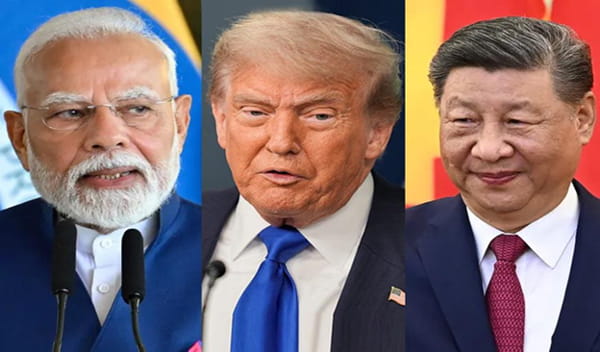
IndianPrime Minister, Narendra Modi (left), President of the US, Donald Trump and President of China, Xi Jinping. | ORF.
Indian foreign policy tradition has long reflected a commitment to strategic self-reliance, from the historical non-alignment to the current framework of “multi-alignment.” Across this trajectory, India has consistently asserted its right to pursue national interests independently rather than through formal alliances. India’s political leadership frequently articulates this logic. Prime Minister Narendra Modi declared,[16] “India’s time has come… We will engage with all nations on the basis of mutual respect and mutual benefit.” Similarly, External Affairs Minister S. Jaishankar underscored this notion by stating,[17] “India will do what is in India’s interests. Others must also understand that the era of single pole is over.” Together, these statements reflect India’s self-perception as an autonomous actor in a transitioning global order.
Yet the assertion of strategic autonomy has also carried tangible political costs for India. Indian political choices, rooted in sovereign calculation and national interest, have increasingly drawn criticism and pressure, particularly from Western partners. This contrasts sharply with the reception given to Vietnam, which is lauded for its precise and disciplined “bamboo diplomacy.” Hanoi has maintained close and parallel partnerships with China, the United States, Russia, India and Japan, without criticism.
A useful way of understanding this asymmetry lies in the hierarchical logic of the international system. As an emerging great power, India attracts far greater strategic scrutiny and expectation. Its actions are interpreted not merely as a function of independent foreign policy, but as signals with systemic consequences for the balance of power. Smaller and middle powers such as Vietnam, by contrast, are granted greater latitude to maneuver precisely because they are not viewed as potential architects of the international order. Consequently, India’s pursuit of strategic autonomy is often judged through the lens of alignment politics, while Vietnam’s is viewed as pragmatic statecraft.
Structural Asymmetry: Why Vietnam Is Praised, and India Is Pressured
Both Vietnam and India face the shared challenge of navigating an increasingly complex and competitive international order. Yet their global positions, capacities and ambitions could not be more different. Vietnam does not seek a great power status, nor does it aspire to regional hegemony. Its long-term strategy rests on a unified ASEAN, emphasizing economic development and collective security.
India, by contrast, is the world’s fourth-largest economy and military, carrying both great power ambitions and structural potential. India and China face a structural dilemma, where any strategic gain by India is a loss for China and vice versa. For the West, India is a regional bulwark against Chinese expansionism, an alternative market and a like-minded democracy with shared strategic interests. India was seen as a demographic, economic and military giant in waiting. Over the last decade and a half, India has been courted[18] by all major powers, enjoying a period of deep engagement with Russia, the United States, China and Europe, participating in both the Shanghai Cooperation Organization and QUAD.
In recent months, however, India’s geopolitical latitude has been increasingly constrained. It has found itself navigating pressures from the United States (and the West), China and Russia. The loss in India’s geopolitical “sweet spot”[19] is evident in multiple developments: punitive actions by the Trump Administration over India’s energy and military ties with Russia, China’s lingering insensitivity of various Indian security concerns and Russia’s diminished attention to India’s external challenges, due to its own conflicts.
India’s strategic importance to the United States stemmed from its capacity to contain China, which explains Washington’s robust promotion of India as a net security provider in the early 2000s. Cultivating close ties with New Delhi was critical for maintaining the regional balance of power, and implicit in this engagement was the expectation that India would align closer to Washington. Yet, China’s rapid economic and military development reshaped global priorities, compelling both the US and Russia to prioritize immediate rewards from the Chinese growth machine.
A further inflexion point emerged following India’s assertive stance on strategic autonomy regarding the Russia-Ukraine war, seen as defiance rather than pragmatism. This signaled to Washington that India would not abandon its independent foreign policy and was unlikely to ever treat the US as an exclusive partner. In response,[20]US-India relations have increasingly assumed a transactional character.
Meanwhile, China’s belligerent actions along the LAC in 2020, combined with its support for Pakistan in the May 2025 conflict with India, have further challenged the outlook for India as a “net security provider” in the region. The diplomatic, military and economic asymmetries between the two Asian giants have persuaded Beijing that relations should be seen from a realpolitik lens where hierarchy should be established congruent with relative power.
While Vietnam leverages ASEAN to diffuse tension and risks, India operates largely alone as a continental and maritime power. Moreover, India’s limited ability to translate diplomatic posture into sustained capability accumulation has remained uneven. This weakens the material foundation of its autonomy. Therefore, India’s policy space is narrowing not because its doctrine is flawed, but because its structural position generates expectations that its material power has not yet fully matched.
Conclusion
Strategic autonomy in contemporary international order is not judged by conceptual purity but by structural position. Vietnam and India both practice multi-alignment, yet their experiences reveal how hierarchy, power expectations, and capability asymmetries shape the success or constraint of autonomous strategies. Vietnam’s autonomy is stabilized by its limited systemic ambitions, ASEAN embeddedness, and disciplined hedging, allowing flexibility without provoking alignment demands. India’s autonomy, by contrast, unfolds under the burden of great-power expectation, unresolved power transitions, and shrinking tolerance for strategic ambiguity. The divergence between the two thus reflects not failure of doctrine, but the unequal pressures imposed by a fractured and competitive multipolar order.
(Exclusive to NatStrat)
Endnotes
Separating Reality from the Rhetoric: Facts, Fiction, and the Indus Waters Treaty
India’s Strategic Autonomy in Practice: Supply Chains, Technology, and Power