

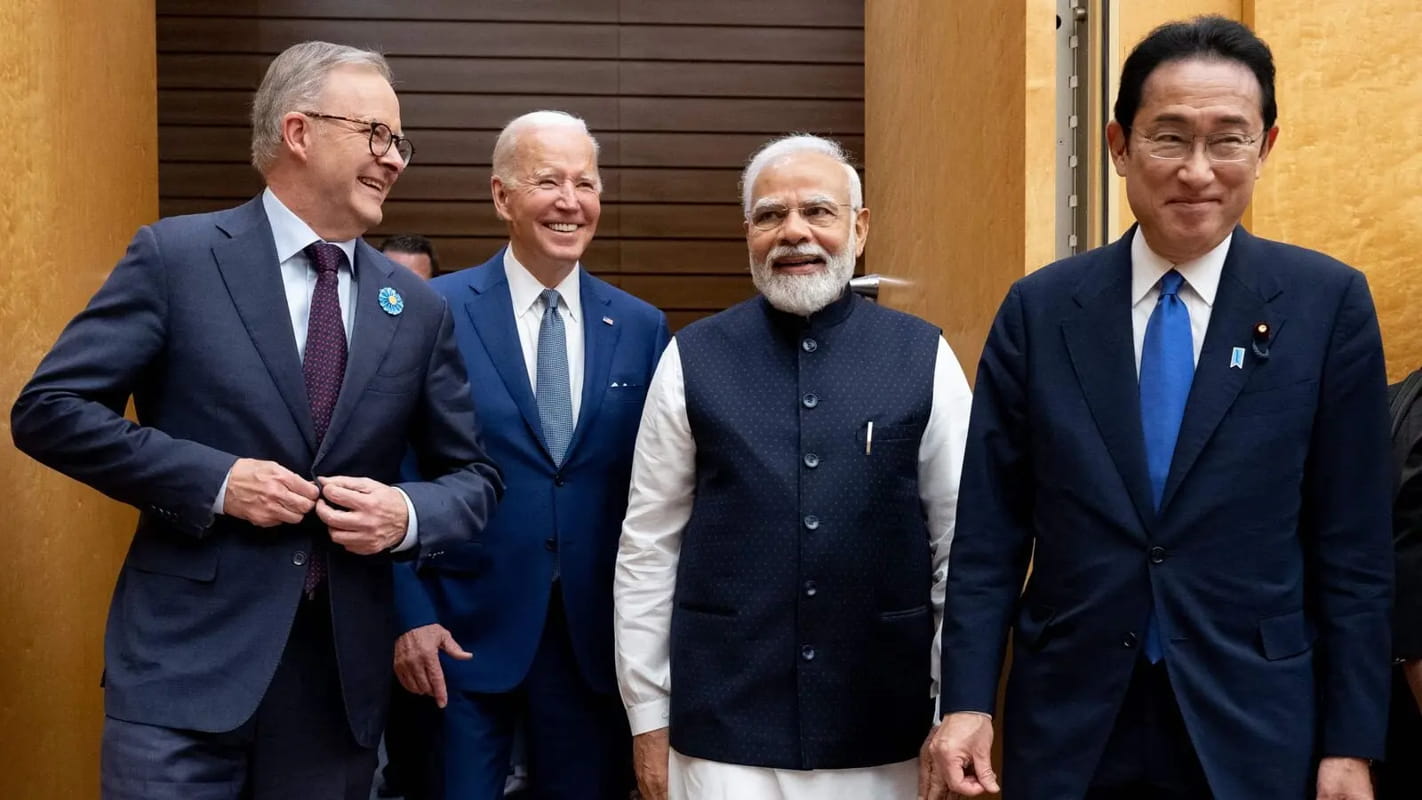
Indian Prime Minister Narendra Modi with other Quad leaders at their summit in Claymont, Delaware, US on September 21, 2024. | Hindustan Times.

Introduction
In international politics, strategic autonomy refers to the capacity to act independently. In an interdependent world with integrated supply chains, the ability to act independently is never absolute. Sovereign states aiming for strategic autonomy work to strengthen domestic capabilities and to balance competing forces, thereby creating relatively more space for independent action. A sovereign state pursuing strategic autonomy will evaluate a specific policy or action to determine whether it will enhance or constrain its ability to act independently in the international domain.
Strategic autonomy is a consequence of a country’s location in the hierarchy of power relations in international politics. Big powers are aware that they have the capabilities to act autonomously. Consequently, they are not overly concerned about maintaining their autonomy; instead, they define their external engagement in terms of establishing and maintaining spheres of influence.
On the other hand, it is the middle and rising powers (if not all, at least some) that define their international engagement in terms of strategic autonomy. Some rising powers believe they will emerge as big powers in the future and fend off pressure to align with the interests of the big powers by actively diversifying their relationships.
Therefore, strategic autonomy is not an insular approach to international politics. Rather, countries pursuing strategic autonomy seek to cultivate diverse relationships. As Prime Minister Narendra Modi noted, India's policy has shifted from “maintaining equal distance from all nations, ..[to] ..the current approach.. [of].. being equally close to all—an "Equi-Closeness" policy.” However, the policy of equi-proximity does not automatically translate into developing alliance relationships.
India’s ‘No’ to Alliances
Countries such as India perceive that an alliance relationship constrains their choices. There are instances when countries within an alliance framework, such as France, have stressed the importance of acting independently in the international domain. Interestingly, the European Union, despite its alliance relationship with the United States, has also, in recent years, stressed the importance of adopting an approach of strategic autonomy.
There have been arguments that India should align with the United States to emerge as a major power. However, such exhortations overlook important challenges that hinder alliance formation between India and the United States.
An alliance is said to be in play if two or more countries form a group with a pledge that they would come to each other's rescue to fend off aggression by another country/countries outside the group. A primary prerequisite of an alliance is that the member countries recognise each other's territorial boundaries. A failure to recognise each other's territorial boundaries makes it difficult to determine if a member country is being subjected to aggression.
Interestingly, none of the Quad countries recognises India's territorial boundaries as cartographically defined by Delhi. For instance, the US has thus far refrained from stating that China and Pakistan are in illegal occupation of Ladakh and Jammu and Kashmir. Since the Quad countries do not recognise India's territorial boundaries as defined by Delhi, the prospect of the framework evolving into an alliance is very remote.
A similar dynamic is also evident in the case of BRICS countries. With China persistently engaging in grey-zone territorial violations against India, the prospect of BRICS evolving into an alliance is also unlikely. India cannot get into an alliance with any of the major powers, as they do not recognise India's territorial integrity with reference to Jammu and Kashmir and Ladakh. Thus, India's strategic autonomy is also a consequence of how the world treats India.
Some have hinted that Pakistan, while being an ally of the United States, was able to engage with China, and India could perhaps also maintain diverse relationships while being an ally of the United States. All major powers understand that Pakistan's strategic objectives are directed toward India, and that it neither seeks to emerge as a major power in Asia nor dreams of having a globally competitive economy.
Pakistan's strategic choices have an impact only on the Indian subcontinent and do not have a continental or global impact. On the other hand, India is the fourth-largest economy and seeks to play a leading role in international politics, and its strategic choices will elicit a robust response from global powers, which India needs to factor in.
Impact of History and Economic Interaction
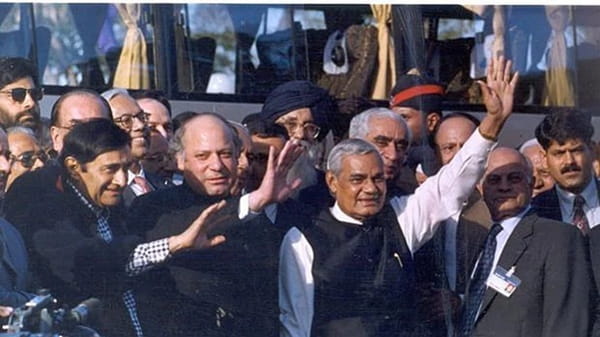
Indian Prime Minister Atal Bihari Vajpayee with his Pakistani counterpart Nawaz Sharif in Lahore in 1999. | National Herald
India's pursuit of strategic autonomy is also shaped by history and economic interactions. During much of the Cold War, the West, particularly the US, provided Pakistan with advanced military equipment. The end of the Cold War did not bring about dramatic changes in US policy towards India. India, because of its nuclear programme, was subjected to US sanctions, which were lifted only after the India-US nuclear deal was operationalised in 2008. Consequently, over the decades, India’s military procurement was tilted in favour of Russia. It is indeed true that the India-US defence partnership has advanced significantly in recent years.
However, it is still uncertain if the US, like Russia, would provide India with advanced strategic weapons, such as nuclear-powered submarines, without any strings attached. In the economic realm, the United States is India's largest trade partner. Among India’s top ten trading countries, the United States (with a GDP of US$ 29 trillion in 2024) is the only economy with which India has a trade surplus. The Russian economy, with a GDP of US$ 2 trillion, does not constitute a significant export market for India.
China is also India's leading trading partner. However, India has a massive trade deficit with China. Because of domestic industrial overcapacity, China has emerged as a major exporting nation; therefore, it is highly unlikely that Indian exports will find space in China in the near future. Consequently, India will be more dependent on the US, the European Union, Southeast Asia and other emerging markets. To sum up, while India enjoys a robust defence relationship with Russia, in the economic realm, its future is tied to Europe and the US market. Given such dichotomies, it will always be difficult for India to have an alliance relationship with any of the major powers.
Post-Alliance Phase
Furthermore, the trend towards multipolarity in international politics is increasing, and power is getting increasingly diffused, which is impacting the foreign policies of sovereign states. It is perhaps important to recognise that international politics has entered a post-alliance phase for the following reasons:
❖ First, the transatlantic alliance and the US hub-and-spoke alliance in the Pacific are experiencing significant strain. The US leadership has called on its European allies to take ownership of security on the Continent, and President Trump has suggested a G2 partnership with China. These policy statements have raised concerns about whether the US will abandon its allies in the event of a conflict. More importantly, it appears that US leadership has conceded to China's version of spheres of influence (New Type of Great Power Relations).
❖ Second, European leadership, despite their deep anxiety about Russian intentions, has only extended material support to Ukraine and has refrained from putting boots on the ground. Such reluctance stems from concerns about escalation of war and fear of body bags returning home, with the consequent political backlash.
❖ Third, many Western societies today are deeply polarised, with competing political groupings suspecting and accusing each other of undermining national interest. These developments suggest that Western democracies today lack the appetite to meet classical alliance obligations to put boots on the ground and endure a long war. Since global politics is drifting into a post-alliance phase, India needs to invest more in pursuing strategic autonomy.
Conclusion
To sum up, India's location in the hierarchy of power relations in global politics, the reluctance of major powers to recognise India's territorial integrity as defined by Delhi, and the fraying of alliance relationships in a multipolar world order will prompt India to exercise strategic autonomy in international politics. Additionally, India today has diverse economic, technological, and defence needs, which include greater foreign direct investment (FDI) to strengthen its connectivity infrastructure, sustained and predictable energy supplies, eco-friendly technologies that can facilitate the extraction and refining of rare-earth metals, greater engagement with leading technological institutions, collaboration in artificial intelligence and quantum technologies, and fifth-generation fighter technologies. No single country can assist India in meeting these needs at affordable prices. Therefore, it is important for India to diversify its strategic partnerships, which can only happen if Delhi pursues strategic autonomy with greater vigour.
(Exclusive to NatStrat)
Endnotes
Separating Reality from the Rhetoric: Facts, Fiction, and the Indus Waters Treaty