

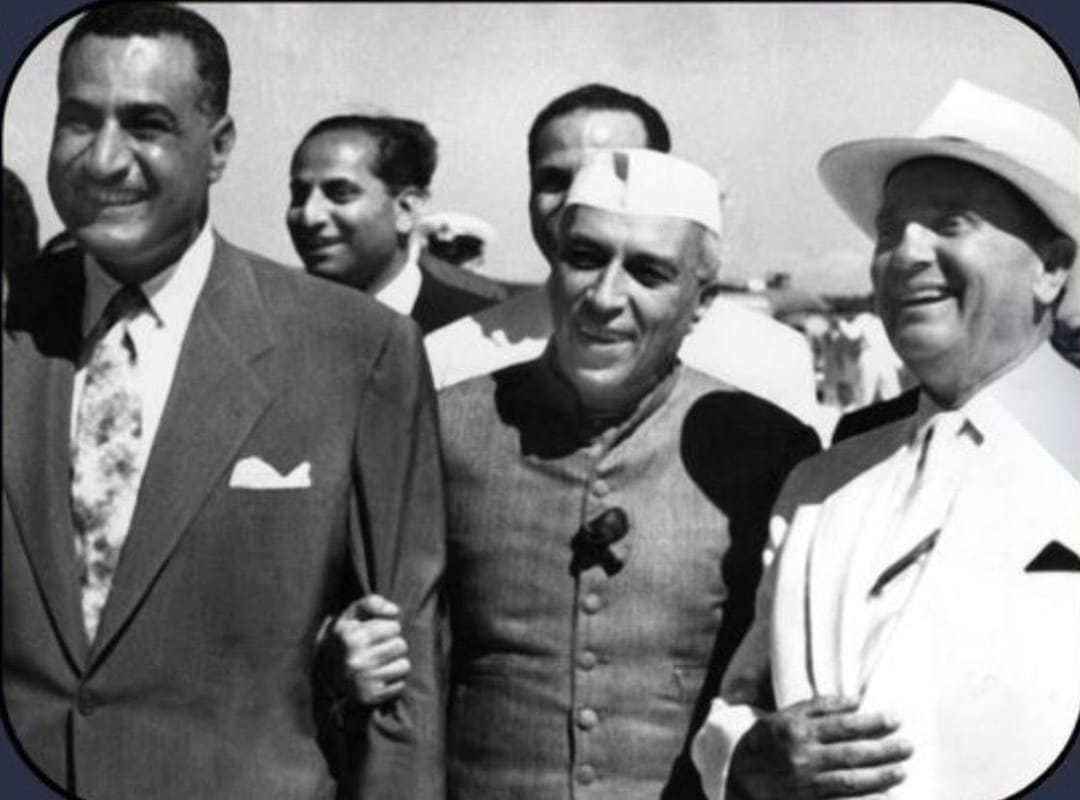
Indian Prime Minister Jawaharlal Nehru (centre), Yugoslav President Josip Broz Tito (right) and Egyptian President Gamal Abdel Nasser (left) meeting in 1956. The three leaders are considered to be among the founding fathers of the Non-Alignment Movement.
As the Modi Government wrestles with the economic and political challenges presented by the American and Chinese governments, it will continue to search for the opposite phrase to apply to its evolving foreign policy. “Non-alignment” will clearly not suffice and “neutrality” is too passive. It should be noted that Nehru rarely used these terms, preferring ‘independent foreign policy’ – which remains to this day the best description of the theory and practice of Indian foreign policy.
The Challenge of Defining India’s Foreign Policy
The difficulty in defining Indian foreign policy is not a new one. Since Independence both insiders and outsiders have indulged in word games on the subject. The ideological moorings of non-alignment began, existed and died with the idealism of Jawaharlal Nehru, followed by the realism and pragmatism that continues in various forms to this day. This could be described as “improvisational opportunism”, in the sense of adjusting and seeking opportunities in a constantly changing geopolitical landscape, in which India seeks recognition as an emerging power together with a sense of exceptionalism based on Hindu dharma or righteous conduct, Buddha’s Middle Way and Golden Mean, and Gandhi’s non-violence.
Neutrality was foreshadowed by Nehru from 1938 onwards, and articulated as non-alignment in 1950,[1] its essence being that sovereignty enshrined the right to take decisions that were not subject to any outside pressure or authority. Yet, being a non-ideological person, Nehru’s instructions in 1948 to Indian delegates at international fora were to put India’s interests first even before the merits of the case.[2] This was essentially realpolitik, which continues to this day irrespective of manifold definitions.
Meanwhile, under Nehru, the country gained kudos as the leader of the newly decolonised countries after successful Indian diplomatic initiatives in the Korean War (1953), the Geneva Indo-China Conference (1954), the Suez conflict (1956) and Congo peacekeeping (1960). Yugoslavia and Egypt were non-aligned through defiance of great powers, but India was not confrontationist and did not feel the need to seek foreign assistance to protect its sovereignty. Relations with the US-led West continued but were lukewarm and subject to periodic downturns approaching hostility.
Non-alignment
Non-alignment as a description of policy in International Relations was unusual; it implied agnosticism and was easier to define in negatives – not idealistic, not exclusive, not ideological, not passive, not impartial, not indifferent. The Janata government (1977-79) also failed to produce any definition of its newly minted policy of ‘genuine’ non-alignment. Rajiv Gandhi used the term ‘nonalignment’ without a hyphen to mitigate its inherent negativity,[3] but was unable to override the rules of grammar. Senior diplomat T N Kaul claimed non-alignment was not a policy but a posture or attitude,[4] and his colleague R Jaipal bizarrely concluded that to be non-aligned was to be “no more virtuous or meritorious than to be aligned.”[5]
The Non-Aligned Movement with periodic summits became a vehicle for anti-West, anti-US sloganeering and should logically have been terminated after the demise of the Soviet Union. This is because non-alignment necessarily presupposes the existence of two or more opposing camps, it was self-evidently considered passé after the collapse of the Soviet Union but no country wished to apply the coup de grace.
Inertia, however, is commonplace in International Relations. For example, the long moribund League of Nations was only finally terminated in 1946 after the Second World War.
By then shorn of India’s ideological post-colonial moorings, the quest for innovative definitions of its foreign policy began even as the new international groupings of the ‘unipolar’ world after 1990 took pains to portray themselves as not anti-American. From 1990 to 2014 under Prime Ministers Narasimha Rao, Atal Bihari Vajpayee and Manmohan Singh, India's foreign policy was directed towards economic growth, strategic partnerships and global integration, highlighted by the India-US nuclear agreement in 2008.
Other actions included introducing a “Look East Policy” to boost ties with Southeast Asia, deepening relations with Russia and Japan, and efforts to secure backing for a permanent seat for India on the UN Security Council. The Indian approach was rooted in the belief that domestic economic development and global diplomatic engagement were interconnected.
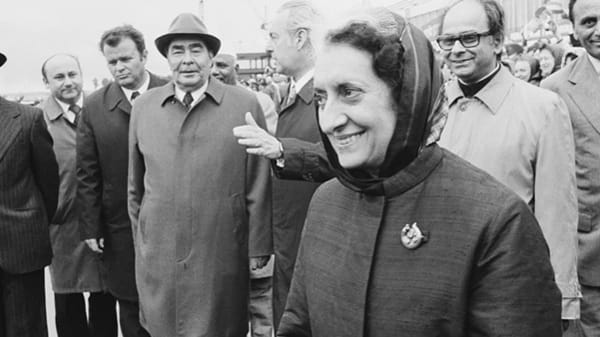
Indian Prime Minister Indira Gandhi and Soviet leader Leonid Brezhnev (4th from left with a hat and tie) in Moscow on June 8, 1976. The two countries signed a Friendship Treaty under their leadership in 1971. | AP/Boris Yurchenko/fox59.com.
The Post 2014 Phase
In 2014, with the election victory of the BJP under Prime Minister Narendra Modi, it became rapidly clear that the received wisdom and inherited lexicon from the Nehru/Congress period was no longer to be regarded as applicable or relevant. Alternative terminology had to be devised in presenting to the Indian public the current government’s projection that there was a new and more robust dynamic in Indian foreign policy.
Hence, the public was variously introduced to strategic autonomy, multi-alignment and multi-polarity, which could mean everything to everyone, especially since India has over 30 so-called ‘strategic partnerships’ with foreign entities, rendering the term bereft of significance, as former European Council President Herman van Rompuy stated significantly: “until now we had strategic partners; now we also need a strategy.”[6] As for the term “multi”, any foreign policy, even for very small nations, can inevitably mean dealing with multiple partners.
It seems self-evident that the current Government is still in search of the right form of words in which to package its foreign policy to the Indian populace. Its task has been made more complicated by the uneven tenor of India-US relations with the second Trump Administration, during which the White House seems to lurch between the extremes of declared affection and disparagement for the Indian Government.
As New Delhi navigates these new challenges caused by Washington, on which so many of India’s aspirations seem to depend, Sanjaya Baru has explained [7] that Foreign Minister S Jaishankar has clarified “that India’s policy of multi-alignment would require her to ‘engage America, manage China, cultivate Europe, reassure Russia, bring Japan into play, draw neighbours in, extend the neighborhood and expand traditional constituencies of support.”
It would be fair to say that thanks to Donald Trump today, India is now required to ‘manage’ America and ‘engage’ China, while continuing to ‘reassure’ Russia. A quarter century ago, ‘engaging’ America was viewed by New Delhi as also a means to ‘manage’ China.
Today, engaging China appears to have become a means to manage America. This situation requires new thinking in New Delhi because it places a few new cards in Beijing’s hands. The Modi Government has so far adapted well to the new global strategic environment, refusing to kowtow to Trump but demonstrating enormous patience in ‘managing’ him. Any return to ‘engagement’ will depend on the success of the efforts to ‘manage’.
This reasoning, however, appears to prioritise India's relations with the US and diminish our ties with other influential partners in our search for multi-alignment. Whether this is a wise approach with a superpower that has let India down more frequently in its 80-year existence than any other foreign partner will be tested by time.
Meanwhile, India sees virtue in running with the hare and hunting with the hounds, best viewed by the renewal on the margins of an international gathering skipped by the Prime Minister, of a 10-year US-India Framework Defense Agreement, which according to Manoj Joshi, reiterates “a pact first signed in 2005 and extended in 2015, neither of which produced outcomes of lasting significance. (It) has pledged transformative co-development and technology transfer but delivered little beyond rhetoric…. [risking] becoming another buyer-seller agreement that has netted the US over $22 billion in material sales to India over the past two decades.”[8]
Conclusion
In regard to definitions therefore, we circle back to conclude as we began.
As the Modi Government wrestles with the economic and political challenges presented by the American and Chinese governments, it will continue to search for the opposite phrase to apply to its evolving foreign policy. “Non-alignment” will clearly not suffice and “neutrality” is too passive. It should be noted that Nehru rarely used these terms, preferring ‘independent foreign policy’[9] – which remains to this day the best description of the theory and practice of Indian foreign policy.
(Exclusive to NatStrat)
Endnotes

Separating Reality from the Rhetoric: Facts, Fiction, and the Indus Waters Treaty