

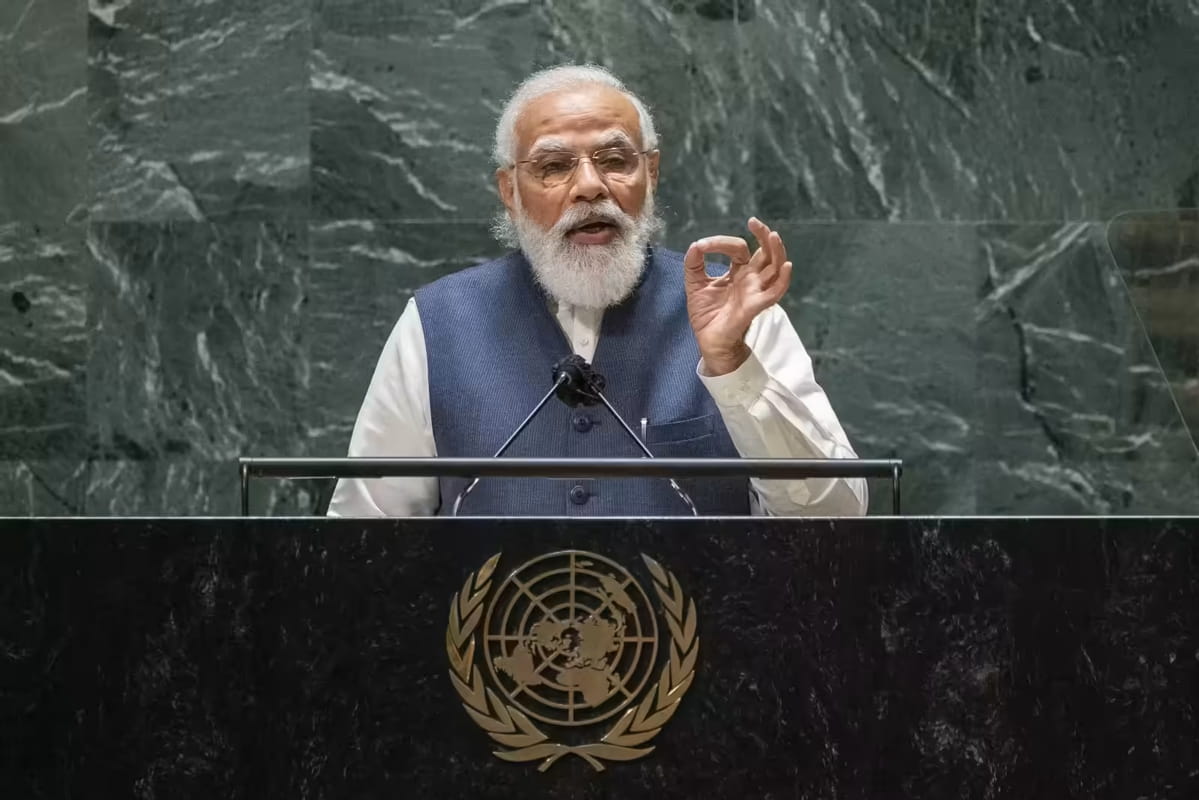
Indian Prime Minister Narendra Modi addressing ‘The Summit of the Future’ on September 23, 2024 in New York. | UN Photo/Loey Felipe.
Now, sovereignty is ensured by the freedom to engage and shape external outcomes. Autonomy is not a doctrine. It is a discipline. India’s strength will be measured not only by the tanks deployed on its borders, but also by the chips in its data centres; by the strength of its coffers; by its reach in cyberspace and outer space; and by the credibility of its choices. When India can say yes or no on its own terms, back those words with capability, and match them with delivery, that is strategic autonomy.
Introduction
The global order is transforming at a pace faster than the norms that govern it. Economic interdependence, once promoted as a cooperative endeavour, is now weaponised. Trade is filtered through tariffs and subsidies. The spread of technological innovation is controlled by export restrictions. Geography, once about boundaries, is now also about transboundary routes, energy corridors, and satellite constellations. Some even see today’s great-power competition as a prelude to a great-power concert. India’s response to this volatile environment is to re-imagine strategic autonomy from a moral posture to an operating method.
The strategy is not about fence-sitting. It is a deliberate method to navigate contested arenas. It is not about keeping its distance from the world, but about the freedom to shape engagements on India’s own terms through sovereign choices. It is about being present on multiple platforms, building partnerships across divides, shaping outcomes without getting boxed in, and retaining the flexibility to shift course.
From Non-Alignment to Networked Power
India's strategic autonomy can be traced back to its non-aligned identity. During the Cold War, there was space between rival blocs for an independent foreign policy, until the 1971 Indo-Soviet Treaty signalled that autonomy needed to be backed by strength. Subsequently, though marked by slow growth, the drive was towards self-reliance in food and nuclear security.
The economic liberalisation of 1991 translated opportunity into capability. As India integrated with the global economy, its choices expanded. After the 1998 nuclear tests, it opted for engagement rather than isolation, and the 2008 Civil Nuclear Agreement with the United States underlined its capacity to negotiate for its sovereignty, not just assert it.
Three phases capture this arc: freedom from control protected sovereignty in the early decades; freedom to integrate after 1991 built capability; and today, freedom to engage enables presence with choice.
Today, India partners with the United States on maritime awareness and semiconductors, with France on the co-development of weapons systems, with Russia on energy and defence requirements, and with Africa, ASEAN, and Latin America on digital public goods. Engagements are not endorsements. They reflect agency that allows collaboration without constraint.
As a guiding principle, no single external partner should dominate any critical domain. In a volatile global environment, dependencies can be weaponised. Such situations require prompt review and rebalancing. While exceptions may arise, they must remain limited, temporary, and clearly justified.
Autonomy in a Fragmented World
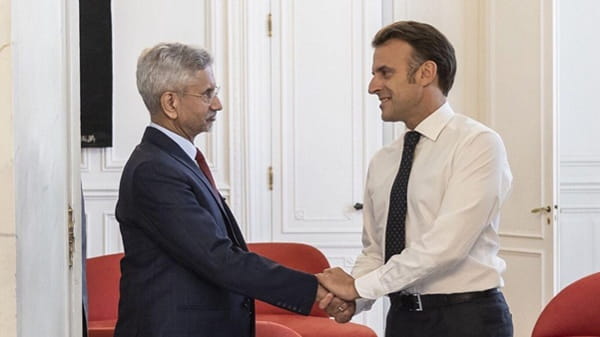
Indian External Affairs Minister S Jaishankar meets French President Emmanuel Macron in Paris on June 12, 2025. | @DrSJaishankar/X.
Since 2020, there have been pandemics, sanctions and supply shocks, which have hardened interdependence. The United States and China are decoupling in critical technologies. Europe is enhancing its defence spending, responding to events in Ukraine. The Global South has a more vocal tone but its leverage remains limited. India’s response is disciplined diversification.
India has enhanced technology cooperation with the United States through iCET (Initiative on Critical and Emerging Technology), now renamed the TRUST (Transforming the Relationship Utilising Strategic Technology) initiative. US firms are committing multi-billion-dollar investments in semiconductor assembly, testing and design in India, alongside programmes to train tens of thousands of Indian engineers.
All this while India and Russia have retained their defence ties and increased energy cooperation. Following the war in Ukraine, discounted Russian crude at one stage accounted for close to two-fifths of India’s oil imports, before gradually tapering as sanctions, tariffs and restrictions on Russian-origin products tightened.
India is also active in BRICS and the SCO, retaining multilateral flexibility. India’s presidency of the G20 saw it champion a pragmatic agenda regarding digital infrastructure for development. It helped mainstream digital public goods through its toolkit for low-cost, interoperable rails. This has led to the gradual transboundary growth of UPI. As of late 2025, UPI is live for merchant payments or person-to-person transactions in at least nine countries, enabling Indians to have usable payment rails abroad.
Taken together, these actions exemplify not just India’s adaptability, but an evolving strategy, which is neither isolationist nor aligned. The emphasis is on engaging widely, depending narrowly and constantly rebalancing to secure long-term autonomy.
Strategic Value and Trade-Offs
The pursuit of multiple partnerships and fewer hard dependencies gives India room to manoeuvre. However, it also results in pressures, making it vital to weigh what this freedom to engage delivers in practice and what it demands in return.
Mainstreaming sectors such as energy, technology, and finance has enhanced market resilience and helped protect households and businesses from unexpected shocks. Access to world-class know-how has improved jobs, infrastructure, and service standards at home. Participation in global fora and support for development finance have extended India’s reach in the Global South.
The most significant advantage of this approach lies in option value — the ability to say yes or no with credibility, improving outcomes on price, access, and intellectual property. In uncertain times, having options turns surprises into manageable costs rather than strategic crises.
The costs are real, yet manageable. Hedging can be interpreted as ambivalence and may reduce leverage in partnerships. Lack of alignment with blocs can dilute India’s role when rules are shaped. A wide web of partnerships slows decisions, as more factors must be weighed in crises. Diversification raises costs and complicates interoperability. Great powers, such as the US and China, test the resolve of those outside their camps through tariffs, sanctions and access restrictions. These pressures are containable when anchored in clear, issue-defined red lines — no compromise on territorial integrity, no external veto over core economic and digital choices, and no participation in coercive arrangements that undermine the Global South. With such guardrails, and playbooks for emergencies and a constant presence on global platforms, the benefits of autonomy can remain extensive while costs are kept in check.
Autonomy Tests Lie Ahead
Today, much is at stake in the security landscape. In the context of emerging challenges, the realms of borders and maritime pathways, climate and health, cyber and satellite communications, and financial markets and payment systems all interact and shape what is possible under the rubric of strategic autonomy.
In the defence sector, the aim is credible deterrence without formal alliances, built on better awareness, quicker reach and steady readiness along India’s land boundaries and coastline. Along land borders, it means managing simultaneous pressures without getting drawn into others’ rivalries. At sea, it means being indispensable to the security of the Indian Ocean.
In energy and resource transition, security now includes lithium, cobalt, nickel and phosphates in addition to oil and gas. It also addresses the resilience of critical infrastructure and public health. The objective is to ensure supplies of fuels, critical minerals and key health and food inputs, with ports, pipelines and flexible networks to support industry and domestic sectors during shocks.
Autonomy, in cyberspace and space, includes secure computing, hardened infrastructure, resistance to cyber and disinformation threats, and assured connectivity to space-based resources. The same satellites used for routine transactions are now at risk, making their protection imperative, along with protecting national borders.
Freedom in economic matters will also depend on what India’s balance sheet looks like vis-à-vis the world. Who owes it money? In what currencies are its contracts denominated? How vulnerable are Indian companies to secondary sanctions? How robust are Indian payment systems? These will shape the scope of India’s freedom of choice. A diversified trade basket without diversified financial partners is a partial hedge, at best.
Strategic autonomy, however, cannot be limited merely to external balancing. It is underpinned by a cohesive internal social order. It involves competent law-enforcement institutions that can tackle transboundary challenges, including international terrorism, cybercrime and organised crime, and ensure that state legitimacy is not undermined.
From Options to Outcomes
The success of any strategy is judged by outcomes, not claims. A simple scoreboard can show real progress.
Three shifts, from the factory floor to foreign policy, will decide whether option value becomes lasting capability. The first is productive power, which means designing and producing more of what India uses, with each foreign deal judged by what it adds to skills, scale and intellectual property. Second is technological agency, built on dependable compute and a say in standards, so that digital cooperation becomes a source of diplomatic capital. The third is narrative clarity, which ensures that partners know what India will do, why, and by when, thereby turning ambiguity into legitimacy. Together, these shifts turn episodic choices into predictable delivery.
In a world of tough choices, true power lies in having options and using them effectively. Once, sovereignty was ensured by freedom from control by others. Subsequently, sovereignty was ensured by freedom to build and integrate capacity. Now, sovereignty is ensured by the freedom to engage and shape external outcomes. Autonomy is not a doctrine. It is a discipline. India’s strength will be measured not only by the tanks deployed on its borders, but also by the chips in its data centres; by the strength of its coffers; by its reach in cyberspace and outer space; and by the credibility of its choices. When India can say yes or no on its own terms, back those words with capability, and match them with delivery, that is strategic autonomy.
(Exclusive to NatStrat)

Separating Reality from the Rhetoric: Facts, Fiction, and the Indus Waters Treaty