

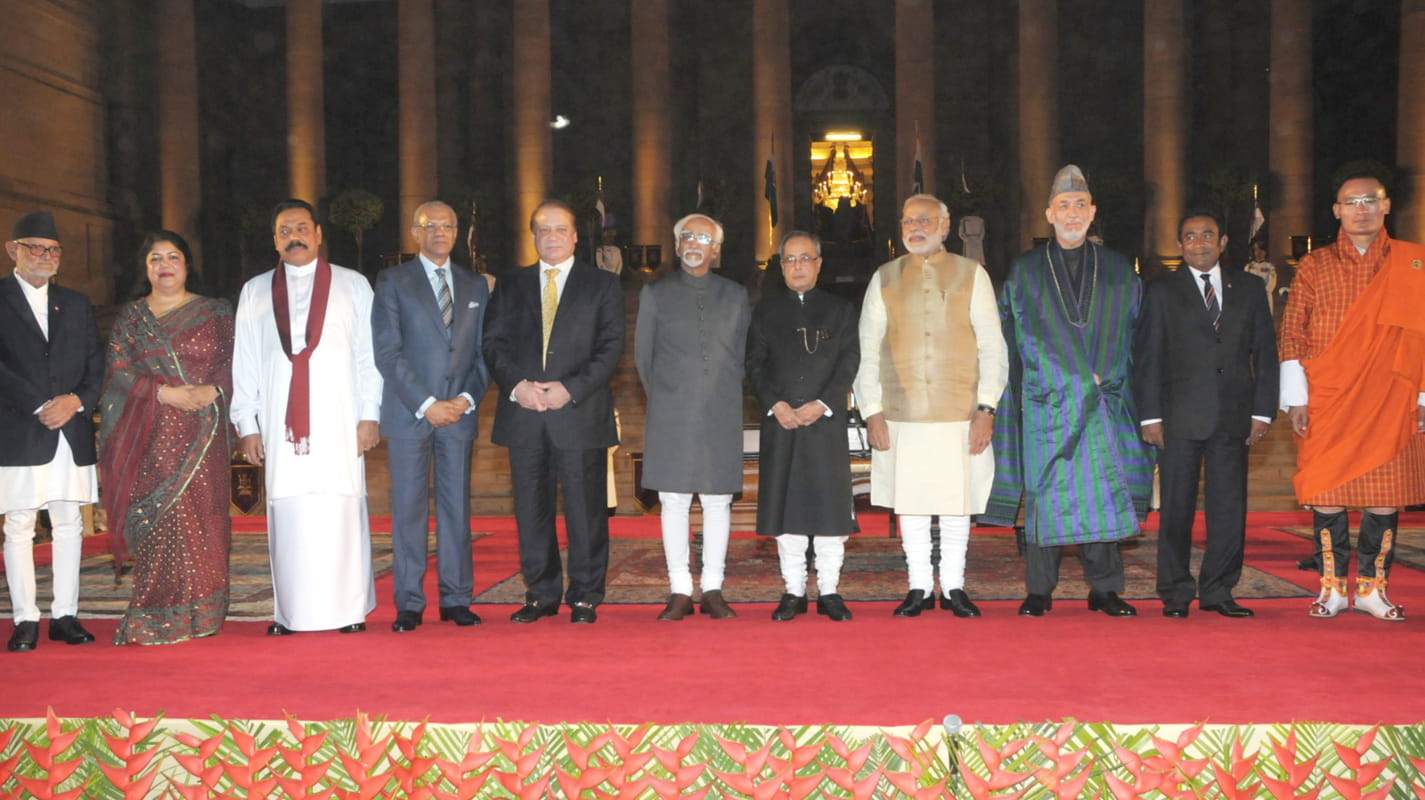
President of India, Pranab Mukherjee ((7th from left), the Vice President of India, Mohd. Hamid Ansari (6th from left) and Indian Prime Minister, Narendra Modi with the Heads of SAARC countries after the Swearing-in Ceremony, at Rashtrapati Bhavan, in New
The strategic objectives of India and America were driven by compulsions which did not necessarily collide but could not ever harmonize. The distance widened through the 1950s. When the Cold War edged towards a nuclear catastrophe over the Berlin crisis between 1958 and 1962, Nehru argued that India would not avoid engagement with the Soviet bloc for fear of America, and if Washington became unfriendly as a result, India would seek friends elsewhere.
India, the US & Accident of History
The strategic distance between India and the United States—two nations that have never been at war and are unlikely ever to be—remains a paradox of contemporary geopolitics. This is compounded by Washington’s continuing support to Pakistan, an unstable jelly-state held piece-meal by an Army which flaunts jihad as its official motto, faith supremacism as its ideology, and has given support and sanctuary to America’s most vitriolic 21st Century enemy, the terrorist Osama bin Laden; little could be more antithetical to America’s proclaimed values.
One reason lies in an accident of history. Between 1947 and 1948, a coincidence made India and the United States principal advocates of parallel world views.
India’s first Prime Minister Jawaharlal Nehru was convinced that India, free from British rule by August 1947, needed to preserve its independence through a vigilant foreign policy which maintained a distance from military blocs that served to perpetuate global conflict. Within weeks of freedom, Nehru sent a message to the American magazine New Republic asserting unambiguously that India would “avoid entanglement in any blocs or groups of Powers” because blocs fomented war. Washington dismissed this as woolly-headed piety which had no place in the hard and harsh reality of the gathering Cold War between the liberal-democratic West and doctrinaire Communist Soviet Union.
America, invigorated by the concept of Thomas Jefferson’s “empire for liberty”, decided that freedoms saved from Nazi fascism and Japanese imperialism could only be protected by the subversion and defeat of Communism, which had spread across a contiguous swathe of territory from eastern Germany to China. By 1950, Communism spearheaded by Stalin in Moscow and Mao Zedong in Beijing, was actively pursuing expansion in Europe, Asia, Africa and Latin America.
Jefferson considered liberty an obligation, but such a moral-political responsibility was beyond American capabilities in the 19th Century: while European colonizers throttled liberty around the globe, Americans prioritized the search for internal settler-wealth. The American mind changed after two World Wars. Perched on the high altitude of leadership, libertarian America mobilized to fight the Cold War, unwilling to concede space to neutrality, dividing the world into the binary of ‘us’ versus ‘them’. Neutrality was appeasement.
The strategic objectives of India and America were driven by compulsions which did not necessarily collide but could not ever harmonize. The distance widened through the 1950s. When the Cold War edged towards a nuclear catastrophe over the Berlin crisis between 1958 and 1962, Nehru argued that India would not avoid engagement with the Soviet bloc for fear of America, and if Washington became unfriendly as a result, India would seek friends elsewhere.
In the autumn of 1962, a shocked Nehru discovered that there was no ‘elsewhere’ for India after Chinese aggression across the Himalayas. Catastrophic defeat opened eyes and minds in Delhi. India recalibrated its strategic thinking. Independence needed more than ideals; it required the concrete reinforcement of robust security, or, to coin a term, ‘defendence’: the ability to establish defence mechanisms, including weapons and pacts, based on the logic of national self-interest without surrender of autonomy.
America was willing to help in the immediate aftermath of 1962, for till the split with Russia, China was part of the Sino-Soviet phalanx. But Anglo-American equivocation over Kashmir as they attempted to obtain the best terms for their ally Pakistan, and the supply of sophisticated arms on generous terms to the Pakistan Army intent on further aggression against India, rebuilt the walls of mistrust.
In 1965, Pakistan bolstered by state-of-the-art American Patton tanks, launched another invasion of Jammu and Kashmir. India defeated its bete noire with ageing Centurions, M4 Shermans and the PT-76 as supplementary armour purchased from Russia. After 1965, India turned towards Moscow. The Indo-Soviet defence treaty was signed in 1971, on the eve of the third and most decisive war with Pakistan.
Ironically, in 1796 America’s founding father George Washington had advised his successors to “steer clear of permanent alliances with any portion of the foreign world” to protect America’s autonomy and instead “safely trust temporary alliances for extraordinary emergencies”. This is what India did.
Pakistan was never ambiguous towards the Pentagon. It remained loyal to what should be called the Jinnah Gambit.
The Jinnah Gambit
The Pakistan movement was never driven by the urge to end British rule; Muhammad Ali Jinnah wanted freedom from Hindus, the locus standi of partition. In 1946, Jinnah told a press conference in Cairo that “Hindu India” would be a greater “menace for the future” than British power had ever been. Such thinking translated seamlessly into a partisan foreign policy in which Pakistan’s security needs were purchased by subservience to American strategic requirements.
Jinnah’s security thesis was built around reductive reasoning: Pakistan could not survive without a powerful ally. The Communist Soviet Union was atheist, and hence anti-Islam; France had become weak; Britain was crippled. The only rational option was America. In November 1946, Jinnah sent his friend and financier M A H Ispahani to test American waters. Ispahani reported that Americans liked “sweet words” and first impressions mattered. They still do.
In September 1947, Jinnah told an influential American journalist reporting from the subcontinent, Margaret Bourke-White of Life magazine: “America needs Pakistan more than Pakistan needs America. Pakistan is the pivot of the world as we are placed – the future on which the future of the world revolves.” He added with a satisfied smile that Russia was not that far away. Pakistan was ready to become a Western base for “Middle Eastern defence” against the southward advance of the Soviet Union. He could hardly have been more categorical for an audience in Washington which believed in strategic clarity as a moral virtue.
Jinnah’s first manoeuvre was audacious. In September 1947, or about a month before Jinnah ordered the first war for Jammu and Kashmir, Pakistan sent a formal request to Charles Lewis, the American charge d’affaires in Karachi, for two billion dollars in aid spread over five years. Pakistan’s leaders have never underestimated the sale price of Pakistan.
The money took time but the message travelled fast. In the summer of 1950, American President Harry Truman sent a plane to London for Jinnah’s successor Liaquat Ali Khan and received him personally in Washington on 3 May at the onset of the first formal state visit by a Pakistan Prime Minister. Khan pledged full support against Communism and voted against North Korea at the United Nations. Truman is well-known for saying that if you want a friend in Washington, you should get a pet dog. If you want an ally, however, there is plenty of company. Khan’s overtures were music after the lectures America heard from Nehru during his month-long visit in October 1949.
On 5 January 1954, President Eisenhower authorized military aid to Pakistan; on 19 May 1954, America and Pakistan signed the Mutual Defence Agreement in Karachi, and America gained access to facilities near Peshawar for its air force and CIA. In 1956, Pakistan supported the Anglo-French-Israeli invasion to take the Suez Canal from Egypt. Two years later, the first military dictator of Pakistan Ayub Khan seized power in a coup; American approval came with Eisenhower’s visit to Pakistan in December 1959. Till this day, America uses its Pakistan base for military action when it chooses; Pakistan does not intervene because it cannot.
India has never surrendered its autonomy, not even in the aftermath of 1962. That is why, Pakistan is an ally of America and India is only a friend.
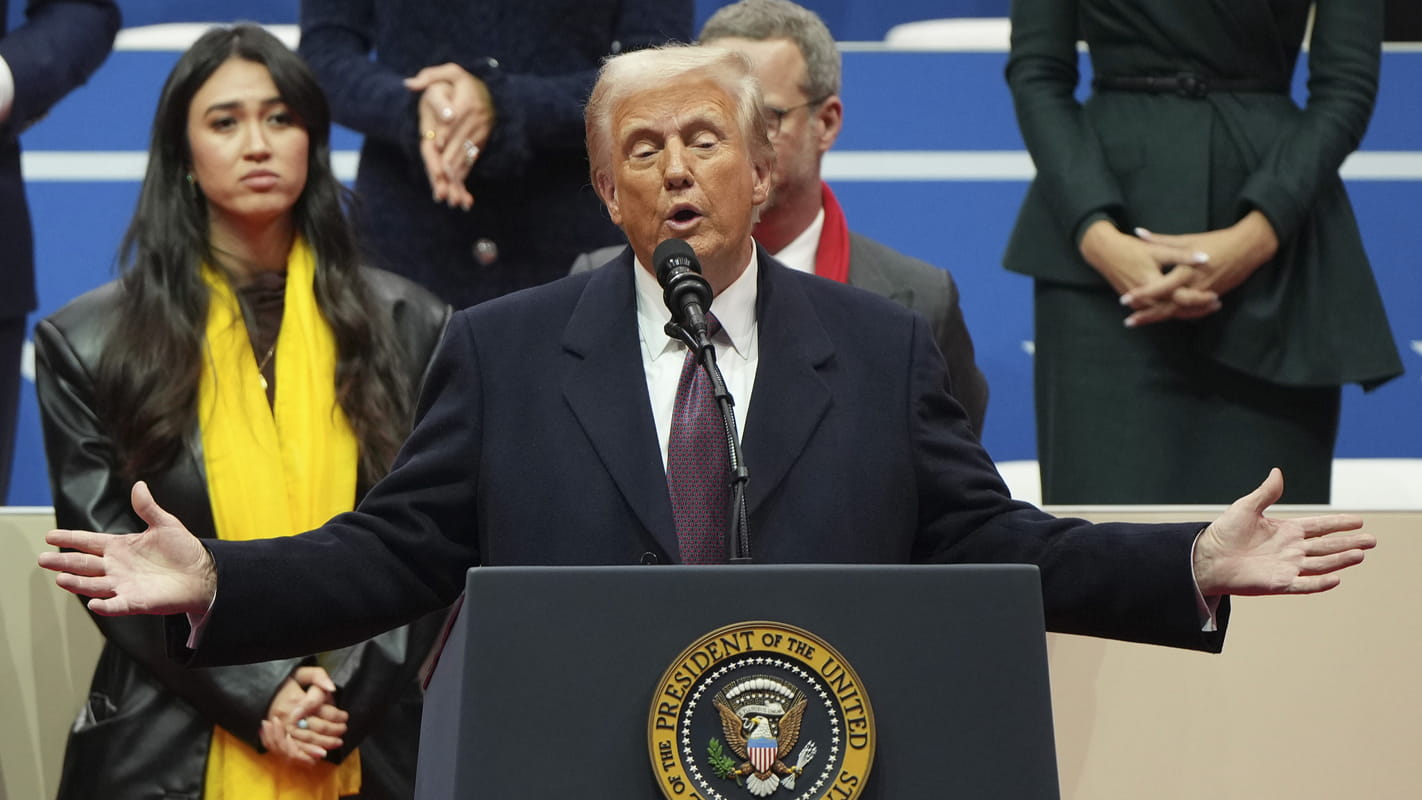
There is not much difference between Truman's dispatch of an American plane for Liaquat Ali Khan in 1950 and President Donald Trump’s lunch invitation to Field Marshal Asim Munir, the de facto ruler of Pakistan, in 2025. Both are token public gestures to signal a hard alliance. Washington understands that there is some collateral damage from Pakistan’s ideological willingness to provide a sanctuary for Islamist radicals and terrorists but merely seeks to ensure, not always successfully, that this is not targeted towards America.
Munir is the most hardline defender of faith-supremacy and benefactor of terrorism in Pakistan’s history. His speech on 15 April, 2025 to non-resident Pakistanis could hardly be more specific: Pakistanis, wherever they may reside, should never forget that they belong to a “superior ideology and superior culture”. America has not even demanded the release of the man who helped CIA to trace Osama bin Laden; Dr Shakil Afridi continues to rot in a Pakistan jail as a “traitor”. Pakistan is also permitted a bandwidth within which it can take its conflict with India as far as possible.
There is, however, an unresolved contradiction at the heart of Islamism in the modern era, identified by Ayatollah Khomeini, ideologue and mentor of the 1979 Iranian revolution. Khomeini noted in 1979 that “Islam is opposed to nationalism. Nationalism means we want the nation; we want nationalism and not Islam.” He and his disciples have never forsaken Iran’s national interest in any quest of an international Jihad. When a Jihad suits Iran’s interests, it is useful; when it does not, it is dispensable.
Neither has Iran abandoned its pre-Islamic legacy, unlike Pakistan. On 24 November 2025, The Times, London reported a public event in Tehran’s Revolution Square celebrating the potential fate of Iran’s enemies. The iconic image on display was of the Roman emperor Valerian on his knees before the Persian King Shapur. “Kneel before Iranians”, said the caption. Shapur the First (215-270 CE) was not a Muslim. He defeated Valerian in 260 CE at Edessa. Another image of the famous scene, now at the Getty museum, shows Shapur mounting his horse by stepping on the back of Valerian.
Pakistan is led by ideologues who believe their history starts with the Arab invasion of Sindh in 711 CE, which established a foothold on the subcontinent but left little long-term impact. Pakistan is a confused and dysfunctional state because it has abandoned its heritage of the Indus valley civilization, Mohenjo-Daro, Harappa and Gandhara only because they are pre-Islamic. Pakistan has made Islam co-terminus with nationalism.
If Islam was sufficient as the basis for a nation state, why would there be 22 Arab countries? In November 2025, Islamabad argued at the Istanbul peace talks with Afghanistan that an Afghan attack on Pakistan was against sharia since Pakistan was an “Islamic” state. The Afghan Taliban mullahs laughed all the way back to Kabul.
Faith is an individual relationship with God; politics feeds on much baser metrics. There has never been solidarity in any religion, whether Islam, Christianity, Hinduism, Buddhism or Confucianism, in the name of faith. Solidarity is possible only when mutual worldly benefits beckon.
Eyebrows were raised, some sharply, at news of the Pakistan-Saudi Arabian defence pact. A few overheated egos in Islamabad began to talk of an Islamic NATO with its version of Article 5 which would force the money-rich Arab world to come to Pakistan’s aid against India. The Saudis, who write the cheques, are not threatened by India. Their threat is from Israel or Iran. The Saudis are in no hurry to send their air force to the subcontinent; instead, if there is any military movement, Pakistani brigades might end up in the desert wondering which version of Islamism is their enemy.
The dynasties who rule in the Arab world recognise that radical Islamists who want a return to a caliphate do not recognise either borders or kingdoms and see Emirs as pliant instruments of the hated West. On 23 November, 2025, the British magazine Spectator posted a report on its website headlined ‘ISIS is stirring once more’. ISIS, the most organized and dangerous of radical groups, has begun to use artificial intelligence to recruit new fighters; a decade ago it used Twitter, Facebook and YouTube, with videos of beheadings while ruling over territory the size of Britain across Iraq and Syria until it was defeated by a US-led coalition in 2019. Defeat did not mean elimination.
The ghost caliphate has maintained arms depots and built relationships with desert tribes and clans, particularly in the Karachok mountain chain of Iraq and Deir al Zur in Syria. It continues an indoctrination programme in camps where former ISIS families have been relocated.
Hayat Tahrir al Shyam, which has cobbled together a government in Damascus after the overthrow of the Assad regime, was once an ally of ISIS. Its leader Ahmed al Sharaa has put on a tie to honour the dress code of the Trump White House, and is backed by the Arab Gulf but there are questions over how much actual territory it controls. The Gaza War has reignited support for ISIS.
The Age of India: Rise of a Benevolent Power
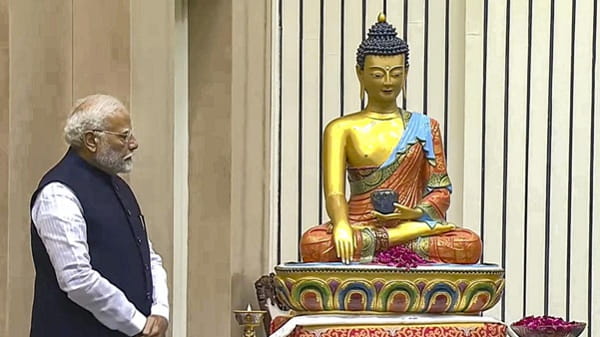
Indian Prime Minister Narendra Modi during the International Abhidhamma Divas programme, in New Delhi, on October 17, 2024. | PTI.
The central challenge before India has been to prove that Indian nationalism can guarantee the security and prosperity of its people and take India to the high table of the 21st Century. The latest statistics from the World Bank indicate that poverty in India has been virtually erased. Over the last decade, India has also sustained the largest welfare schemes in recorded history, most notably providing sufficient food to 800 million people and expanding tech availability to over a billion, a remarkable digital expansion. For the body politic to function at the level of people’s expectations in a democracy, both hands must be muscular: economy and military.
The change is visible, if not always recognised. During the first decade of Prime Minister Narendra Modi’s government, India has emerged as a benevolent power with a steel backbone. It rejects war as regressive but understands the meaning of Bismarck’s aphorism: an invading army at the border will not be stopped by eloquence.
On Wednesday 10 July, 2024, Prime Minister Modi said at a meeting with Indian diaspora in Vienna that India had given the world Buddha, not yuddha, or war: “For thousands of years, we have been sharing our knowledge and expertise. We didn’t give ‘Yuddha’, we gave the world Buddha. India always gave peace and prosperity, and therefore, India is going to strengthen its role in the 21st century.” As Mahatma Gandhi noted, dryly, an eye for an eye would leave everyone blind.
India has been a first responder in any humanitarian crisis, playing a striking role during the Covid crisis and reaching out with immediate aid during any natural calamity within the range of its extended neighbourhood. Prime Minister Modi has changed the meaning of neighbour, redefining it by goodwill and reach rather than proximity. The new arc of neighbours extends from the Gulf to the Malacca straits; Pakistan is a presence, not a neighbour. Modi has established a swadeshi foreign policy, which harmonizes national economic and political interests with partnership for a better world. Multinationals, to give one example, engage with India on India’s terms because they appreciate that it is mutually beneficial. If they want the Indian market, they must learn to ‘Make in India’. The so-called superpowers now understand that while India can be persuaded, it cannot be bullied or threatened.
India has met the challenge of economic development through a turbulent growth story. The 1970s were stagnant, touched by the malign odour of stale socialism that had long passed its sell-by date. It was only in the mid-1980s that a younger generation began to strike out towards change and took the first hesitant steps towards reform. The pace might have been faster but for the cataclysmic upsurge of secessionist forces and hostile insurgencies which led to the assassination of two Prime Ministers, Mrs Indira Gandhi and Rajiv Gandhi.
Economic reform in the 1990s began to open the doors to entrepreneurial creativity, but the passage towards a new horizon took time to clear. India found itself in the 21st century, of which the decade between 2015 and 2025 has witnessed a series of breakthrough advances in the collective health of the people and the nation. India is on its way to meeting its greatest challenge: a Viksit Bharat, or a developed nation, by 2047.
India was once caricatured as a combination of lofty hot air and low delivery. The nadir was in the 1960s. The low point in relations with Pakistan came during bilateral talks in 1963 when India offered Poonch, Uri, Kishanganga, and the Neelam valley to Pakistan as a final settlement. This arbitrary offer seems unbelievable today, but facts sit patiently in the archives. Even more incredible is that Pakistan’s leaders, consumed by the hubris that drove them to war in 1965, rejected this option.
Today, Pakistan has shifted the conflict with India from set-piece battles between conventional armies to the continuous bleed of terrorism. India has made it clear that there cannot be two laws, one where America or its allies can pursue their quarry across borders, but advises restraint when India is attacked by terrorists. India seeks justice after a Pakistan-sponsored terrorist outrage, not arbitrary revenge. Weakness, whether economic, diplomatic or military, is now a distant memory.
The world has long been in thrall to empirical theories like 'balance of power'. In a quiet but methodical style, India is exhibiting through its policies the power of balance. The principal motives for aggression have not changed much through history: ambition, ideology, and the compulsive temptation of supremacy. ‘Balance of power’ seeks equality in aggression, on the assumption that it is the natural impulse of state behaviour.
Narendra Modi’s search for equilibrium in international relations is linked by five interconnected principles: respect (samman) for every nation; dialogue (samvad) as the basis of conflict-resolution; security (suraksha) as a pillar of stability; prosperity (samriddhi) through domestic effort and international cooperation; and cultural harmony (sanskriti) as a civilizational virtue.
It is time for the world to discover the power of balance.
(Exclusive to NatStrat)
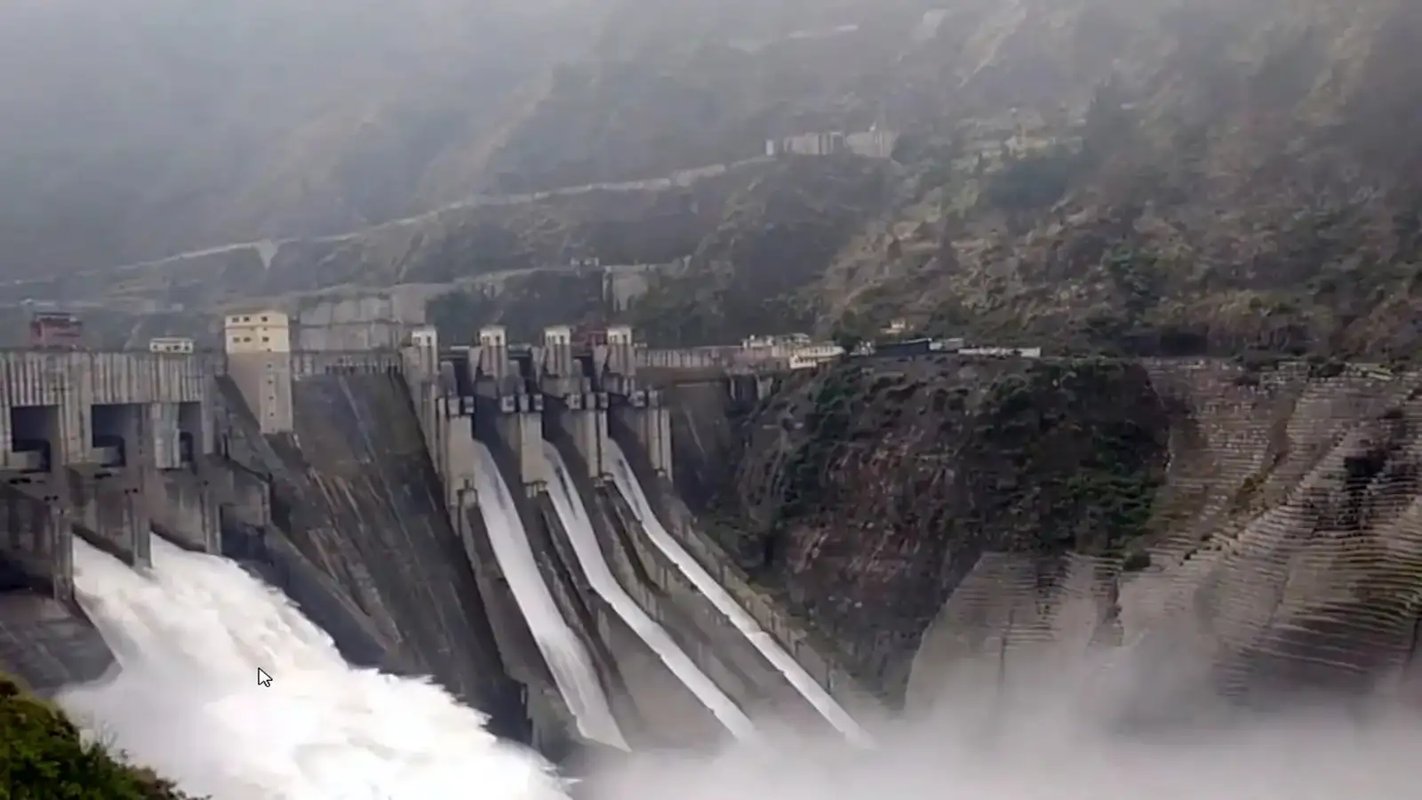
Separating Reality from the Rhetoric: Facts, Fiction, and the Indus Waters Treaty