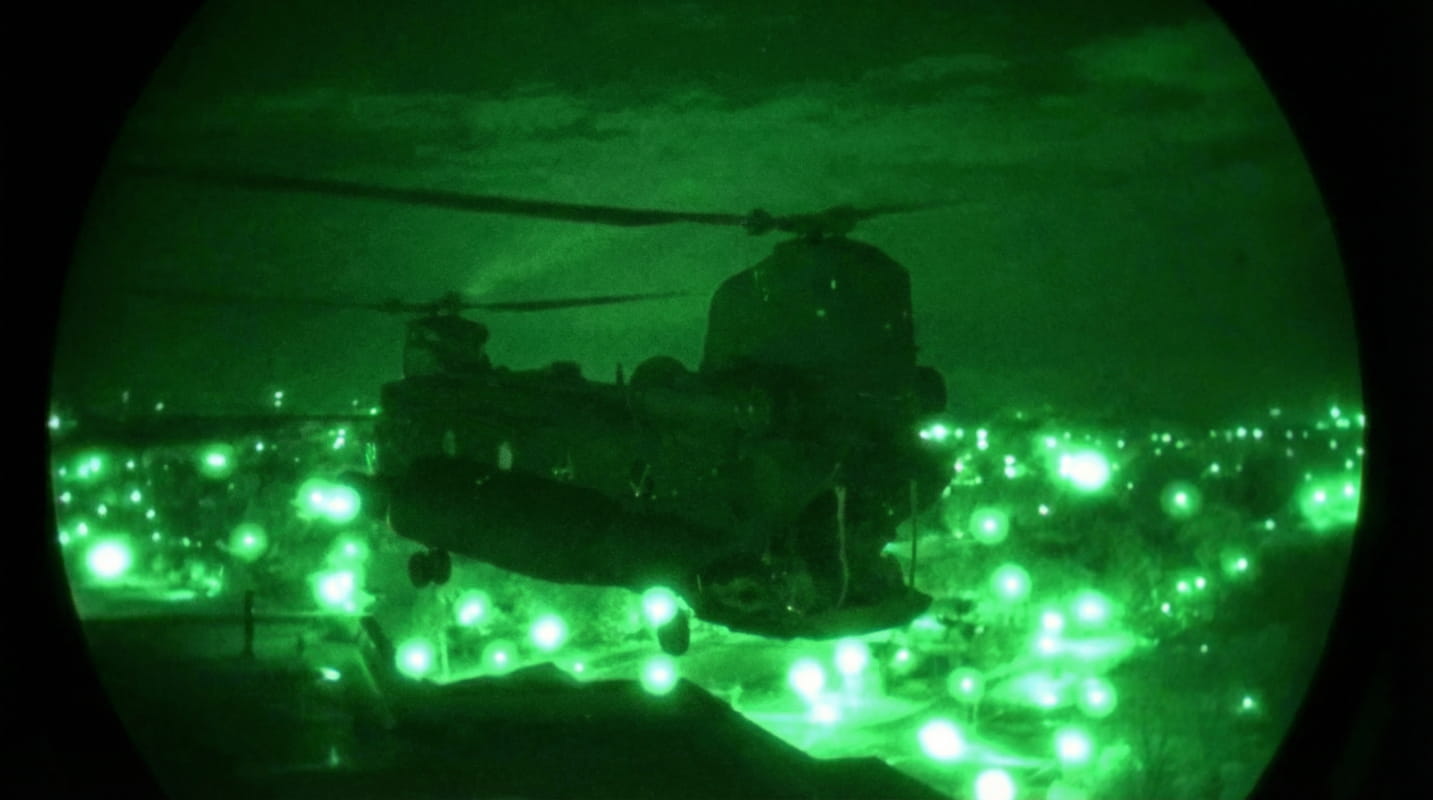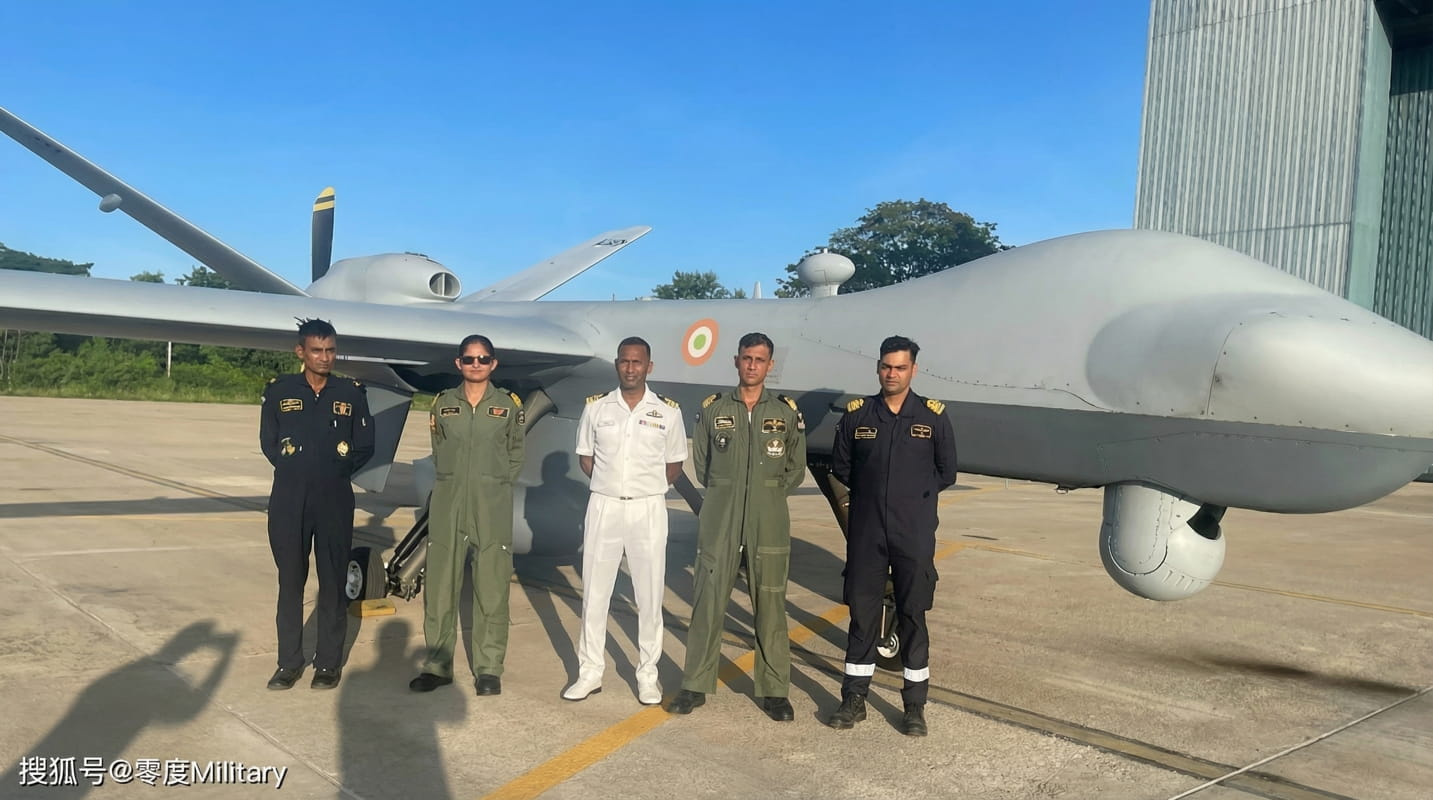


Representative image.
“Software eats the world, and now it’s eating the battlefield.”- Marc Andreessen
An important lesson for India from the Russia-Ukraine War, as well as its own domestic experience during the recent Pakistan conflict, is the need for indigenisation in drone manufacturing in the face of changing geopolitical and defence partnerships.
Contemporary and future warfare are being reshaped entirely by drone weaponry, also known as dronery. The recent use of drones in warfare, emerging from the Russia-Ukraine War to the Middle East and now closer to and at home in South Asia, have shown their increased and widespread use in domains beyond basic surveillance, with multiple actors showcasing their adaptability and agility. The arms race and warfare technology development now has drone and counter-drone strategies at their centrefold, with emerging powers like Turkey, China and Iran establishing a stronghold in development and other states rushing to indigenise their production and material procurement. This is transforming the use of AI, training and military doctrines, as well as emerging militaries across the world. In such a situation, countries not only need to prioritise and re-strategise their national defence systems and war preparedness with integration of new technologies and weapon alliances but given the involvement of non-state actors, also look at international regulations and the acquisition of drone technology.
Introduction
Experts are in argument about the history of drone warfare with some stating it began with the construction and use of Queen Bee in 1935 which was a radio controlled by biplane while others argue the stage for current drones and the basic concept behind was first observed in action long ago in 1848 during the Italian revolution with the use of unmanned hot air balloons to bomb Venice. Hence, while drone attacks and usage are not entirely new to warfare, the characteristics and scale of their use in the Russia-Ukraine War have alerted the world about drones as a specialised weapon of war. In past conflicts, the most widespread use of drones was for surveillance on enemy camps to capture imagery, troop movements, locate cargo, among others, to serve as intelligence platforms to carry out coordinated attacks.
The past decade has also seen an emergence of new global players like Turkey, Iran and China in a drone market previously dominated by the USA, Israel and Russia, at production costs far lower than the traditional drone powers. This term can be analysed further by data from Stockholm International Peace Research Institute (SIPRI), which shows that the USA delivered 12 combat drones in the past decade to France and Russia, excluding Ukraine, which received both monetary assistance as well as developed advanced drones from the USA. In contrast, China delivered nearly 300 drones to 17 countries.[1] This could largely be owing to the highly advanced and high-cost nature of US drones but highlights China’s monopoly over commercial, combat drones and their components.[2]
Israel and Turkey have emerged as indigenous drone powers in the market, with public-private partnerships providing research, development and production of combat drones to meet national demands as well as become global suppliers. Furthermore, the attack on Israel by Iran on 13 April 2024 revealed Iran’s drone power as it used around 170 drones, cruise and ballistic missiles.[3] Iran has been developing these drones as an alternative to their staggering airpower. The attack was largely a failure as a large proportion of it was intercepted, revealing gaps in their power. However, it is also alleged that other groups in a fight against Israel, like Hamas and Houthis, are also using Iranian drones, which also raises concerns about non-state actors and their access to unregulated combat drones.[4]
The recent conflict with Pakistan has highlighted our neighbour’s drone availability through the drone swarms they launched between 8 and 12 May 2025. However, it has also alerted the world and our rivals about our drone capabilities as the successful Operation Sindoor was conducted using drones to suppress air defences (AD) while using missiles to destroy terrorist camps inside Pakistan, as well as our counter-drone structures like S-400, which were able to intercept most Pakistani drones.
Drones are now a part of aerial warfare. However, a false narrative has emerged fromthe Russia-Ukraine War and the Middle East: drones can be used as an alternative to traditional air power and fighter jets due to their low operational and acquisition cost. For countries like Ukraine with differing terrain and financial limitations, drones might serve as an alternative to fighter jets. In our case, they serve as new instruments in our defence arsenal, complementing the traditional ones.
Naval Drones
One popular misconception that recent clashes have created is that drones are just a part of aerial warfare. However, different historical uses date back to the presence of drones as weapons in both land and naval domains. This has been further transformed by innovations and technological advancements that have created naval and land drones. The domains of maritime security are evolving now with Unmanned Underwater Vehicles (UUVs), Unmanned Aerial Vehicles (UAVs) and Unmanned Surface Vehicles (USVs). Drones are involved in naval warfare for uses like aerial in some cases, like surveillance and attacks but also for specific purposes like anti-submarine warfare. One such case of traditional surveillance is the US-developed and used MQ-4C Triton.[5]
In naval warfare, much like aerial warfare, while drones have been present and actively deployed for quite some time, the one-time use of drones for attacks known as kamikaze drones is a novel feature.[6] So far, their use in the maritime domain has not been used in battle but primarily focused on ocean floor mapping and surveillance for gathering intelligence and strengthening countermeasures.[7]
However, naval combat drones might just be the most revolutionary drone warfare aspect that emerged out of the Russia-Ukraine War in terms of technological advancements. Ukraine, which had lost its naval fleet in 2014 during the Russian annexation of Crimea, was predicted to easily collapse once Russia sent its ships into the Black Sea.[8] However, the Magura V5 Combat Drones have appeared to be life-saving, preventing a naval blockade by the Russian Navy.[9] These, along with their domestically-developed Neptune missiles, have been successful in sinking one Russian submarine, five amphibious landing ships, four smaller patrol warships and their flagship warship of the Black Sea Fleet – the Moskva – since 2022.[10][11]
The use and innovation of fibre optic imaging have further strengthened naval drone technology as they are now capable of sending images for intelligence and surveillance purposes to the Sound Navigation and Ranging System and using new technology like gyroscopes to detect motion changes.[12] The Houthis have shown another successful display of combat naval kamikaze drones developed locally at a low cost, which are like Ukraine’s Magura V5 and have deployed them in the Red Sea to target commercial ships and restrict access to a global shipping route essential for commerce.[13]
The US and China are two other nations actively developing and researching naval drone capabilities and technology. Most new US naval ships now have Long-Range Unmanned Surface Vessels which use swarm technology to hit targets.[14] The discovery of Chinese underwater unmanned gliders has raised global concerns over their growing naval capabilities as they have also announced an active project for developing AI-driven unmanned submarines.[15]
It is important to note that American and Chinese drone developments in the maritime domain are even more alarming given that the conflicts in the Taiwan Strait and the South China Sea arelargely dependent on their naval capabilities and maritime exercises.
Russia-UkraineWar
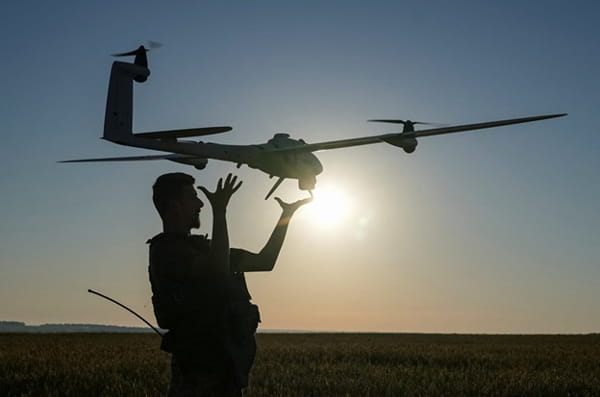
A drone operating launching his UAV in the Russia-Ukraine theatre. | Center for European Policy Analysis.
The Russia-Ukraine War has used drones in every domain (air, land and sea) and for every aspect of warfare, including surveillance, dropping cargo, documenting attacks and conducting strikes.[16] The use and capabilities of drones have evolved throughout the war so far, as have their manufacturing and development. Initially, Ukraine was seen using Turkish TB2 Bayraktar drones to target Russian convoys and the Moskva; at this time, it was more of a supporting mechanism and a distraction from the main defence line of attack.[17] However, surveillance by drones has been used to maximum effect by Ukraine as it has used software like Kropyva to create a map using the routes, locations, targets and movements captured by their drones.[18]
The scale of drone usage during the war has been another alarming feature that has taken drone warfare to a new and unprecedented level. To assist this, Ukraine formed the first of its kind military branch overseeing drone operations: the Unmanned Systems Force in February 2024.[19] Initially, Ukraine relied heavily on Chinese drones. As the war progressed, so did the growing closeness between Russia and China. A need for indigenous production emerged as Chinese companies stopped supplying to Ukraine. Ukraine adapted soon, and while it continues to use Chinese-manufactured components, it uses commercial drones and components to assemble them locally. They have also increased their annual production rate to four million drones.[20]
Ukraine’s vast deployment of drones varies by their size, typeand range to adapt to the user end from toy-sized to winged aircraft-like structures for surveillance.[21] Given their in-house manufacturing and cheap Chinese components, their price range is also very dynamic and can be developed in lower ranges, except for advanced models like the Buntar 3.[22] Drones, being much more cost-effective to hit multiple and prolonged targets against Russia, have been used dominantly by Ukraine in place of traditional air systems like fighter jets. The in-house assembly also has larger implications as civilian-use drone models like the Chinese DJI Mavic, manufactured to document weddings, have been used by individual Ukrainian soldiers to gather intelligence on troop movements and positions.[23]
However, while Ukraine emerged as an indigenous, technologically-savvy country, adapting their drones as per uses and culpabilities learned from previous missions, Russia has also used their strengthened cooperation and ties with manufacturing giants like China and Iran to do the same. It set up a factory in Tatarstan to produce roughly 6,000 units of Geran-2 drones, which were traditionally the Shahed-136 drones.[24] Russia is also adapting and evolving its approach towards drone responses; it can now repurpose and build a new drone from an intercepted Ukrainian drone.[25]
The beginning of the war showcased the effectiveness of drones to a new extent. Ukraine was seen countering traditional aerial power with drones despite the limited impact of explosive capabilities of drones by exploiting their pinpoint accuracy and hitting moving vehicles using First Person View drones. Traditional methods would have been difficult to carry out due to heavy artillery shelling by Russia.[26]
Traditional airpower includes larger aircraft and missiles lacking stealth and cannot fly atlow altitudes like drones can. These features have helped drones bypass radar and AD systems.
Turkish Drones
Private companies in Turkey, primarily Baykar, which developed the Bayraktar TB-2 drones and Kale, areto be credited for Turkey’s global lead as a drone manufacturer and supplier. Baykar has announced Turkey as the world’s largest drone producer, and data from the International Crisis Group reveals that it has either supplied or is working on an agreement with 41 countries on drone supply, primarily of the TB-2 drones.[27] The Bayraktar TB2 has showcased its capabilities in conflicts all over the world, including with Turkish forces as early as 2019 against Kurdish insurgents. It sold armed and regular versions of the TB-2 drones to Ukraine the same year in a USD 69 million contract.[28] The drone has also been deployed in various terrains, highlighting its capabilities, like in North Africa’s civil wars and the Nagorno-Karabakh conflict between Azerbaijan and Armenia, as they were used to target AD, soldiers and tanks.[29]
In a further attempt to revolutionise the future of technology in warfare, Turkish Aerospace Industries (TAI) announced the KAAN project in 2016, which is an AI-assisted, all-weather suitable fighter jet with superior target recognition, mapping and electronic warfare (EW) capabilities.[30] The development of this project also comes as part of the same broader policy goal which brought drone development in Turkey. The goal was to reduce foreign dependence after the impact of the arms embargo imposed by the West on Turkey following the Cyprus Peace Operations, and to also reduce the reliance on Israel’s Heron UAV. More recent projects from Baykar are further complicating AI-powered drones from a technological warfare perspective. The company announced the first successful flight of the Kizilelma in 2022, its first unmanned fighter jet, and started its mass production recently. It is also developing naval drones and has upgraded the TB2 to become a more lethal combat weapon with TB3.
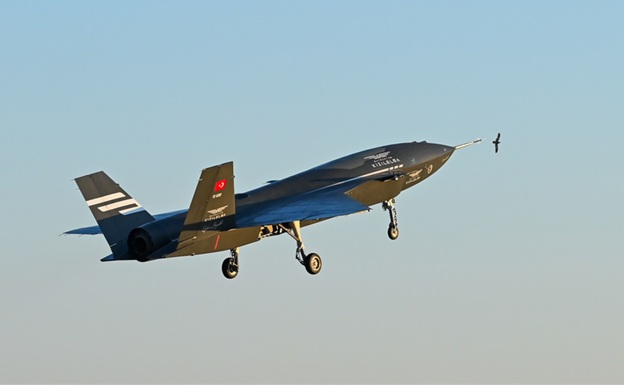
Turkish firm Baykar’s Kizilelma on its maiden flight, September 2024. | Baykar Tech.
Turkish drone power has also emerged as a rising concern for India as its neighbour, Pakistan, was seen boosting Turkish Akinci drones during the recent conflict in May 2025. Additionally, reports suggest that TB3s have been supplied to other nations in the South Asian subcontinent, including Bangladesh and the Maldives.[31] Pakistan-Turkey ties are also alarming, as earlier this year, following the Pakistan-Turkey Industrial Expo, they announced setting up a factory for KAAN production in Pakistan in a move to assist Turkey with lower production costs and give Pakistan a chance at high-end technology at affordable rates. This is alarming as Pakistan’s access to fifth-generation fighters has so far been limited due to restrictions and economic burdens.[32]
Given that Bayraktar owner Selçuk Bayraktar is also the son-in-law of Turkish President Recep Tayyip Erdoğan, drone technology command and production is likely to be an accelerated political motive in Turkey’s near future as well. The Turkish President maintaining the development, production, acquisition, supply and use is a positive sign for Turkey’s allies, including Pakistan. (This is the first part of a two-part series on the topic. Read the second part here.)
(Exclusive to NatStrat)
Endnotes