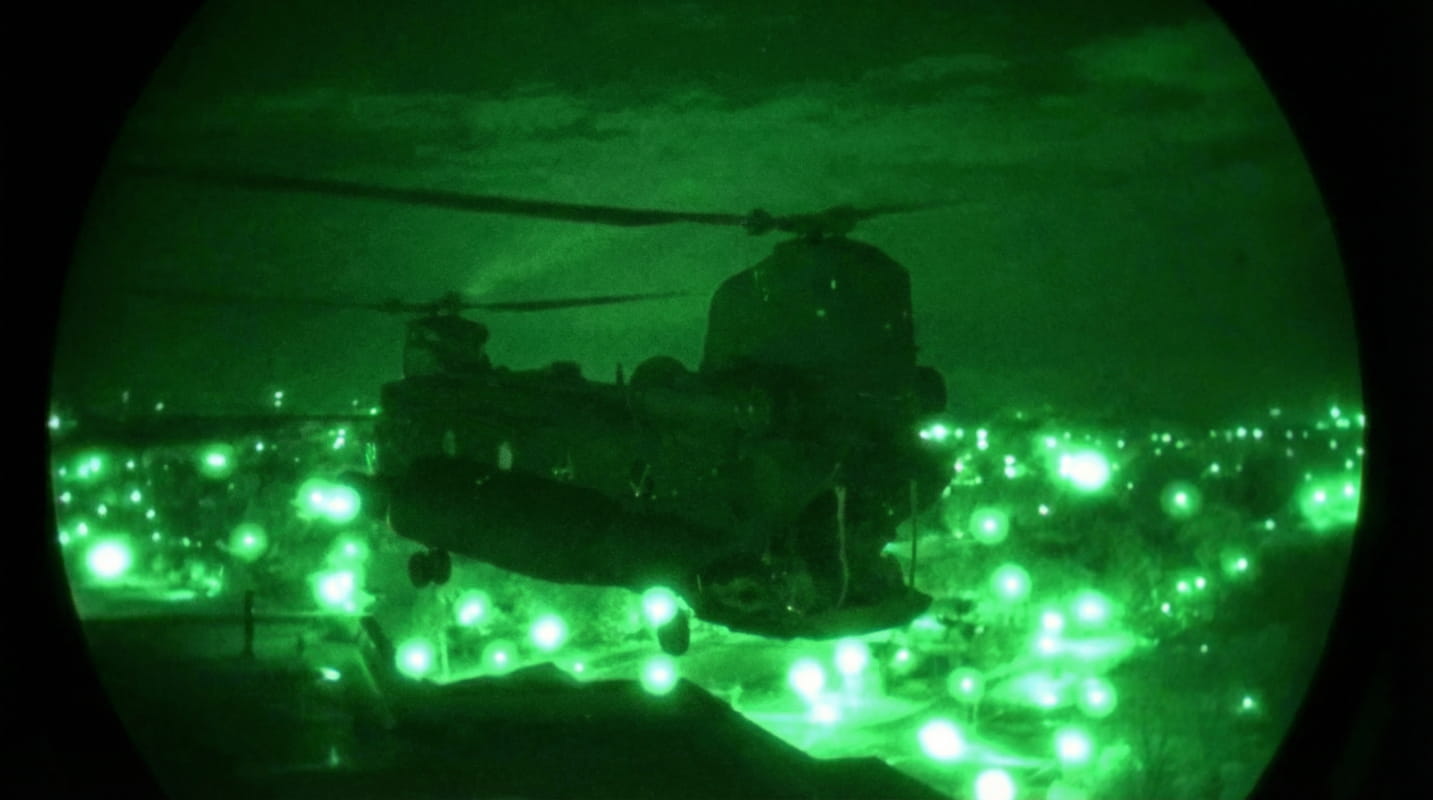


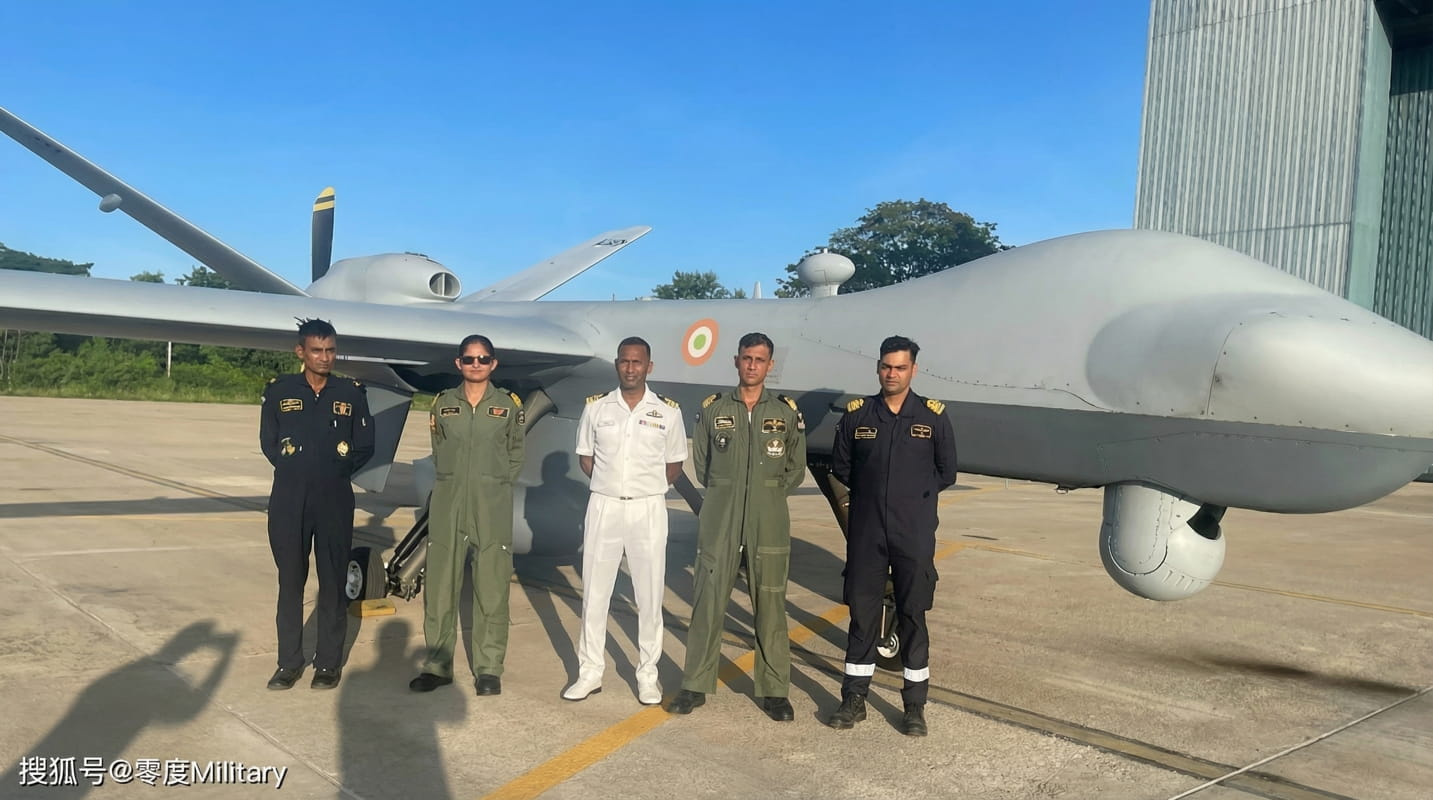
Indian Army, Navy and Air Force officers with a drone operated by India. | India Today.
An important lesson for India from the Russia-Ukraine War, as well as its own domestic experience during the recent Pakistan conflict, is the need for indigenisation in drone manufacturing in the face of changing geopolitical and defence partnerships.
Use of Drones in the India-Pakistan Conflict
Pakistan retaliated to Operation Sindoor on the night of the 7 May 2025 by launching Operation Bunyan al-Marsus, which it claimed targeted Indian military bases only but was seen as attacking civilian areas and cities along the border too. Turkey emerged as a partner in Pakistan’s mission as it carried out drone strikes in these areas by deploying roughly 300-400 Turkish drones, including Asisguard Songar and NESCOM Burraq drones. While reports claim Pakistan also has Chinese CH-3 and CH-4 drones along with some indigenous ones like Shahpur and Sarfirosh kamikaze drones, their use during the conflict from 7-12 May can only be speculated as no such evidence was found.1
The conflict revealed India’s superiority against sucha drone attack as it was not only able to successfully carry out drone strikes with only 25-70 drones being intercepted by Pakistan but also by intercepting 90 per cent of Pakistani drones as they entered Indian territory.2
India deployed loitering munitions, medium altitude and long endurance (MALE) drones, specifically Israel’s Harop and Heron Mark, instead of Pakistan’s swarm technique, which appeared to have been ineffective.3
India’s Drone Capabilities and Production
India has a vast range of drones it utilises to carry out surveillance, rescue operations and serve as a means of transportation, as well as carry out precision attacks on enemy camps. They range from those acquired by other global players, indigenously developed private drones, private drones developed in collaboration with international companies, as well as those by the Defence Research and Development Organisation (DRDO), indigenously and in collaboration with Indian private companies.
Drone rules established in 2021 and the Drone Shakti Mission in 2022 created a pathway for private companies, start-ups, collaborations with the government sector for technological research and development, manufacturing and deployment of drones.4 As a result of this, its fleet by mid-2024 included 2000-2500 drones with a spending cost exceeding USD 400 million.5 India has also acquired drones from multiple countries, including Israel, which has emerged as an active Indian partner and collaborator in defence technology with Heron, Harpy and Harops.6 It has also signed a deal to acquire 31 MQ-9B Predator drones from the US and used them in a recent rescue mission of 15 Indian crew members near Somalia by the Indian Navy.7
However, it is important to note that under Atmanirbhar Bharat and India’s drive for indigenisation of defence technology, it has also developed the Nagastra-1 kamikaze drone and the Rustom-2 MALE drone.8 During the Covid-19 pandemic, India also effectively used indigenous drones to deliver vaccines and essential medical supplies to remote areas of the Northeast, Jammu and Kashmir, Andaman and Nicobar Islands, as well as to Nepal, eliminating time constraints and accessibility challenges.9
India has also been able to become a global player in drone production, owing to efforts from the Adani Group, which launched a collaboration in 2018 with Israel’s Elbit Advanced Systems to produce Hermes 900 drones in Hyderabad.10 Emerging defence startups like Garuda Aerospace and Paras Defence are focusing heavily on indigenisation, with the former achieving 75 per cent indigenous products and parts and the latter creating UAV cameras for domestic production and testing of hydrogen-powered drones in collaboration with Israel’s Heven drones.11
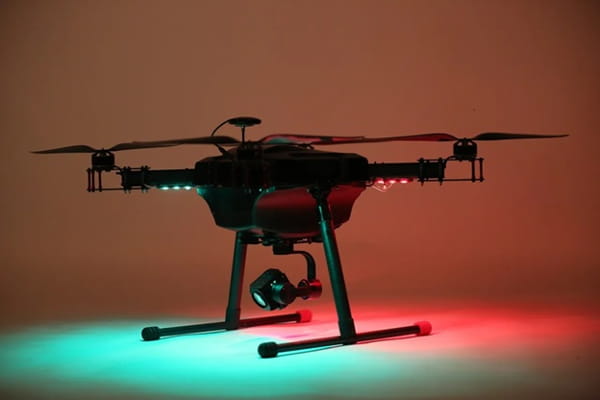
A Garuda Aerospace drone. | Bots and Drones India..
A major challenge for India’s drone capabilities will be the manufacturing cost. Chinese drones are among the cheapest in the market, followed by Turkish drones. However, our diplomatic and geopolitical rivalries with both nations limit us from collaborating with them or acquiring their drones. Post the India-Pakistan conflict, we can now argue against their effectiveness. The challenge for Indian defence industries will also be to create and manufacture cost-effective drones without using Chinese parts for their integration in the Indian Armed Forces.
Among other significant indigenous drones are the Skystriker drone, which is a kamikaze drone with a range of 500 kilometres12 and HAL CATS and Netra, developed by Ideaforge and the DRDO to enable surveillance from high altitudes, suppression of enemy air defences (SEAD), and swarm techniques13. The Indian Navy has also been active in this technological advancement with its joint creation of Abhimanyu with NewSpace Research and Technologies, which is a first-of-its-kind, swarm-powered AI combat drone in India’s private sector.14 The Navy has also acquired the Drishti 10 Starliner, developed by Adani Group for maritime surveillance.15
Chinese Drone Capabilities
China has also been heavily investing in UAV systems to facilitate compatibility with AI, swarm techniques and target precision with a large range of drones. Low production costs, defence companies like AVIC and DJI, along with government initiatives, have allowed mass industrial-scale production and application of advanced technology for these developments.16 Its swarm technique was earlier flag shipped by the Chinese Jetank mothership but has now been upgraded with the Jiu Tian drone carrier that can carry six tonnes of drones and ammunitions at a high altitude of 15,000 metres and can deploy up to 100 small, loitering or kamikaze drones from two sides, creating a highly lethal precision attack that could easily overwhelm traditional AD systems.17
The Chinese have also developed lightweight, AI-powered micro drones that have been used by the People’s Liberation Army (PLA) to carry payloads greater than any other drone globally.18 Other Chinese drones like the CH-9, Wing Loong-X, TB-001 Scorpion and Wing Loong-X have allegedly been used in the Taiwan Strait and the South China Sea are also highly advanced, with the CH-9 able to remain airborne for 40 hours, carry around 500 kilograms and launch KD-12 missiles.19
While China has supplied drones globally to multiple countries, reports of their success arefromlimited cases in North Sinai and Africa and have not yet been tested against advanced counter-drone systems like EW systems. Also, it has been reported that the nation is not highly effective in its counter-tactics against drone swarms, with a 40 per cent success rate.20 A possible close concern for India has been Myanmar’s active use of Chinese drones, including CH4 Rainbow, CH3A, and Yellow Cat UAV by the Tatmadaw against the civilian population and rebels since 2021.21 They have also used the repurposing technique, much like Russia and Ukraine, by remodelling Chinese agricultural drones to function as combat drones.
The use of drones has overcome the nocturnal barrier presented by traditional airpower to carry out attacks using thermal night vision forward-looking infrared cameras.22 Attacks on areas like Sagaing, Bhamo and Laiza in Myanmar have been the most notable of these.23 In retaliation, the National Unity Government (NUG) and Karenni Nationalities Defence Force have also repurposed commercial drones to drop explosives and contrabands, including the drone attack by NUG in April 2024 on the Tatmadaw’s capital.24
Use by Violent Non-State Actors
With the rise of social media and the internet in the past, we have already witnessed the exploitation of cheap and accessible technology by terror groups, as 90 per cent of them use such platforms to gather recruits, spread propaganda without filters or interception in real time.25
The comparative low cost, easy production and multipurpose feature of drones is also highly threatening when seen in terms of their availability and use by violent non-state actors. The role of insufficient government frameworks, international regulations, sale and manufacturing by the private sector, with a largely flexible use of terms and regulations of the use of drones, further complicates and facilitates their use and acquisition by such groups.
The reassembly and commercial to combat bridging of drone use is a novel feature as commonly available consumer products costing on the lower end between USD 1000-3000 have been used for combat purposes, raising concerns about their ease of access to non-state actors and violent groups in the future too. Such modified drones have already been deployed by Mexican drug cartels, and multiple reports of bomb-strapped drones have appeared in Mexican towns of Aguililla. These drones are being used to deliver drugs as well as attack their enemies and law enforcement agencies.26
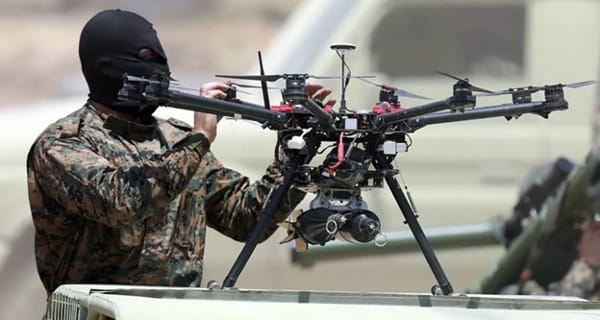
A Hezbollah soldier in a training exercise, May 2023. | Tasnim News.
Earlier, the high cost and regulatory frameworks of Western drones limited their supply to countries but with the emergence of private low-cost players in Turkey, China and Iran, this line appears to be blurred now, raising security concerns worldwide. There have also been reports of the Taliban acquiring commercial drones from as early as 2008, including some from China but their utilisation has primarily been limited to propaganda purposes: filming attacks and in some limited cases for carrying them out on check posts.27 These can be seen to date back to their takeover and the formation of the government.
Counter-Drone Structures
With the rise in use and development of combat drones, there is also a need for research,development and advancement of counter-drone technologies and strategies. Most successful of these countermeasures, as witnessed through incidents and attacks thwarted globally, have been kinetic defence structures, EW or hijacking/hacking of drones.
Electronic Warfare
Jammers, radars, spoofers, lasers and microwave systems that haveelectromagnetic strips to block and disable drone systems fall under the category of EW.28 The most commonly used is jamming, which blocks communication lines and signals between drones and their operators, often masking radio signals and causing the drone to become uncontrollable and even go down.29 However, jammers and radio frequency scanners, which can detect and locate a drone before takeoff are both less functional in cases of multiple drone attacks or swarm attacks and often have limited ranges.
Therefore, some countries are now also focusing on developing anti-sensor drones to overcome these systems, like those developed by Anduril.30 Microwave energy pulses against drone swarms or multiple drone attacks like those produced by Lockheed Martin's MORFIUS have proven to be successful.31 Tests over time have revealed that lasers can be easily bypassed as they struggle to attack moving vehicles and can be deceived in weather conditions like rain and fog.
Kinetic Defence
Kinetic defence systems, including traditional AD systems, believe in firing at drones with bullets, missiles, nets, water cannons, among others, to shoot down the drones. The per-shot cost of using medium and long-range AD systems, which are also usually a part of traditional AD systems like S-400, Patriot, National Advanced Surface-to-Air Missile System (NASAMS) and Gepard Anti-Aircraft guns, is said to be too costly for utilisation on small, low-cost UAVs.32 However, in our experience of the May 2025 Indo-Pakistan conflict, it has proven to be most successful against drone attacks. These expensive ones offer a range that new cheap kinetic systems like L3 Vampire are unable to provide.33
The one downfall stated of kinetic systems is that there is a risk of drone debris following itsdestruction, falling in civilian areas and causing injury or loss of life. This has been seen in Saudi Arabia during the shooting down of a Houthi drone, which injured 12 people in the process34, and recently in Punjab during the conflict with Pakistan, where it injured a family of three.35 The UK and the US are also heavily investing in the research, development and production of long-range kinetic devices, with the market of counter-drone tech projected to reach USD 10.5 billion by 2030.36
New Technology Counter Structures
Since kinetic and electronic warfare are not foolproof methods to counter drones and can be bypassed, countries and private companies are now focusing on developing new structures and technologies to thwart these attacks. This includes China’s 16-barrel anti-drone barrage system developed specifically to counter swarm attacks.37 Israel has also developed a new system called EnforceAir that detects and hijacks an enemy drone and can take over its operational controls.38
Layered Defence
However, conflicts around the world have revealed that layered defence systems offer maximum protection against adversary attacks. One example of a three-tier layered and comprehensive defence system is what India has developed and deployed. Its outermost layer is formed by the Russian S-400; it has further placed an order for two more, which are set to arrive by 2026 (India Today News Desk, 2025). They are tasked to detect, track and destroy missiles, aircraft, drones, among others, entering the Indian airspace. This system is further strengthened with other ballistic missile defence systems, having both exo and endo atmospheric interception, which allows for the detection of ballistic missiles anywhere up to a range 5000 kilometres and at an altitude of 80 kilometres.39
Our medium-range surface-to-air missiles (MRSAMs) systems, developed jointly with Israel, form the middle layer. It can target fighter jets, missiles anddrones within a range of 70-100 kilometres.40 The inner-most layer comprises indigenously-developed Akash, Akash-NG and Quick-Reaction Surface-to-Air Missiles (QRSAMs) covers the low-altitude and short-range missiles, aircraft and drones.41 This is finally covered by a combination of EW systems like jammers, radars and spoofers.
Conclusion
An important lesson for India from the Russia-Ukraine War, as well as its own domestic experienceduring the recent Pakistan conflict, is the need for indigenisation in drone manufacturing in the face of changing geopolitical and defence partnerships.
Ukraine previously used Chinese-manufactured drones but soon faced a challenge as the growing Chinese-Russianpartnership meant a stop to this supply. While Ukraine is now manufacturing its drones, it continues to rely on Chinese components for the same. The Turkish and Chinese developed-drones by Pakistan deliver a similar message to India and make us wonder that in the event of a skirmish or conflict with China, India might be vulnerable to losing Russian backing, which seemed crucial in our recent defensive structure. This raises a further call for self-reliance in all defence sectors for India. (This is the second part of a two-part series on the topic. Read the first part here.)
(Exclusive to NatStrat)
Endnotes