

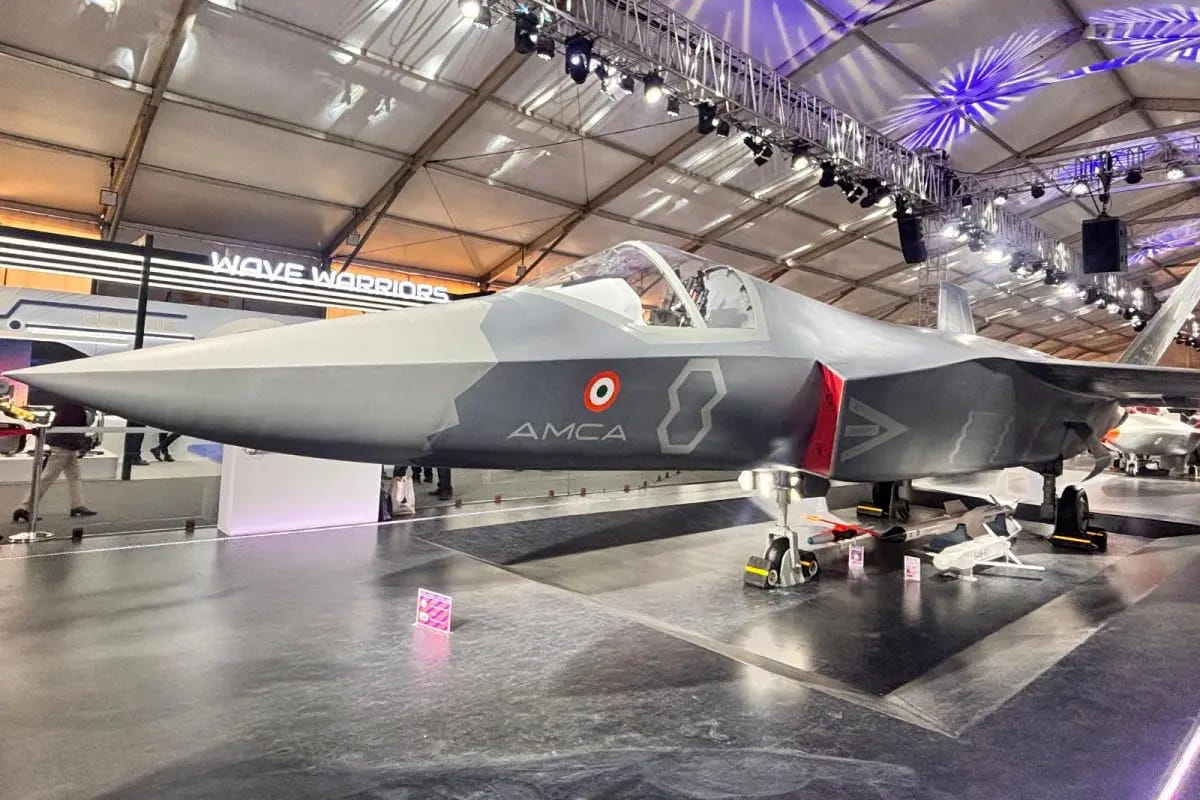
A model of India’s fifth-generation stealth fighter jet, the Advanced Medium Combat Aircraft. | X: @SpokespersonMoD


With Russian President Vladimir Putin’s much-anticipated New Delhi visit in the first week of December 2025 for the 23rd India-Russia Annual Summit, discussions have intensified on the Su-57 most likely to be a key agenda item. A major breakthrough on India’s two-decade wait to join an elite club of global air combat – which produces, not just fields, fifth-generation stealth fighters – could be imminent.
Introduction
2025 has been a landmark year for the Indian Air Force (IAF) in many ways. Three major challenges seem to have emerged from the excitement of hosting two of the world’s foremost fifth-generation ‘stealth’ fighter jets at Aero India in February, to the intense international scrutiny and speculation over the strategic wins and tactical losses during Operation Sindoor in May, to the historic decommissioning of the last of the Mig-21s in September.
Interlinked within India’s strategic, tactical and technological air combat framework, they fall into the following categories:
1. Short-term: the fighter-jet squadron strength of the IAF is at a six-decade low, down to just 29 against a sanctioned strength of 42. To address this challenge, advanced discussions are on to acquire a significant number of the 4.5-generation Rafales (two squadrons of which are already deployed) via another government-to-government (G2G) deal with France’s Dassault. Also, fast-tracked production and delivery of Hindustan Aeronautics Limited’s (HAL’s) indigenous Light Combat Aircraft (LCA) Tejas Mark-1A variant (an upgraded version of the long-delayed and largely obsolete 40 fourth-generation Tejas Mark-1 units under induction since 2015,) are in progress alongside.
2. Near-term: rapid advances in China’s stealth fighter program, with a potential “sixth-generation” variant (first seen in Dec 2024) already being tested, and fifth generation Chengdu J-20 ‘Mighty Dragon’ and Shenyang J-35 being produced at scale, have triggered national strategic concern and a yet-to-be-resolved debate since the start of 2025. Deep cooperation between China and Pakistan – deployed to noteworthy tactical effect in air-to-air combat during Operation Sindoor – has added to the predicament. Reports of China preparing to offer 40 units of its (export variant) J-35 stealth fighter jet to Pakistan by 2026 have been in circulation, even if Pakistani Defence Minister Khawaja Asif claims it to be a mere social media narrative. With India’s own stealth fighter programme – the Advanced Medium Combat Aircraft (AMCA) – only expected to reach the prototype stage by 2028-2029, and make operational deliveries starting in 2035-2036, India needs a counter to the China-Pakistan stealth aircraft threat over the next five to ten years.
3. Long-term: the lack of an indigenous jet engine has become India’s most pressing strategic hindrance to aerial combat. Intense geopolitical flux in recent years, and significant uncertainty in the United States’ (US’s) domestic politics (and resulting policy positions), has meant that reliance on the US’s General Electric (GE) – for the delayed deliveries of F404-IN20 fighter jet engines to be used in the Tejas LCA Mark-1A, after a deal was agreed upon for the same in 2021 – has left New Delhi in the lurch.
This is likely to have a cascading effect on India’s indigenous jet production and delivery timelines for years to come, unless a critical stopgap solution (or alternative) to the problem is found.
The analysis below takes a deeper look at the second challenge of India’s prolonged desire and the IAF’s growing need to on-board fifth-generation fighter jets and stealth technology.
The Fifth-Generation Fighter
‘Survivability’ is considered as the overarching criteria of a fighter jet’s evolutionary ‘generation’. The main capabilities of a fifth-generation fighter aircraft are: high nose-to-tail stealth technology – to be able to fly and penetrate enemy air defenses without being detected; advanced data and sensor fusion – for comprehensive situational awareness and battlespace connectivity; supercruise – the ability to fly at supersonic speeds without using an afterburner; increasing fuel-efficiency; supreme maneuverability; and serving as a command-and-control (C2) post in the air.
India’s interest in being at the forefront of this air combat paradigm goes back to the start of the century. In 2000, Mikhail Pogosyan, then head of Russia’s Sukhoi Design Bureau, had proposed a potential partnership to India on their futuristic programme of advanced front-line aviation complexes, which were launched in 1999 and labeled PAK-FA. The project first took shape in the form of the T-50 platform and then evolved into the Su-57 aircraft in its current avatar. Keen on getting involved in the endeavour beyond the role of a financier, India held off its commitment for a few years, and even courted the US’s Advanced Tactical Fighter (ATF) project for their F-22 platform in 2002.
Unable to purchase the F-22 or enter a partnership over the F-35 in 2005, New Delhi agreed to join hands with Moscow on what became the ‘Fifth-generation Fighter Aircraft’ (FGFA) programme in 2007. By 2010, a preliminary contract was signed between Russia and India for the development of the FGFA with the goal of delivering 250 aircraft to the IAF at an estimated $35 billion.
Unfortunately, India exited the programme in 2018 after having invested $295 million – after years of timeline delays, design differences and project dissatisfaction – fearing exorbitant costs, inadequate technology transfer and platform deficiencies on stealth, radar and engine.
America’s F-35 Charm Offensive
In February 2025, on Prime Minister Narendra Modi’s visit to the US shortly after Donald Trump’s inauguration as President, Trump announced, “We’ll be increasing military sales to India by many billions of dollars. We’re also paving the way to ultimately provide India with the F-35 stealth fighters.” Deals for advanced US military hardware – such as the Lockheed Martin F-35 Lightning II multi-role stealth aircraft – can take years to materialise, not to mention past American reservations against offering the aircraft to a nation deploying the Russian S-400 air defence system (as in the case of NATO ally Turkey). Analysts therefore believe that this might be a political gimmick by the maverick US President in response to India’s protests over his administration sanctioning a $400 million ‘maintenance and sustainment support’ package to Pakistan for its existing fleet of F-16 Fighting Falcons.
The Lightning is regarded as the world’s foremost multi-role combat aircraft and boasts the world’s most advanced avionics package. Its electronic warfare (EW) capabilities allow it to make standalone attacks without needing support aircraft, thereby penetrating even dense air defences undetected. First deployed by the US Air Force (USAF) in 2016, 19 countries have signed on to the American F-35 programme and over a 1,000 aircraft have been built thus far. However, the Lightning has seen significant troubles and controversies over its costs, reliability, availability and maintenance throughout its lifespan – across hardware, software, electronic or logistical aspects – leading to allegations of being a ‘trillion dollar train wreck’ and ‘having hollowed out the USAF’.
Besides, there is significant skepticism in India over the F-35’s suitability to New Delhi’s defence ecosystem. Choosing a platform like the American F-35 platform will need India to set up a completely new line of technology systems and support, with a new partner, as was the case with the C-17, C-130 and Apache fleets.
Although the US has agreed to co-produce fighter jet engines with India in the past, and offered the Predator drones (a first with a non-ally) along with crucial other military equipment, in the F-35’s case – without the offer of technology transfer, customisation and joint development of future paradigms – India can no longer be expected to take a large leap of faith on such time-sensitive and mission-critical national security needs.
Additionally, imagine a roughly $100 million lone F-35 Lightning II, immovable and basking in the Indian sun for ten days. Possibly the worst kind of marketing Lockheed Martin was hoping for at a time when their proposal for India’s 114-Multirole Fighter Aircraft (MRFA) mega-tender was reportedly on its way to submission. Going by how Indian public sentiment works – this – besides Donald Trump's reckless Pakistan indulgence and hostility towards India in recent months – have meant that a deal is almost certainly off the table.
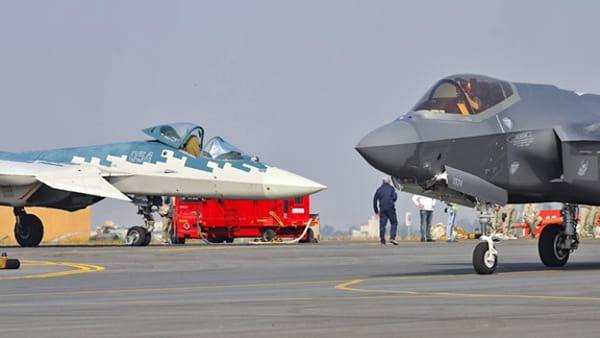
Russian Su-57 and American F-35 at Air Force Station Yelahanka, Bengaluru, at Aero India 2025. | PJSC United Aircraft Corporation/Anadolu via Getty Images.
Russia’s Rekindled Su-57 Offer
Manufactured by Russia’s United Aircraft Corporation (UAC), the Sukhoi-57 is Russia’s first aircraft designed with stealth technology. Designated ‘Felon’ by NATO, it entered service in the Russian Aerospace Forces in December 2020. It has seen combat deployment in Syria and Ukraine since. Much younger in age than the F-22 (operational since 2005), and even the F-35s (operational since 2016) and China’s J-20 (untested in combat), neither of which are available for purchase on the international market, the Su-57 carries significantly more operational experience than the remaining stealth fighters in production – China’s J-35 (first-deployed in 2025) and Turkey’s KAAN (yet to be deployed). However – having courted and come close to selling the Su-57 to many nations in the last 15 years – Russia has thus far been known to have just one purchaser for its prime fifth-generation offering: Algeria. It is reported to have placed an order of six aircraft, with the option to buy four more later. UAC Chairman Vadim Badekha has stated it has delivered two aircraft to a foreign customer, with observes believing it to be Algeria.
The two main reasons for the Su-57’s lack of demand are – its low stealth capabilities, and Russia’s entanglement in the Ukraine War leading to heavy sanctions on its military production capabilities.
The first reason: the Su-57’s radar cross-section (RCS), estimated to be 0.1 to 0.5 square meters, is only slightly better than a 4.5-generation fighter jet like the Rafale. In comparison, the F-35 is widely considered to offer unmatched stealth characteristics, critical for modern air combat where undetected penetration of contested airspace is a game-changer. Its RCS is approximately 0.0015 square meters, which makes it extremely hard to detect. As the former IAF SEPECAT-Jaguar pilot and defence analyst, Vijainder K Thakur, explains:
“The F-35 features all-aspect stealth, meaning ground-based radars, whether positioned in front, behind, or on the sides, struggle to detect it in time for effective engagement by air defense systems. In contrast, the Su-57 has strong front-aspect stealth but significantly lower all-aspect stealth compared to the F-35. When flying head-on, as it would when intercepting an intruding fighter, the Su-57 can approach an F-35 undetected and engage it at close range. However, if the Su-57 were to penetrate contested airspace – while it would not be detected at long distances, it would become visible at shorter ranges, giving enemy radars and air defense systems enough time to engage it.”
The second reason: since Russia’s full-scale invasion of Ukraine in February 2022, there has been a significant burden and diversion of its resources. Alongside Western sanctions that have gutted its access to critical components, Russia’s ability to deliver military hardware has taken a significant hit. This explains why, as of August 2025, only about 25-32 units of the Su-57 are operational. Further, as per one set of leaked documents, many of these aircraft have been deployed in a “stripped-down, incomplete form” and at significant overhead costs. These documents suggest that Western sanctions have succeeded in cutting off Russia’s supply to key microchips, hampering the aircraft’s targeting systems and surveillance capabilities. Analysis from another set of leaked documents indicates that Moscow cannot independently manufacture parts for its new aviation systems on the Felon.
India has also borne the brunt of this scenario in the delayed delivery of two of its five S-400 Triumf air defense systems under a 2018 contract, despite being a major and long-term partner of Russia.
Yet, critical challenges aside, given New Delhi’s desire to get on-board the fifth-generation technology for almost twenty years, and recent developments across its northern borders leading to an imminent two-front (Pakistan-China) threat, Moscow has offered to enhance its strategic cooperation by setting up production of the Su-57 Felon under the ‘Make in India’ programme – allowing for full source-code access and the transfer of comprehensive technology rights. In November 2025, the Sukhoi Design Bureau, along with other Russian military experts, submitted a detailed assessment report to HAL on the readiness of its infrastructure and expertise to produce the export variant (Su-57E) of the advanced stealth fighter jet domestically. Reports suggest their confidence stands at about 50 per cent. In response, HAL is developing its own roadmap for the same, assessing the financial and technical aspects covering infrastructure, research and development, human resources and supply chains. HAL’s formal update to the Ministry of Defense was due by the end of November 2025.
With Russian President Vladimir Putin’s much-anticipated New Delhi visit in the first week of December 2025 for the 23rd India-Russia Annual Summit, discussions have intensified on the Su-57 most likely to be a key agenda item. A major breakthrough on India’s two-decade wait to join an elite club of global air combat – which produces, not just fields, fifth-generation stealth fighters – could be imminent. (This is the first part of a two-part series on the topic. Read the second part here.)
(Exclusive to NatStrat)