

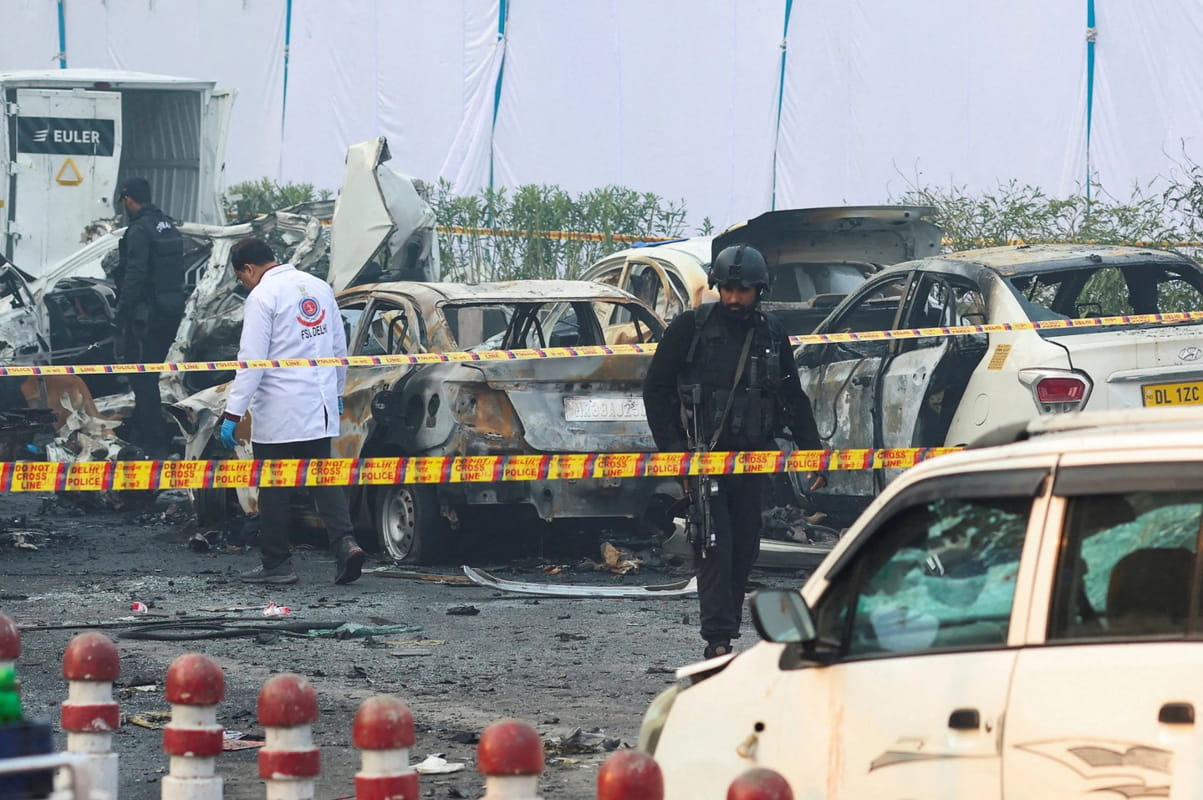
Cordoned off Red Fort in New Delhi after the suicide car bomb blast, November 2025. | AFP-JIJI

Where did combating terrorism and scoring narrative points become interlinked?
This paper argues that the narrative contest between India and Pakistan over terrorism does not pivot around international perceptions of which side is in the ‘right’ during an actual military crisis. The priority of third parties during times of heightened India-Pakistan tension is inevitably on urging de-escalation between the two nuclear-armed states, no matter how justified one side’s grievances are. Rather, two other variables, each of a structural nature, determine which side strategically emerges as the victor following a major terrorist incident.
The first is whether neutral commentators are willing to sustain Islamabad’s knee-jerk denials of cross-border linkages once an immediate war risk has passed. The second is whether Islamabad can lobby neutral countries to pressure New Delhi into resuming bilateral talks.
The paper examines India’s efforts to combat Pakistan-sponsored terrorism between 2005 and 2025, with special focus on events that followed the 26/11 attacks in 2008. It challenges the claim that India derived strategic benefits from restraint, arguing instead that non-replicable factors worked to Delhi’s advantage. Indian gains in perception management were not so much due to decisions taken in New Delhi but due to developments elsewhere that benefited India almost accidentally, and after considerable delay. The paper concludes by identifying factors that have favoured Pakistani Information Warfare (IW) in 2025, and offers suggestions on how these can be neutralised. It is divided into two parts.
The first part reconstructs what actually happened before and after 26/11, distinguishing it from what is perceived to have happened. The second part looks at why India needs to significantly upgrade and intensify its unilateral psychological warfare against Pakistan, rather than seeking diplomatic support to shape international perceptions in its favour.
Part 1: Patterns of cross-border terrorism from Pakistan (2005-2025)
In November 2003, Indian and Pakistani forces agreed to a ceasefire along the Line of Control (LoC). This provided respite to troops on both sides, allowing for a shift in institutional priorities from fighting each other to fighting terrorism. Indian forces concentrated on Pakistani and Pakistan-supported terrorists who were operating in Jammu and Kashmir (J&K). Pakistani forces, meanwhile, became preoccupied with domestic militancy. Two years later, bombs went off in Delhi close to the festival of Diwali. The following year, 2006, over 200 people were killed in train bombings in Mumbai. Then in 2007-2008, a spate of bombings occurred across India.
The South Asia Terrorism Portal captures the long-term trend of jihadist violence within India, occurring outside of existing conflict zones such as J&K, in the following graphic:
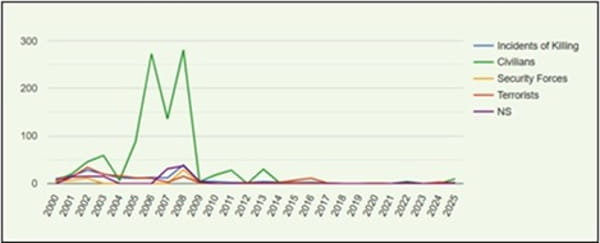
Clearly, something happened between 2004 and 2009, which emboldened the Inter Services Intelligence (ISI) and its proxies, both within the Pakistani militant community and their Indian proteges, to believe that carrying out terrorist attacks against unprotected or ‘soft’ targets in Indian cities would be cost-free.
That exceptional factor was the peace offensive carried out by the then Indian Government to improve relations with Pakistan. With a domestic narrative in India that was starting to focus on the indigenous and non-jihadist nature of some terrorist activities, it became tempting for the ISI to “false-flag” its covert operations. Disguising them as outbreaks of homegrown rebellion in India, or a spillover of militancy from Bangladesh via the Harkat-ul-Jihad-al-Islami Bangladesh (HuJI-B), would create narrative space for more attacks to be launched. It would take attention off the Pakistan-based Lashkar-e-Taiba, the ISI’s favoured proxy for attacking India.
At the international level, the Indian Government concluded a joint counterterrorism mechanism with its Pakistani counterpart in 2006. One could hardly expect the international community to take long-standing Indian complaints about cross-border terrorism seriously when Delhi was itself wavering in its efforts to isolate Islamabad as a state sponsor of terror.
India’s most visionary strategic thinker on covert warfare, at the time, was quick to recognise the damage which had been done to the national interest, writing in 2006 that:
India has suffered its first strategic setback in the fight against terrorism by certifying that Pakistan is not an aggressor but a state aggressed upon. On the terrorism front, it brings both countries on par. For a quarter of a century, we felt Pakistan was the aggressor — first in Punjab, then in Kashmir and now in the rest of the country — leaving more than 60,000 dead. Perhaps India was right in the past to blame Pakistan, but no longer, apparently.
This trend of a sudden rise in terrorist attacks in the Indian hinterland during 2004-2009, carried out by either Pakistani terrorists or Indian-origin terrorists who were inspired and encouraged by Pakistan, and coinciding with strong Indo-Pakistani diplomatic engagement, can be juxtaposed with the trend of terrorist violence in Jammu and Kashmir during the same timeframe:
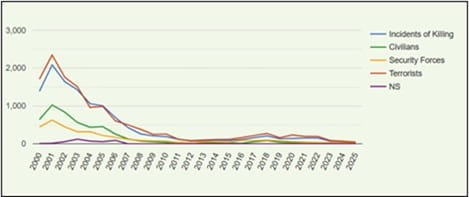
What is evident is that even as terrorist violence directed against Indian cities rose, there was a continuation of a pre-existing downward trend in violence in J&K, from a peak in 2001. During these years, India engaged in a bilateral dialogue with Pakistan that, in substantial measure, included J&K in the agenda. Starting in 2015, there was a rise in cross-border terrorist violence, albeit not a dramatic one, which continued at a slightly elevated level compared to the period 2011-2014, before finally dropping again in 2023.
After 2014, although India continued to engage diplomatically with Pakistan, it did so at a much lower key than before 2008 or even before 2013. Clearly, from 2014 onwards, a newly elected Indian Government felt it could control the tone and direction of Indo-Pakistani relations, including on J&K, whereas during the previous decade (2004-2014) under a previous government, Delhi had been responding more to international pressures to magnanimously engage with Islamabad, notwithstanding cross-border terrorism.
The crucial observation here is that even though terrorist violence in J&K and the rest of the country declined from 2009 onwards, this ‘positive’ trend was at least partly purchased by submitting to international entreaties to have a dialogue with Pakistan, even after that country’s intelligence establishment had perpetrated an act of war against Indian civilians on 26/11.
No matter what positive spin might be put on this fact, it cannot be interpreted as a victory in Indian narrative-building efforts against Pakistan-sponsored terrorism. The ISI might have become more cautious in destabilising India after 2008, but when one considers that the Indian government was willing to talk to Pakistan about issues such as Balochistan, implicitly equating Pakistani sponsorship of terrorism in J and K with unsubstantiated claims of Indian interference in Balochistan, it is evident that India had very poor narrative control even after 2008.
As the writer Tavleen Singh has commented,
The attack on Mumbai was an act of war by Pakistan, and the Indian government did no more than whine at public forums that we had provided sufficient proof that those who planned and orchestrated the unspeakable horror we call 26/11 continued to move about freely in Pakistan and continued to remain unpunished. This itself is proof that the Pakistani State was directly involved. What makes India’s weak-kneed response more shameful is that it allowed Pakistan to take charge of the narrative. Pakistanis I met in the wake of 26/11 said they believed that it was Indian intelligence agencies who had planned the whole thing, or they boasted of how “all it took was 10 young Pakistanis to bring India to her knees”.
In the months after 26/11, there was no sense of progress that Pakistan was being internationally isolated. Rather, quite the opposite. Pessimism prevailed, that after admitting that one of the Mumbai attackers was a Pakistani national, Islamabad would not give up using terrorism as a strategic leverage against India, and continue using it as a state policy.
One writer captured this feeling of despair in February 2009:
Indian diplomats have begun to reflect a certain despondency; there is a significant toning down of the rhetoric against Pakistan, suggesting that India’s diplomatic manoeuvres against Islamabad have run their full course. A statement, quickly retracted, by the External Affairs Minister, Pranab Mukherjee, a few days back, reflects this turnaround in the Indian government’s initial stand. Mukherjee reportedly said that, if Pakistan could not hand over the perpetrators to India, the least it could do was to ensure a fair and transparent trial in Pakistan itself. India’s failure to retaliate against Pakistan in the wake of 26/11 is being perceived as a sign of weakness globally, not commensurate with the image of a country seeking regional superpower status.
Those who argue that strategic restraint served India well in 2008-2009 face a burden of proving their assertions, which they simply do not acknowledge. Instead of being on the back foot as a state sponsor of terrorism that had finally overplayed its hand, and demonstrating its contrition by dismantling the terror network that had spawned 26/11, officials in Islamabad in 2009 focused on portraying India as unreasonable and recalcitrant. Pakistani Prime Minister Yousuf Raza Gilani accused India of ‘stalling the dialogue process’.
To appease Pakistan, its ally Turkey excluded India from an international conference on Afghanistan, held in Istanbul in January 2010. India successfully lobbied to attend a subsequent conference that was also hosted by Turkey. Importantly, this second conference took place after Pakistan had been discovered as hosting the world’s most notorious terrorist fugitive, Al Qaeda chief Osama bin Laden, who was killed by a US military raid in Abbottabad in May 2011. One may ask whether, in the 17 months following the 26/11 attack on Mumbai and preceding the US raid on Abbottabad, it was New Delhi or Islamabad that was more isolated within security dialogues.
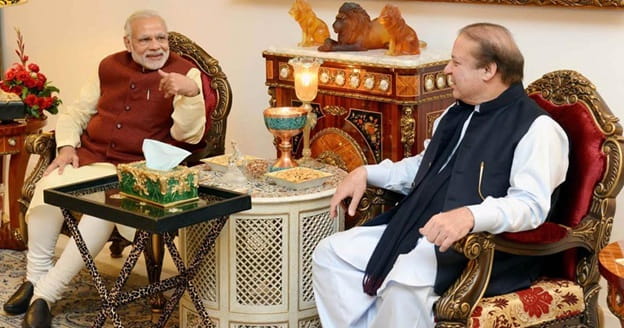
Indian Prime Minister Narendra Modi surprises his Pakistani counterpart Nawaz Sharif in Lahore, December 2015. | PTI.
In pressing for a ‘continued uninterrupted dialogue’ with India, the Pakistani establishment, both in 2009 and much later, has been focused on gaining international credit, while also undermining India’s stance that ‘talks and terror don’tgo together’. The years since 26/11 have shown that it is precisely when India refuses to engage diplomatically with Pakistan, despite all international pressure and weakening of domestic resolve, that the terror threat is contained effectively.
Shifting the facts to legitimise political weakness, after the event
Even before Operation Sindoor, there had been an effort to rewrite counterterrorism history within India to cast the missteps of 2004-2014 in a favourable light. The missteps were centred around a political imperative to engage in dialogue with Pakistan in the hope that Islamabad would calibrate the frequency of its covert assaults on India.
This revisionist version of events has exaggerated the extent to which Pakistan was internationally isolated after 26/11. According to its interpretation, India derived tremendous goodwill for exercising strategic restraint in the face of grave provocation, and Pakistan became an international pariah. Such thoughts are comforting, especially since the window of legitimacy for carrying out military reprisals swiftly closed. They are at least partially grounded in fact.
But their presentation has been somewhat skewed.
Pakistan was not all that severely isolated in the aftermath of 26/11, as it has retrospectively been made out to be in the years since. And it was not just Turkey or China, two countries which have long held pro-Pakistani foreign policies, that undermined India’s efforts at building a counterterrorism narrative focused on exposing ISI-sponsored terrorism.
Barely two months after the attack in Mumbai, the then British foreign secretary David Miliband had made an utterly insensitive political statement. He suggested a resolution of the Kashmir ‘dispute’ would reduce the risk of militancy in South Asia and allow Pakistan to focus more effectively on protecting its western borders. There were at least two aspects of this statement, which were as wrong in 2008-09 as they are today:
1. It placed a victim and a sponsor of terrorism on the same moral plane
2. It overlooked Pakistan’s history of destabilising Afghanistan since the 1970s, and asserting unilateral claims to territory near the disputed boundary that is the Durand Line.
Lashkar-e-Taiba, the group behind the 26/11 atrocity, gleefully jumped on Miliband’s words as offering a justification for its depredations against India. British officials and non-government analysts were sensitive enough to Indian outrage to recognise that their foreign secretary had been tactless and immature. The furore indicated that residual muddle-headedness still guided British public discourse on terrorism even in the aftermath of a massive atrocity like 26/11. A commentator who strongly criticised Miliband’s gaffe still felt obliged to assert that both Pakistan and India were victims of terrorism. Once that idea had acquired a foothold in international discourse, India faced an uphill battle in proving that it alone, and not Pakistan, was the victim of cross-border terrorism. The two countries continued to be hyphenated.
That was the Zeitgeist, the spirit of the times – to equate India with Pakistan and suggest both shared a common enemy. So much for the idea of Pakistan being diplomatically friendless after 26/11, as some commentators claim today. India at the time was indeed praised for its restraint, but it was ‘non-state terrorists’ who were condemned, not the country where they came from. After all, the prevailing mood of the early 2000s was that terrorists had no country, no religion, no distinct form. They were (supposedly) shapeless enemies of all humanity.
What did happen immediately after 26/11 was that ISI efforts to twist the evolving narrative about the attack and project it as an Indian ploy to defame Pakistan were overshadowed by coverage of international diplomacy aimed at preventing an India-Pakistan military clash. This was undoubtedly a setback for Pakistan but it hinged on the irreducible fact that one of the Mumbai attackers had been captured alive. Had that not been the case, Pakistani disinformation in the winter of 2008-09 would have been as prominent in international news commentary as it was in the aftermath of the Pahalgam attack in summer 2025.
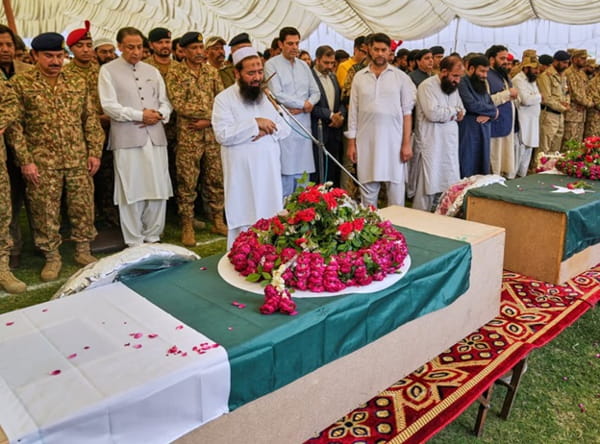
Lashkar-e-Taiba (LeT) terrorist Hafiz Abdul Rauf leads funeral prayers for terrorists killed in Indian airstrikes in Muridke during Operation Sindoor. | AFP.
Interestingly, despite Pakistan’s own admission as to the 26/11 attack’s origins, as of 2025, there are still occasional efforts by Pakistani writers to portray the attack as an act of domestic terrorism.
Those who argue that India ‘won’ the battle of narratives in 2008-09 are overstating their case: India emerged clearly better-off than Pakistan in the mud-slinging match that such battles usually have been. But it was not because strategic restraint led the West to support India on moral grounds. Rather, it was the bravery of a Mumbai police officer who lost his life while apprehending the lone captured gunman that truly exposed Pakistan.
More problematic than Miliband’s clumsiness was the deliberate effort by American officials to confuse and diffuse New Delhi’s diplomatic offensive against Islamabad. As revealed by Wikileaks, the US urged India to dial down its accusatory statements in the aftermath of the attack, claiming that Pakistani cooperation with investigations was becoming more difficult due to Indian pressure. A US State Department official even told the Indian Foreign Secretary that Washington was not convinced that the Pakistani military was directly involved in the attack. He was suitably rebuffed. Yet, this was very much part of an ongoing American effort to shield Pakistan.
In 2010, the US Army War College published a monograph whose title advertised a favourite theory of the US policy establishment, that while Lashkar-e-Taiba was indeed supported by elements within the ISI, it was no longer subservient to the Pakistani military and was largely its own master. The monograph subtly distributed blame between India and Pakistan, urging that India concentrate on fighting domestic terrorism rather than focusing ‘disproportionately’ on foreign groups. In true American fashion, the last sentence concluded with a warning of nuclear war, thus lending credence to Pakistan’s long-standing policy of nuclear blackmail.
For all its virtue-signalling, the European Union proved as much a disappointment for India as the US and the UK. As one researcher noted, the EU Council’s position in the immediate aftermath of the attacks could scarcely be interpreted as favouring India: ‘The December 2008 Council conclusions on the Mumbai terror attacks gave New Delhi the impression that the EU took Pakistan’s side by increasing its aid to that country rather than sympathising with India’s victims.’ The 27-member economic bloc (which then included the UK) was soon offering Pakistani textiles preferential access to the European market. Not only did this move threaten to harm competing Indian business but it also undercut New Delhi’s efforts to build international economic pressure on Islamabad, which would induce the Pakistani military-intelligence complex to back away from supporting cross-border terrorism. In another indication of its own confusion and susceptibility to foreign influence, the then Indian government later allowed itself to be convinced not to oppose the concessions being offered to Pakistan.
Finally, it must be remembered that in the weeks immediately following the 26/11 attack, Western media sources claimed that the United States had warned India about an upcoming terrorist attack. This seemingly innocent disclosure served a sinister purpose: it portrayed Indian security agencies as not competent enough to act on intelligence, thus diminishing Pakistan’s own culpability for having enabled the attack, as well as the duplicity of Western governments for having overlooked smaller Pakistani transgressions that eventually culminated in the attack of 26/11.
The New York Times ran an article about the apparent lapses of Indian security agencies, setting the tone for a sub-narrative that would put India on the defensive internationally. None of this suggests that India received the kind of international sympathy which is today associated, retrospectively and inaccurately, with the ‘weak-kneed’ policy of strategic restraint.
When restraint became confusion
There is a strong parallel between the indecision shown by the then Indian government in November-December 2008, and the so-called ‘paralysis of analysis ’that later afflicted the Administration of US President Barack Obama as intelligence reports indicated growing foreign interference in the 2016 US election. In both cases, an academic-turned-apex decisionmaker hesitated, considering multiple retaliatory courses of action without settling on any. Down the line, policy officials understood they were operating in a political climate where even damning evidence would be picked apart until exhaustion would compel them to admit that the adversary had won the round, by conducting a covert operation against a political regime that was psychologically ill-prepared to respond.
Academic research is vital and necessary and has the advantage of respecting differing points of view and rigorous cross-checking of facts and sources. Yet the characteristics and requirements of a decision maker dealing with national security matters are different. A fleeting opportunity to strike back will not come again. The international legitimacy that a wounded nation has when treacherously attacked at the zenith of its peace efforts will never be reconstructed.
India, when it did not retaliate to 26/11, received praise for its restraint but its attacker faced no real criticism. What happened to deter Pakistan from attempting a repeat of the Mumbai carnage did not occur at the level of public narratives but far from the view of the ordinary Indian, Pakistani or Western analyst. (This is the first part of a two-part series on the topic. Read the second part here.)
(Exclusive to NatStrat)