

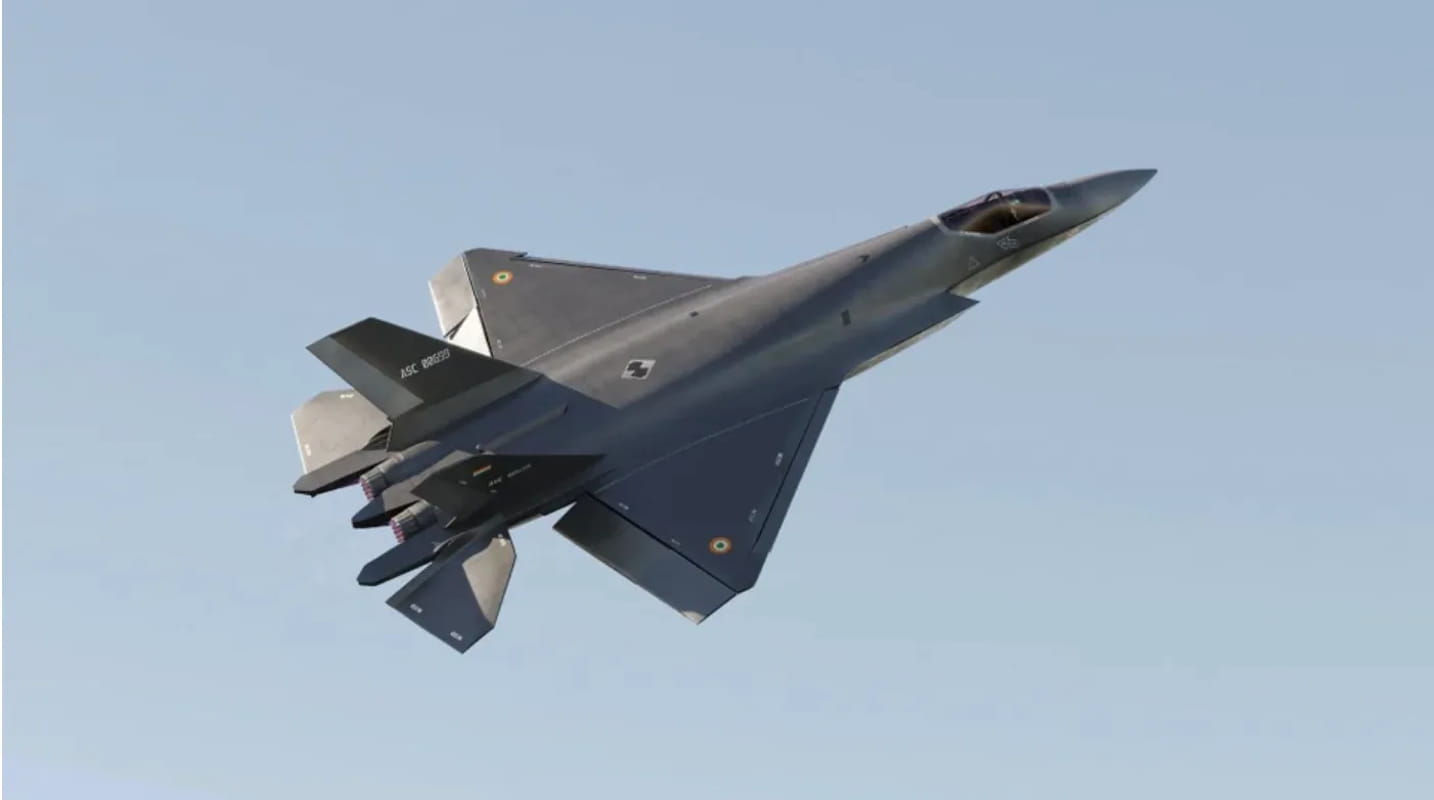
Design Illustration of India’s Indigenous AMCA Programme. | YouTube: Australian Military Aviation History.


It is China’s progress in this realm, however, which is most noteworthy from an Indian perspective. Latest reports suggest that an upgraded version of their December 2024 ‘sixth-generation’ prototype – a large, tail-less, three-engine aircraft that alarmed global defense observers and is unofficially labeled the J-36 – has taken flight. Although, the steady state of developments with the better-known Chengdu Aerospace Corporation (CAC) manufactured J-20 ‘Mighty Dragon’ (the first stealth fighter produced by China) is most likely to force India and the other major Indo-Pacific stakeholders to respond with urgency.
The AMCA Project
India’s fifth-generation stealth fighter jet programme – the Advanced Medium Combat Aircraft (AMCA) – was initiated in 2011 by the Aeronautical Development Agency (ADA), an autonomous aircraft design body under the supervision of the Ministry of Defense’s (MoD) Defence Research and Development Organisation (DRDO). Proposed as a 25-tonne, Mach 2.15 (2,600 kmph) fighter, the twin-engine, single-seater machine will have a combat range of 1,620 kilometres. Built with shoulder-mounted, diamond-shaped, trapezoidal wings, the jet will use advanced radar-absorbent materials and structure. It will also incorporate innovative design elements like a diverter-less supersonic inlet to optimise engine performance, and a serpentine air intake duct to minimise radar emissions.
The AMCA’s prototype manufacturing began in March 2022, with the Cabinet Committee on Security (CCS) clearing the full-scale engineering development of the five prototypes in March 2024. As per existing timelines, the final prototype flight is due in 2029, with the aircraft likely entering service in 2035.
On 27 May 2025, Indian Defence Minister Rajnath Singh opened the AMCA project up to the country’s private sector, signaling the need for speed and public-private collaboration in project execution. Under an Expression of Interest by the ADA, all permutations-combinations of public-private partnership were permitted.
It eventually led to Hindustan Aeronautics Limited (HAL) partnering with Tata Advanced Systems Limited (TASL) and Adani Defence and Aerospace, Bharat Electronics Limited (BEL) tying up with Larsen & Toubro (L&T), BrahMos Aerospace Thiruvananthapuram Limited teaming up with Goodluck India and Axiscades Technologies, and BEML Limited collaborating with Bharat Forge Limited and Data Patterns. These bids were due to be assessed by two senior government panels for their capability and competency to deliver on the futuristic, high-stakes AMCA, by November 2025.
Major Global Advances
India’s persistent lag to incorporate the multi-pronged advantages that accompany this platform – stealth, speed, avionics, and long-range strike potential – into its air combat strategy has an important downside. Technologically, the main global players are already evolving beyond what is considered the ‘fifth-generation’ fighter paradigm of today.
Having partnered with the US on the F-35 program over the years, the recent British-Italian-Japanese collaboration over the Global Combat Air Program (GCAP) is a prime example of this. Planned as a sixth-generation ‘system of systems’, the project is centered around technologies like advanced stealth, directed energy weapons (DEWs), drone-swarming and machine learning for pilot assistance. India was also invited to join the programme but given its own strategic priorities, has chosen not to.
The US, having stopped production of its foremost stealth aircraft – the F-22 Raptor – too announced its own Next Generation Air Dominance (NGAD) initiative in May 2025. Boeing won the contract to build their sixth-generation fighter aircraft: the F-47. Reports suggest the first machine is already being built, with the first flight due in 2028. France, Germany and Spain too have long committed to a Future Combat Air System (FCAS) – even if marred by disagreements and considered on the brink of collapse – under which France’s Dassault is leading the development of a Next-Generation Fighter (NGF) and Airbus is leading the development of a Combat Cloud (a multi-domain capable, command-and-control system for information-sharing).
Sizing up the Chinese Threat: ‘Intelligent Air Combat’
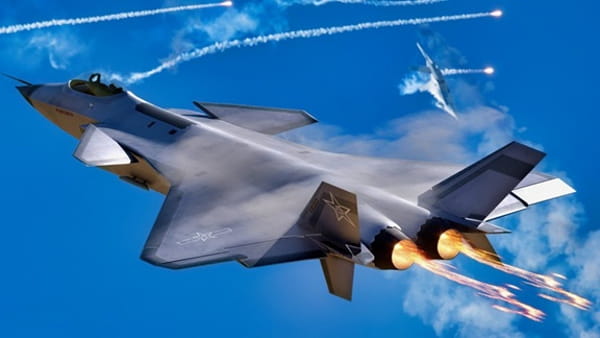
China’s Chengdu J-20 stealth fighter. | The National Interest.
It is China’s progress in this realm, however, which is most noteworthy from an Indian perspective. Latest reports suggest that an upgraded version of their December 2024 ‘sixth-generation’ prototype – a large, tail-less, three-engine aircraft that alarmed global defense observers and is unofficially labeled the J-36 – has taken flight. Although, the steady state of developments with the better-known Chengdu Aerospace Corporation (CAC) manufactured J-20 ‘Mighty Dragon’ (the first stealth fighter produced by China) is most likely to force India and the other major Indo-Pacific stakeholders to respond with urgency.
Highlights on this mainstay of China’s stealth warfare and air-space dominance strategy, of which the first prototype flew in 2011 and full combat readiness was achieved in 2018, include:
These three pillars of strength suggest that the J-20 is being envisioned as a cognitive command node for China’s future air combat domains like the sixth-generation systems; well beyond its original fifth-generation classification and mandate. Essentially anchoring the era of AI-powered autonomous decision-making, predictive threat analysis, and target prioritisation capabilities.
Technological Sovereignty and India’s Immediate Priorities
As a rising global power, India is overdue for a decision upon and commitment of significant resources towards upgrading its fighter jet fleet. Including the deployment of fifth-generation capabilities to enhance its aerial combat / defence strategy. Given the factors and variables discussed above, certain choices seem clear to that effect.
i) Besides expecting to acquire about 18 jets (one squadron) off-the-shelf, and to resolve source-code tussles with France, India’s two main requirements in closing this deal out will be: a) that Dassault Aviation manufactures a bulk of these 114 aircraft in India, and b) the indigenous content in these aircraft is at least 60 per cent. Dassault has already signed up for the establishment of a fuselage production plant in Hyderabad, in partnership with TASL, and a maintenance, repair, and overall (MRO) company based near Noida International Airport in Jewar.
ii) Simultaneously, a deal with France’s Safran to enter into joint production of high-thrust next-generation engines for the LCA Tejas Mk2, AMCA, as well as the twin-engine deck-based fighter (TEDBF) programmes seems like a necessary decision towards reducing dependence on the US.
While HAL has recently concluded an agreement for 113 F404-GE-IN20 engines to power 97 Tejas Mk-1As (extra engines will serve as reserves), if the agreement is not legally binding – given Washington’s track record with military sales to New Delhi – the IAF will continue to see delays in the delivery of these American fighter-jet engines. In addition to the continued wait for an indigenous jet engine, this will become a crucial strategic handicap.
i) Particularly on the back of Operation Sindoor’s kinetic success (where this approach paid rich dividends), and China’s growing capabilities on long-range stealth aircraft and accompanying missiles, deploying the Su-57E’s low-observability, advanced speed, long-range strike capability, and large weapon-carrying capacity would be a crucial upgrade. Almost as a 4.5+ / ‘five minus’ generation addition to the IAF’s depleted fighter-jet squadron strength.
ii) Latest reports suggest that in line with its commitment to reduce dependence on foreign defence suppliers and maintain sovereign control over critical technologies, New Delhi is pushing Moscow to replace the Su-57E’s N036 ‘Byelka’ AESA radar with the indigenously-developed Uttam AESA radar (currently deployed on the Tejas) and the Virupaksha radar (being integrated into the upgraded Su-30MKIs under the Super-30 programme). This highlights India’s efforts towards adhering to gold standards in sensor technology and EW, gearing up for fifth and sixth-generation multi-domain, network-centric warfare.
iii) India must also manage Donald Trump’s mercurial attitude towards such partnerships prudently, given their “hostile” perception in the eyes of the Americans, and shore up its impending GE-F404 engine imports from the US to keep its fast-approaching Tejas Mk1A fighter jet deliveries on-track.
i) Until recently, most Indian aircraft could not speak to each other securely; they could only do so on open, unsecured channels; reportedly enabling the Pakistani Air Force to hear IAF communications during Operation Sindoor, for instance. Another instance from the operation is the coming together of Pakistan’s Chinese-made J10C fighters as part of a multi-domain “kill chain” network of data-linking systems, sensors, and surveillance to enhance the aircraft’s ‘situational awareness’ and the range of its Chinese-made PL-15 missiles, taking the IAF’s tactics by surprise.
ii) The IAF must therefore continue its steady shift towards an integrated, network-centric strategy comprising upgraded fourth, 4.5 and 4.5+ generation fighter jets; active and passive radars; autonomous drones and counter-drone systems; an indigenous air defence (AD) network composed of short, medium and long-range Surface-to-Air Missile (SAM) systems; incorporation of satellites and use of encrypted communications; data integration across all its aircraft and AD systems.
Conclusion
After decades of toil, delays and setbacks, India is on the cusp of seeing the rewards of its steadfast commitment to and investment in the LCA ‘Tejas’ project. The foundational project is evolving into a multilayered platform.
Operationalised in 2015 with its original, fourth-generation version (Mk1) considered to be lacking the teeth required for modern warfare, the Tejas’s Mk1A variant is due for rollout by March 2026 and will be a potent step forward. It is expected to match the 4.0+ generation Su-30MKIs. Version Mk2A, envisaged to be on par with the world-class, “omnirole” 4.5-generation Rafales, is expected to see deliveries in three to five years.
True to his visionary spirit, the LCA’s original architect, Dr. Kota Harinarayana, believes the AMCA will be a paradigm evolution of this platform. It would essentially serve as a fifth/sixth-generation stealth-fighter-led ‘Tejas 2.0’ system. (This is the second part of a two-part series on the topic. Read the first part here.)
(Exclusive to NatStrat)