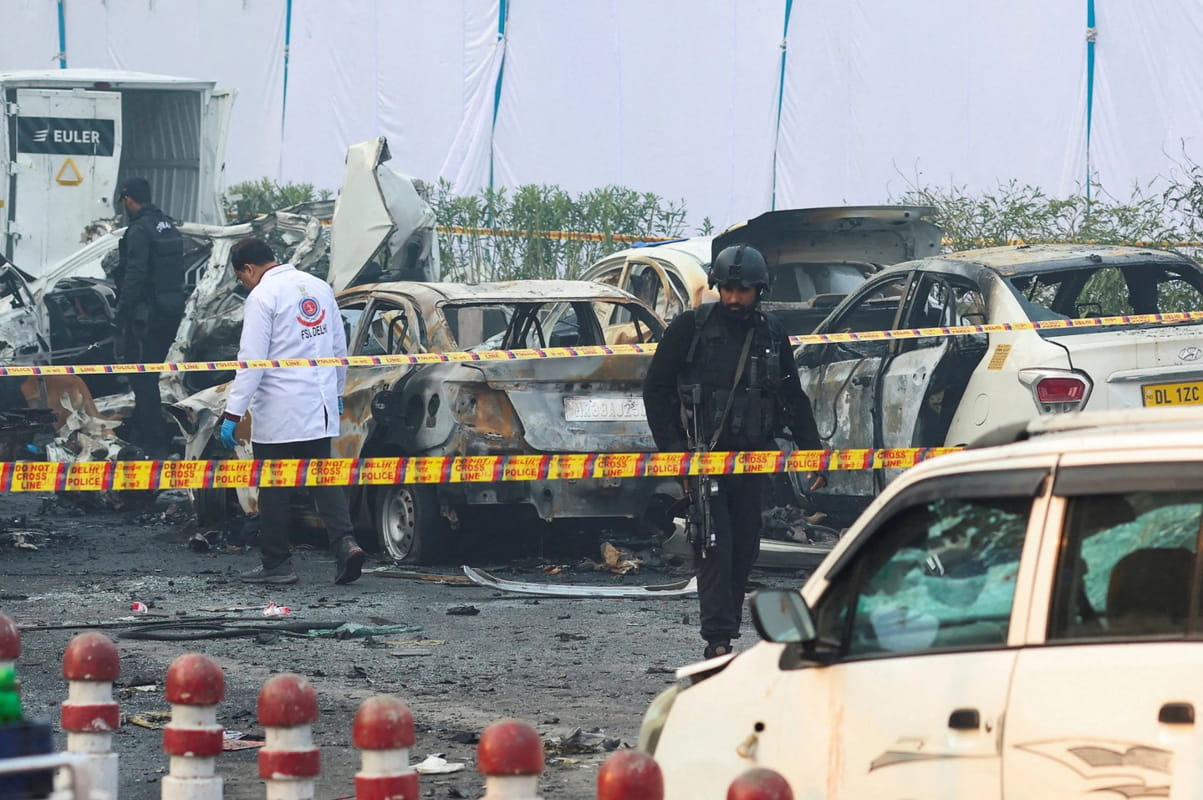



Representative image. | Incyber News.

Unless India manages to accomplish both a sustained reduction of cross-border terrorism and a de-emphasis on Kashmir in international commentary on South Asia, its narrative-shaping efforts will not meet with comprehensive success. For its part, unless Pakistan can manufacture conditions akin to those of 2004-2009, whereby it carries out continuous cross-border attacks on India using jihadist proxies, be they be of Pakistani, Indian or even Bangladeshi origin, while simultaneously mobilising foreign diplomatic pressure on India to hold a dialogue, it too will not make any headway in pushing its strategic agenda.
From counterterrorism to ‘battle of narratives’
Since Operation Sindoor, questions have been asked as to why India has not bested Pakistan in selling its own narrative to foreign audiences. Much has been written about how the Pakistani establishment was quick to put out false information. But this ignores the inherently biased role of the international news media, academic and think-tank community on the specific issue of cross-border terrorism targeted against India.
In 2008-09, New Delhi did not develop a sudden ability to persuade Western analysts about Pakistani ISI involvement in 26/11. Its claims were treated as mere allegations, even after being given weight in 2010 by the interrogation of Lashkar operative Daood Gilani, alias David Headley. The fact that Headley was interrogated in US custody, and in connection with an attack that had killed six Americans, was not a small factor in allowing his disclosures to reach a level of international attention that previous captures of Lashkar operatives in Kashmir and elsewhere in India had failed to do.
Attempting to craft a narrative that establishes culpability for a covert operation is like trying to prove a premeditated fratricidal murder in the midst of a massed infantry bayonet charge. There are enough life-threatening factors in the immediate environment that the burden of proving a deliberate and selfish intent to kill on the part of any one individual is raised to near-impossible levels. Only exceptional circumstances provide clear evidence of guilt. The same logic applies to India-Pakistan discourse clashes over responsibility for cross-border terrorist attacks.
Despite all its restraint in 2008, with the insurgency underway in AfPak, India was not able to persuade third-party audiences (outside of government intelligence and diplomatic circles) that the ISI was the principal author of 26/11. The notion that Lashkar-e-Taiba was not a mere ‘non-state actor’ continued to prevail until May 2011, when that group was linked with the leadership of another terrorist actor, one considered much more directly threatening to Western interests.
Luck, not brilliance
Al Qaeda’s ties with Lashkar had been documented by an Israeli research paper less than a month after 26/11. Considering the deliberate targeting of Jewish persons during the attack, it is unsurprising that Israeli researchers would want to study Lashkar and its links to international terrorism. However, Anglo-American focus on Lashkar, outside of select government circles, did not really come about until after correspondence between the two groups was recovered from Osama bin Laden’s hideout in Abbottabad in May 2011. The fact that the Al Qaeda chief was living within proximity to a major Pakistani military base inevitably raised questions about possible ISI complicity in sheltering him.
In this environment, a trial on American soil fortuitously put the focus on Pakistan again, in connection with the Mumbai attack. Tawahhur Rana, an accomplice of Headley’s, was charged with involvement in both the 26/11 conspiracy and another plot to attack targets in Denmark. At the trial, Headley turned approver, testifying that the ISI had provided support to Lashkar. So much for the myth, until then propounded by Western analysts, that the Pakistani spy agency and the Lashkar were unlikely partners.
It was not Indian genius in crafting narratives which focused international attention on Lashkar and its links with the ISI but the hostile mood that Pakistan faced after Bin Laden had been found living deep in its territory, rather than at a remote location in war-torn Afghanistan.
Had the Abbottabad raid not happened, it is open to debate whether Pakistan would have faced anywhere near the level of hostile scrutiny as it did, or whether ties between the ISI and Lashkar, and Lashkar and Al Qaeda, would have been of concern to anyone other than terrorism researchers. Whatever narrative success was scored in India’s favour after 26/11 mostly came from 2011 onwards and was driven by events well outside of Delhi’s ability to manipulate.
Beyond narratives, and into government dialogues
For a decade after 26/11, Pakistan did not carry out a major terrorist attack on India. The reason was not that the country’s security establishment discovered a conscience. Rather, away from the international media spotlight, warnings of non-kinetic punishment in the event of further large-scale attacks on India were delivered to Islamabad from multiple quarters.
A senior Indian intelligence officer involved in the post- 26/11 investigation told the author of this paper what had happened. According to his version, several Western governments sent delegations to Islamabad to impress upon the ISI that continued sponsorship of attacks as provocative as 26/11 would make Pakistan an outlaw state. Along with diplomatic isolation, the country would face economic sanctions and a propaganda onslaught that would expressly blame its leadership for destabilising the South Asian region.
Coming at a time when the US had already flexed the power of its news media to implicate the ISI in the July 2008 bombing of the Indian embassy in Kabul, this threat of a Western propaganda offensive could not be easily ignored by Pakistan. Crucially, the intelligence officer said that Western delegations warned that their own investigative findings would determine whether or not the Pakistani state was to be held responsible for further jihadist attacks on India. Any public denials issued by Pakistani government officials would be ignored if a positive conclusion were to be reached by the Western intelligence community.
In other words, the rules of the covert warfare game had changed, and the ISI could not count on the same level of Western indifference to its anti-Indian activities as previously. This was the payoff which the West made to India in return for strategic restraint. Not the actual creation of a hostile global narrative against Pakistan but the assurance of creating one if the Pakistani spy agency did not rein in its jihadist proxies.
When advocates of strategic restraint talk in 2025-26 about its benefits in 2008-09, they are referring to events that occurred far from public view. At the level of open discourse in the American, British and European media, there was little to separate Indian and Pakistani narratives regarding 26/11: both were given equal weightage. It was the de-escalatory steps of third powers which received the bulk of positive attention. Since the success of these official efforts was linked to the acknowledgement of the deep anguish felt within India over 26/11, India, by default, dominated the narrative. But that came at the price of not avenging its slain citizens.
Furthermore, it was not that the ISI gave up trying to conduct cross-border attacks. It merely attempted to disguise them better and focused primarily on military targets.
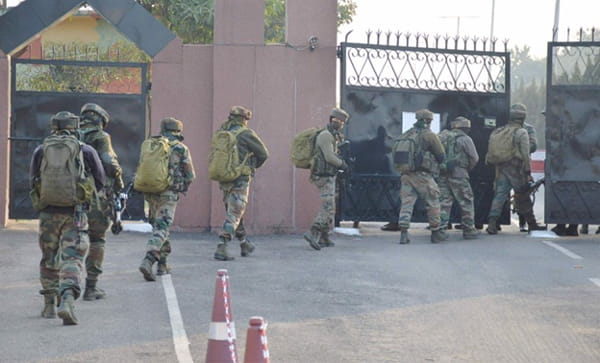
Indian security forces responding to an attack on Sujuwan Army Camp, Jammu, February 2018. | PTI file photo
Attacks at Gurdaspur (2015), Pathankot, Pampore, Uri, Baramulla and Nagrota (all in 2016), Anantnag (2017) and Sunjuwan (2018) all pointed towards a growing boldness on the part of the ISI. It must not be forgotten that the agency even attempted to make Lashkar-e-Taiba’s overground front organisation, the Jamaat-ud-Dawa (JuD), a political party in the 2018 Pakistani elections. Only concerted international pressure on this point led to the plan being dropped. Notably, the international media coverage of JuD’s leader, Hafiz Saeed, often referred to him as an ‘alleged terror mastermind’. This was about the limit to which the Indian narrative on the Lashkar’s long history of conducting cross-border attacks had gained traction in the West. Much of the Western news coverage referenced American accusations against the Pakistani jihadist group and its leadership, and only parenthetically referred to similar accusations by India.
The battle of narratives became more salient in the aftermath of the 2019 Pulwama attack and the Balakot airstrike. By then, the narrative that India and Pakistan were both victims of terrorism had lost credibility. Instead, a new form of moral equivalence was imposed by Western commentators by giving equal prominence to Pakistani military-led disinformation about conventional combat operations alongside Indian civilian-led diplomacy, which still aimed to highlight the cross-border nature of terrorism. The uninitiated international listener thus heard about Pakistan possibly being a haven for terrorists who attack India, but s/he also heard that the Pakistani military was the best in the world. Whether this represents a ‘failure’ of Indian information warfare efforts is hard to say. Any comparison between the two countries’ international outreach campaigns from 2019 onwards is one of apples and oranges. Each side has had different goals and has accomplished them while being unable to deny the other's success in its own chosen sphere. Thus, each side claimed victory in 2019, after India struck a terrorist camp in Pakistan and Pakistan responded militarily.
Pakistan has been focused on showcasing its military prowess and projecting the Indian military as incapable. This serves both domestic and international propaganda purposes. It justifies the Pakistani Army’s institutional corruption and vice-grip over the economy, and it creates doubts in Western capitals as to whether India is capable of serving as a counterweight to Chinese power. Meanwhile, India is focused on maintaining its reputation as a responsible state but one which cannot be expected to indefinitely tolerate spillovers of dysfunctionality from a rogue neighbour.
Pakistani advantages in information warfare
One of the factors which has worked in Pakistan’s favour is that terrorism has become less of a policy concern for Western governments in the aftermath of the Russia-Ukraine War. More attention is being paid to the effectiveness of military weapon systems. In this regard, Pakistani military disinformation in the summer of 2025 had an advantage over India’s efforts to focus global attention on the original provocation, which was a terrorist attack in Jammu and Kashmir. Unlike after 26/11, establishing the provenance of the attack and the ideology of the group behind it was not a priority for international analysts because no Western citizens were targeted.
Pakistan has also had strategic partners which functioned as informational allies, allowing it to shift the focus of debate away from terrorism and towards the India-Pakistan military balance: Qatar, China and Turkey. All three are major information powers in their own right (Pakistan itself is not, lacking a major international media organisation). Al Jazeera, Xinhua and TRT World amplified Pakistani-origin propaganda during and after Sindoor, helped by the fact that Pakistani stringers worked for many international media services. China and Turkey have been suppliers of military equipment to Pakistan and have a vested interest in portraying this equipment as offering war-winning strength to whoever might purchase it. Being a non-aligned power, India lacks the same narrative-shaping partnerships that Pakistan has in the ideological realm with an Islamist-friendly Turkey or in the geopolitical realm with China.
A third factor which worked in Pakistan’s favour during Operation Sindoor was a ready-made template for misrepresenting the targets struck by the Indian Air Force. In 1986, the United States launched airstrikes on alleged terrorist bases in Libya, only to be confronted by accusations of having killed Libyan dictator Gaddafi’s infant daughter (the child’s identity remained the subject of dispute for years afterwards). Pakistan did not have to reach too deeply into the imagination of its spin doctors to have a ready set of sensationalist claims to trot out if and when India did launch military reprisals to a terrorist incident. International news services focused on the Pakistani accusations of civilian deaths because these were more accessible and repeatable. To have proven beyond doubt that the targeted locations were terrorist facilities, as India claimed, would have required sustained investigative journalism efforts. In a context where there were no Western lives at stake, such efforts would have seemed wholly unnecessary.
For its part, India did well to expose members of the Pakistani military for attending the funeral of a known terrorist. However, owing to the nature of the news reporting process – wherein a journalist travels to the site of an incident and interviews locals who claim to be eyewitnesses – it was easier and faster for the Pakistani side to get its own version of events out than for the Indian side to identify and expose inconsistencies and contradictions in the Pakistani narrative.
Fourth, India might have been too complacent in assuming that the United States, with its formidable agenda-setting propaganda machinery, would line up with Delhi against Islamabad. Here, a naïve belief that Indian strategic goodwill is central to US policy in the ‘Indo-Pacific’ might have been partly to blame. If self-conditioned to think that the US needs a sizable Asian ally to contain China; Indian analysts in May 2025 might have been surprised by the relatively indifferent stance that the Trump administration took towards Indian national interests. Instead, they discovered as one observer has since perceptively noted, ‘For Trump, India is not an indispensable player in the Indo-Pacific.’
Finally, there is a narrative framework being developed to reinforce Pakistani propaganda in the form of a Western obsession with Hindu nationalism. It is increasingly common for Western media services to give talk time to Indian-origin commentators who are critical of right-wing politics, and project these voices as ‘objective’ merely because they oppose the government in power. When paired with an India-Pakistan crisis, such narrative framing leads to the impression that any uncompromising stance against Pakistan is driven more by partisan politics than by objective security needs. The result is a devaluation of India’s long-standing grievances regarding Pakistani sponsorship of terrorism, which transcend any political ideology in the country.
As one Indian researcher has observed:
[P]olitical reporting of India reflects a religious preoccupation in Western print media. News coverage accurately portrays the Indian government as Hindu nationalists; however, a problem lies in portraying Hindu nationalism as the core of every significant policy decision, resulting in coverage that lacks in-depth analysis and facts.
In 2004-2010, Western think-tanks and academic institutions crafted a seemingly elegant but misleading narrative that absolved Pakistan as a state sponsor of terrorism. This narrative, promoted by Jessica Stern in her influential 2000 article Pakistan’s Jihad Culture, created the impression that the ISI was not fully in control of its own jihadist proxies.
Over the following decade, until Osama Bin Laden was discovered living in proximity to the Pakistani military academy at Abbottabad in 2011, Indian claims of Pakistani state sponsorship of terrorism were invariably countered with the grand theory (and that is all it was) that the ISI faced a ‘principal-agent’ problem with its terrorist clients. This put the onus on India to produce irrefutable proof of complicity by serving ISI officials in a specific terrorist incident. It lowered the threshold of deniability that Islamabad needed to mask its continuing covert offensive against India.
Following the killing of Bin Laden at Abbottabad, Pakistan seems to have made a serious effort to infiltrate grassroots-level Western policy discourse on South Asia. One overlooked aspect has been the non-profit sector, which, since 2015, has been subjected to increasing state control within the country. Controlling the informational outflow of these groups is a bottom-up method of narrative-shaping, as distinct from a top-down approach that concentrates on cultivating elite members of the Western news media, universities and think-tanks. This author has observed firsthand how some international non-governmental organisations (INGOs) eager to maintain their contacts within Pakistan suppress research data that is unflattering to the Pakistani military. The country has become a regional anchor for Western NGOs. This has worked to the detriment of both India and Afghanistan. Both countries are deemed more difficult for foreign NGO workers to operate in, due to tighter monitoring of foreign nationals who might be engaged in policy-oriented research.
As a result, it is the Pakistani perspective on regional security which is heard the most within Western NGO circles. In 2016, there was estimated to be one NGO for every 2000 Pakistani citizens (this figure counts local as well as foreign NGOs). The country’s security apparatus, under the pretext of extending cooperation, shaped Western research activities concerning domestic affairs and pushed its own viewpoint on foreign affairs.
Any examination of the criminal-terrorism nexus along the Afghanistan-Pakistan frontier remained confined to the Afghan side of the Durand Line. Balochistan was kept off the international discussion agenda. Spurious maps of Kashmir, showing the Indian portion as ‘disputed’ but the Pakistani-occupied side as fully integrated with Pakistan, were circulated to foreign audiences.
Conclusion
Going forward, it might be beneficial to significantly widen the scope of India’s information warfare against Pakistan. Operation Sindoor has put in place a major building block of a broad-ranging counterterrorism strategy. No longer does India need to feel compelled to make artificial and unnecessary distinctions between terrorists and those who shelter, support, fund and praise them. Consequently, a persistent psychological warfare programme targeting the Pakistani Punjabi-Sunni supremacist state on all its pressure points, including its abuse of sectarian and ethnic minorities, tolerance for drug trafficking and failing economy, can be launched.
To move onto the offensive, Indian-origin researchers in the West need to be more vocal and honest on Pakistan at every opportunity, be it on issues concerning Afghanistan, terrorism, corruption and ethnic and sectarian intolerance. A mindset still seems to exist in some quarters within India and in the diaspora that engaging in the same kind of argumentative tactics used by the Pakistanis is debasing for India. Such a presumption needs to be jettisoned: attacking a state that itself is always on the offensive is an act of self-defence, not aggression. To wait until Pakistan raises the issue of ‘Kashmir’ in an international forum before highlighting the Pakistani state’s sponsorship of terrorism cedes the initiative to the enemy.
Narrative attacks on Pakistan should be mounted overtly, rather than through covert (deniable) tactics. Excessive use of methods such as false online identities, fake news websites, and citation loops generated through marginal media calls into question the accuracy of data, even if the information itself is true. Indian-origin experts in the West, familiar with the sub-continent, can focus on studying Pakistan’s domestic conflicts and foreign policy and publishing research papers in Western academic journals.
Once fresh generations of Western scholars understand that the conflict dynamics of South Asia are not limited to Kashmir alone but crucially hinge around Pakistani sponsorship of terrorism, be it in Punjab, the Indian Northeast or cities such as Mumbai, they will be more likely to study the subcontinent from a neutral and balanced perspective. Absent this, India-Pakistan tensions will inevitably be linked to the status of Kashmir in the perception of third parties, meaning that even if Pakistan momentarily reduces its support for cross-border terrorist attacks, it will subsequently claim entitlement to a renewed dialogue process with India by way of ‘reward’.
Unless India manages to accomplish both a sustained reduction of cross-border terrorism and a de-emphasis on Kashmir in international commentary on South Asia, its narrative-shaping efforts will not meet with comprehensive success. For its part, unless Pakistan can manufacture conditions akin to those of 2004-2009, whereby it carries out continuous cross-border attacks on India using jihadist proxies, be they be of Pakistani, Indian or even Bangladeshi origin, while simultaneously mobilising foreign diplomatic pressure on India to hold a dialogue, it too will not make any headway in pushing its strategic agenda. (This is the second part of a two-part series on the topic. Read the first part here.)
(Exclusive to NatStrat)