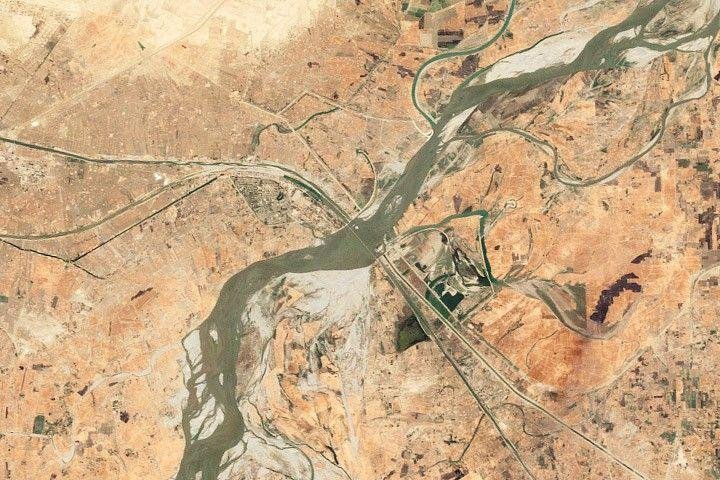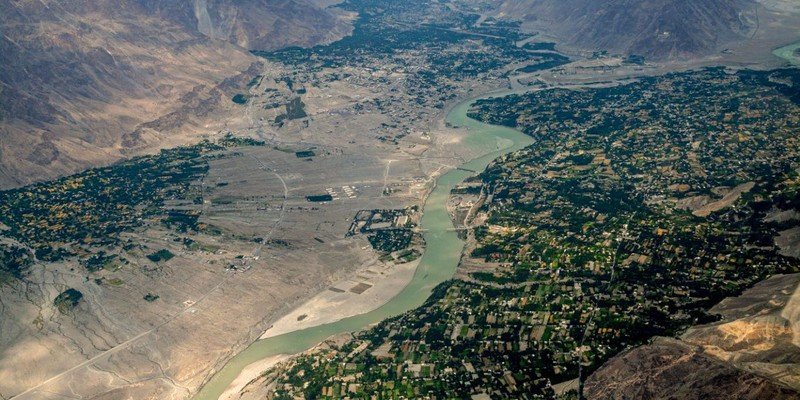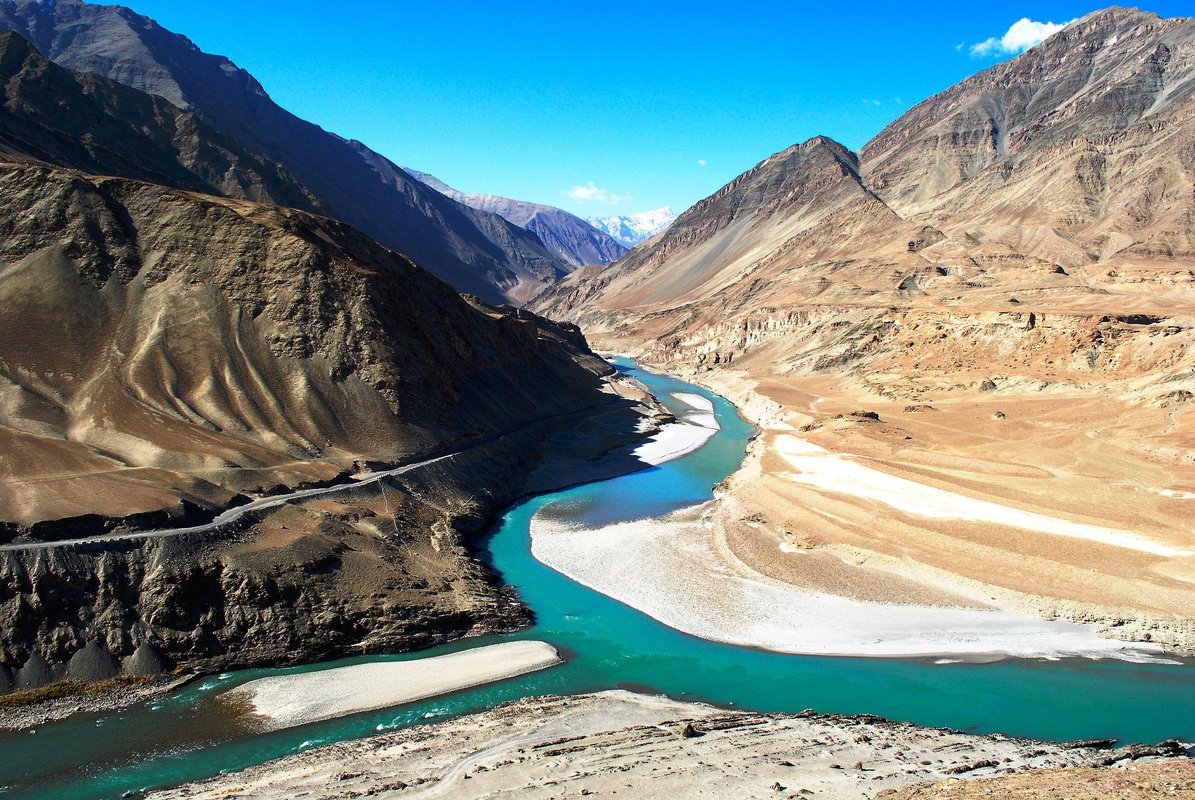
A Photograph of Indus-Zanskar Sangam in the Indus Valley. Source: Sundeep Bhardwaj, (Creative Commons Attribution 3.0 Unported,) via Wikimedia Commons

Introduction
On August 31, the Permanent Court of Arbitration (PCA) in The Hague delivered its award on the Status of the Indus Waters Treaty (IWT), stating that “India’s unilateral decision to place the Treaty in abeyance was not legally permissible”. They announced that the treaty is either performed or terminated, and India's condition in April 2025 is neither. In a recent contribution to these pages, Devendra Kumar Sharma set out the imbalance the IWT entrenched and the scale of waste within Pakistan's own system. This article accepts that diagnosis and takes up the question it leaves open: what India should now do, and through which instrument.
An Award Against an Absentee
The August 31 announcement included a statement on India’s April 23, 2025 decision to place the IWT in abeyance, which they said was not justified under the Treaty or general international law; thus, India remains bound by the Treaty. The tribunal also imposed interim restrictions on India, temporarily restricting certain construction on the Ratle Hydro-Electric Plant on the Chenab for ninety days after the Neutral Expert's final decision. India’s Ministry of External Affairs rejected both the same day, reiterating its position that the Court of Arbitration is illegally constituted and has no jurisdiction over India's sovereign decisions.
Two features of the proceedings deserve emphasis, because neither has survived into general commentary.
First, India has not recognised the legitimacy of the CoA since it was established by the World Bank in October 2022 and has, as such, consistently maintained that the Tribunal was illegally constituted and that “the very establishment of this alleged arbitral body constitutes a grave violation of the Treaty”. Accordingly, India has never appeared before this body; therefore, the hearings have run ex parte, that is, in the absence of one side, so the party in the room has built the record entirely.
Secondly, India maintains that it is not boycotting or rejecting the dispute-settlement machinery under the Treaty. On the contrary, India has actively requested and participated in the proceedings before the Neutral Expert as explicitly mentioned in Article IX of the Treaty. The crux of India’s objection is procedural rather than utilitarian: it argues that the Treaty does not envision the simultaneous examination by a Neutral Expert and a CoA over the same issue. Since the IWT establishes a graded sequence, India, therefore contends that once a treaty forum is established on a matter, another forum should not examine the same issues concurrently, which has happened now. The concern is not the adjudication itself, but with the dual and overlapping adjudication.
The Word That Does Not Appear in the Treaty
The Indus Waters Treaty has detailed provisions for continuation, termination and modification by a duly ratified treaty between the two governments. It makes no provision for a situation in which one party pauses performance of its obligations while the treaty remains valid. The term ‘Abeyance’ is not mentioned in the Treaty, and rather it is an invention after the Pahalgam massacre of April 22, 2025. While necessary as an act of self-preservation, it also created ambiguity, giving an adjudicator the defence it needs. Under the Treaty, a State can terminate it on a legal basis. A State that declares a treaty alive but unperformed is, in gentle terms, described as breaching the Treaty.
While arbitration can determine legal rights, it cannot restore a relationship that has ceased to function. The Permanent Indus Commission (PIC) has not met since May 2022, and many regular activities that kept the Treaty functioning, such as yearly exchanges of flow and storage data, design notifications, and inspections, have stopped. A tribunal can direct a party; it cannot convene a Commission that a party will not attend. The Treaty survives on paper while producing every liability of a live obligation and none of its benefits.
The Bilateral Record
Many argue that India cannot claim to be settling matters bilaterally while simultaneously taking unilateral actions. However, the historical record shows that India has always tried to resolve the dispute via the Treaty’s existing bilateral mechanisms. In January 2023 and again in August 2024, India issued notices of modification under Article XII(3) of the IWT, citing different demographics, clean-energy requirements, and sustained cross-border terrorism. Both followed five PIC meetings between 2017 and 2022, during which Pakistan declined to discuss the Kishanganga and Ratle designs. Pakistan maintains that it replied in April 2023 and found the Indian notice too vague, while India says no substantive engagement followed. Regardless of which account is accepted, the key takeaway is that India sought to pursue its concerns through the Treaty’s own machinery, whereas Pakistan turned to an outside forum.
The Article 370 Precedent
The instrument now needed is legislative. One government's policy can be undone by another, depending on the political circumstances of the day. Yet the development of water infrastructure is measured in decades, and no government can reasonably plan major investments in storage, division works, or tunnels if the underlying policy rests on a temporary administrative decision. Abeyance is reversible. A statute is not. Therefore, if India is to chart a new course, it requires a foundation that is durable.
There is already a precedent that lies close at hand for such an approach. The abrogation of Article 370 on August 5, 2019, was not done by executive notification. It passed both Houses, was given effect through a Presidential Order, and was tested thereafter in the Supreme Court, where a Constitution Bench upheld it in December 2023. India argued that case before no outside forum and needed none. The whole of Jammu and Kashmir, including the territory under Pakistani occupation, has been an integral part of India since the Instrument of Accession, and what a sovereign republic does to its own Constitution in respect of its own territory answers to its own courts.
In that spirit, the author has drafted, and released for public discussion, an Indus Waters Treaty (Abrogation) and Western Rivers Development Authority Bill, 2026, together with a companion Constitution Amendment Bill, and submitted both to the Union Government in a private capacity. The Bill converts abeyance into statutory abrogation for the Indus, the Jhelum and the Chenab alone; leaves the Ravi, Beas and Sutlej untouched; and sets up a Western Rivers Development Authority (WRDA) with drinking water as the first charge, ahead of irrigation and power, and river-basin ecology as a statutory duty rather than an afterthought.
Utilisation, Not Rhetoric: The Test of the Ravi
A statute that is not followed by construction on the ground would simply be rhetoric of a more elaborate kind. The Union Jal Shakti Minister has made it clear that the rivers are put to Indian use with not a single drop flowing to Pakistan, with short, medium and long-term plans drawn up in April 2025. Delivery, not declaration, is now the binding constraint. The most uncomfortable evidence for that is domestic.
Table 1: Indus system allocation and utilisation
| Item | Quantity (MAF unless stated) |
|---|---|
| Eastern Rivers allocated to India | about 33 |
| Western Rivers allocated to Pakistan | 135 to 140 |
| India's share of the system | about 19.6 per cent |
| India's actual utilisation | about 28 |
| Indian entitlement still crossing to Pakistan | 5 to 6 |
| Pakistan’s losses: discharge to sea and system | more than 60 |
Source: Devendra Kumar Sharma, NatStrat, 4 September 2026.
Five to six MAF of India’s own Eastern Rivers, to which India has undisputed rights, crossed the border into Pakistan because the necessary infrastructure has not been completed. This is not water restricted by any arbitral award or international litigation; it is water from rivers allocated to India since 1960.
The Shahpur Kandi project, sanctioned in 1995, was delayed for three decades due to inter-State cost disputes. The Ujh multipurpose project on the Ravi remains held back by unresolved issues of land acquisition and financing. A republic unable to harness a river indisputably its own has limited grounds for confidence about the Chenab, where the gradients are steeper and the works incomparably larger.
The Chenab-Beas Link Tunnel, tendered by the National Hydroelectric Power Corporation (NHPC) in May 2026 at about Rs 2,350 crore (approximately USD 273.78 million), represents the first serious attempt to translate long-standing ambitions into physical infrastructure. The 8.7-kilometre tunnel at Koksar in Lahaul-Spiti will divert the Chandra and Bhaga headwaters into the Beas basin through a canal network of some 113 kilometres. Measured against a Chenab flow of roughly 35 MAF a year, it is modest, but it should be read as the first item of a programme rather than as its completion.
Policy Recommendations
Conclusion
The IWT has been in a coma since April 2025, kept alive on paper at The Hague while every organ by which it functioned has ceased to work. Sixteen months of rejection statements have not altered a cubic metre of flow, and five awards have not restored a single exchange of data. The choice remains between an indefinite condition that no treaty text recognises, and that every tribunal will read as a breach, and an open, debated parliamentary termination followed by construction. India should legislate and then build.

Separating Reality from the Rhetoric: Facts, Fiction, and the Indus Waters Treaty