

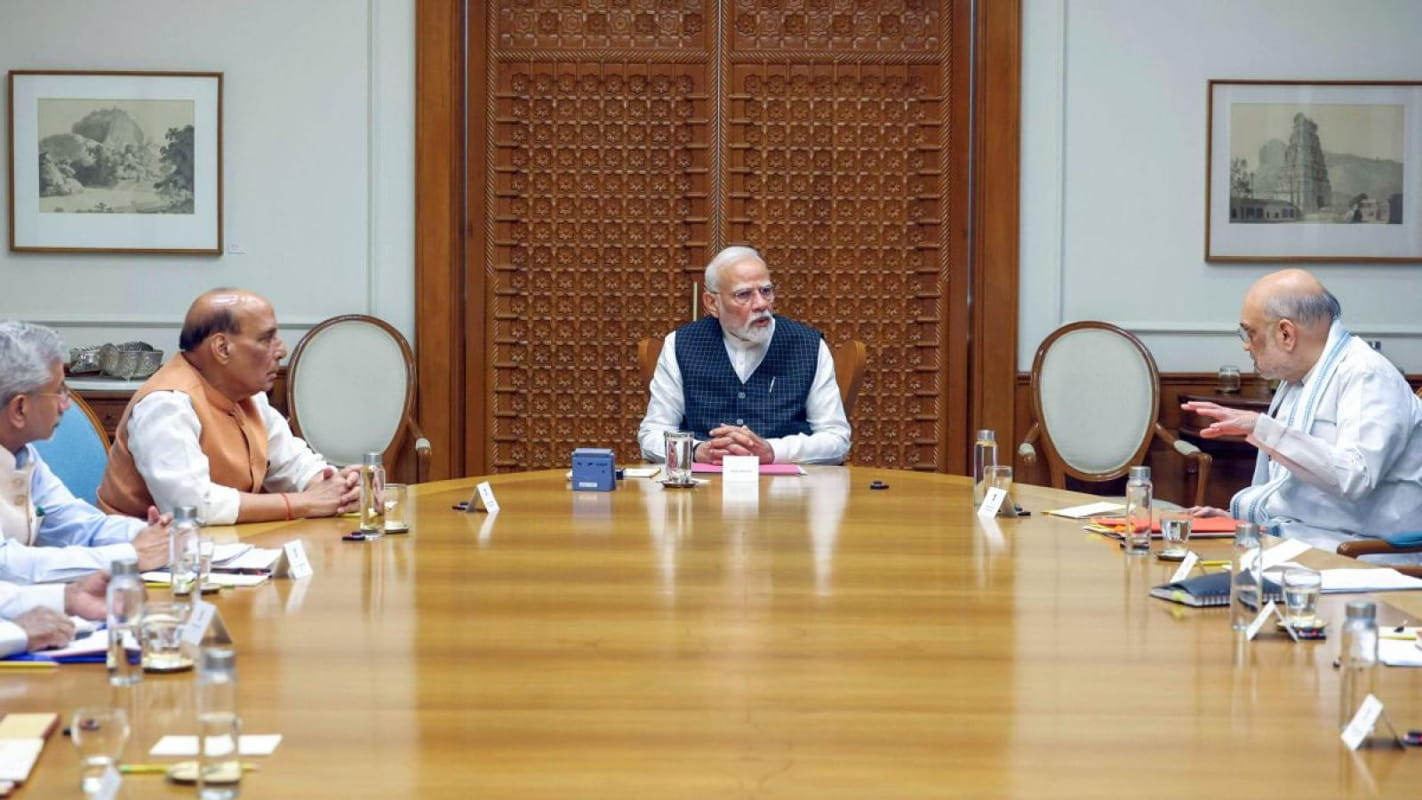
Indian Prime Minister Narendra Modi chairs a meeting of the Cabinet Committee on Security in New Delhi following the Pahalgam terror attack, April 2025. | Prime Minister’s Office, Government of India / PTI.
Executive Summary
A year after India suspended the Indus Waters Treaty (IWT) on 23 April 2025, Pakistan continues to prosecute a coordinated media campaign portraying the suspension as an act of aggression that is devastating its agricultural economy. The article examines this narrative and finds it wanting on both legal and empirical grounds. The IWT was systematically weaponised by Pakistan to obstruct legitimate hydropower development in Jammu and Kashmir.
Pakistan’s claims of agricultural devastation are not supported by the facts. Its water crisis is primarily the product of domestic policy failure, and the vulnerability is self-made. The article concludes that the suspension of the Treaty is a legitimate and measured response to an inequitable and outdated arrangement.
Background
It has been a year since India suspended the Indus Waters Treaty on 23 April 2025, a treaty widely celebrated in the West as a landmark achievement in international water law. What that narrative obscures, however, is a far more complex story of unequal concessions and long-term strategic weaponisation by Pakistan that impeded India’s development on the Indus system of rivers. The fallout of the suspension has reshaped bilateral ties and regional water dynamics. Even as India moves to maximise its rightful water use, Pakistan has been vociferous—through a coordinated media campaign—in asserting that the suspension of the IWT is devastating its agricultural economy.
A wave of articles has emerged framing the resumption of the original IWT terms as indispensable to regional peace and stability. Leveraging the Western media in particular, Pakistan is cultivating the image of a wronged nation—a victim of Indian high-handedness—while simultaneously propagating a narrative that reinstating the IWT is the surest bulwark against water wars.
Such a narrative rests on a fundamentally flawed premise: the Indus Waters Treaty was an instrument of cooperation. In reality, it functioned more as an instrument of asymmetric division—one that imposed extensive obligations on India without imposing a comparable burden on Pakistan.
The durability of any water-sharing treaty depends, above all, on the conduct of the upper riparian state. That this treaty endured six decades of recurring conflict is a credit that belongs entirely to India, which—as a responsible and principled nation—honoured its obligations through the most turbulent periods, without any reciprocity from Pakistan. Throughout this time, Pakistan continued to wield the treaty as a political instrument to obstruct and retard development in Jammu and Kashmir.
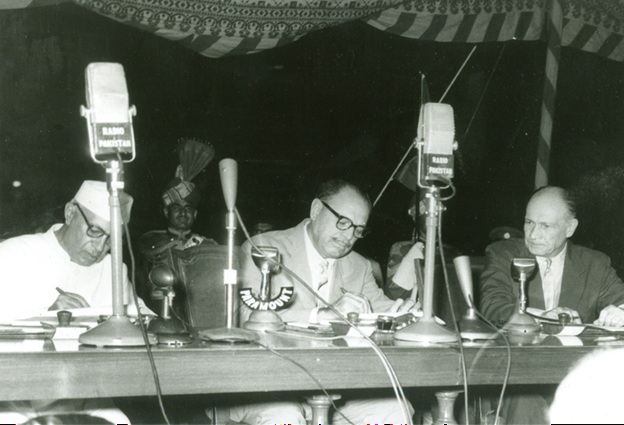
(Left to right) Jawaharlal Nehru, Prime Minister of India and Mohammed Ayub Khan, President of Pakistan, sign the Indus Waters Treaty on 19 September 1960 while William Illiff, Vice President of the World Bank, looks on. | The World Bank.
India's sovereign right to suspend the Treaty
Some commentators frame India’s suspension of the Indus Waters Treaty following the Pahalgam attack as an escalatory or destabilising act. This framing is both misleading and morally inverted. India is a victim state that has suffered devastating terrorist attacks on its soil for decades, carried out by actors operating from Pakistani territory and/or with the support of the Pakistani state. The Pahalgam attack was merely the proverbial last straw.
The proposition that India must continue fulfilling treaty obligations towards a state that sponsors terrorism against it defies elementary principles of international law. This includes the doctrine of rebus sic stantibus, which permits the suspension of treaty obligations when the foundational circumstances have materially changed. A treaty designed to foster cooperation cannot survive as a one-way obligation when the other party continues to undermine the bilateral relationship through proxy violence.
The Treaty's structural inequity has been ignored for too long
Sympathetic commentators portray the IWT as a ‘stabilising force’ and a model of durability, while conspicuously ignoring the magnitude of what India conceded in the name of cooperation. As the upper riparian state, India was allocated only the three eastern rivers—the Ravi, Beas, and Sutlej—comprising less than 20 per cent of the basin’s total flow, much of which was already in use. Even for this diminished share, India was required to pay £62 million (approximately $2.45 billion in present value) as compensation for replacement works in Pakistan-occupied Kashmir. This extraordinary concession may be a result of the geopolitical pressures of the time and the limited understanding then of India’s developmental needs and the basin’s hydrology. Six decades later, with India’s population and water demand having grown enormously, and with Jammu and Kashmir remaining chronically underdeveloped due to treaty-imposed restrictions on water use, the arrangement has become structurally untenable. The contention that any improvement in India’s reservoir storage capacity poses the risk of an escalating crisis amounts to an argument that India ought to abandon its legitimate developmental aspirations altogether.
Pakistan has weaponised the Treaty's dispute resolution mechanisms
The warm portrayal of the Permanent Indus Commission and third-party processes as enabling dispute management conspicuously omits Pakistan’s serial abuse of these mechanisms to obstruct entirely legitimate Indian run-of-the-river hydropower projects on the western rivers. Many of them are on the tributaries and have capacities of less than 5 MW, causing no material harm to Pakistan’s water availability. Pakistan has raised objections to the Kishanganga, Baglihar and Ratle Projects, among several others, dragging India into arbitration proceedings of questionable jurisdiction and deploying treaty fora as instruments of diplomatic harassment rather than genuine dispute resolution.
While some articles, particularly in Western media, vaguely acknowledge that technical disputes have become more frequent and increasingly politicised, they nonetheless fail to assign any responsibility to Pakistan for this deterioration.
The comparisons to other river basins are not appropriate
Some intellectuals draw parallels with the Aral Sea basin, the Mekong River Commission, and the Senegal River Basin to argue for cooperative governance. These examples involve states that share broadly aligned developmental interests — a reminder that cooperation frameworks require at least a baseline of good faith to function. India, however, enjoys no such assurance. Pakistan’s continued support for terrorist infrastructure targeting India renders the comparison with the Mekong Commission or the Jordan-Israel water arrangements fundamentally inapt.
Pakistan urges international actors to support ‘water diplomacy’ in rebuilding trust. India’s position is unambiguous: all dealings with Pakistan are bilateral, and third-party mediation is firmly rejected.
Trust can only be rebuilt through verifiable, sustained action by Pakistan to dismantle its terrorist infrastructure and honour its international commitments. To ask India to treat the IWT as sacrosanct while Pakistan continues to act with impunity is not a prescription for peace but a prescription for the continued exploitation of India’s restraint.
Pakistan’s own mismanagement is the root cause
Pakistan’s narrative conflates a political grievance with a physical reality that the facts do not support—at least not in the manner or to the extent being claimed. A careful examination reveals that Pakistan’s agricultural water crisis is, in large measure, self-inflicted.
Currently, 97 per cent of the fresh water in Pakistan is used in the agriculture sector, which makes up 18 per cent of Pakistan’s GDP. This disproportionate demand is compounded by the widespread cultivation of water-intensive crops—rice, wheat, sugarcane, and cotton—reflecting fundamentally poor crop-selection strategies. The numbers on wastage are stark: total water wasted by Pakistan through unutilised flow to the sea is as high as India’s entire share under the Indus Waters Treaty.
Weak governance, inadequate regulatory mechanisms, and relentlessly rising agricultural water demand in Pakistan have led to unchecked groundwater exploitation. The four major crops (wheat, rice, sugarcane, and cotton) that represent nearly 80 percent of all water use generate less than 5 percent of GDP. This era of reckless overuse of groundwater in Pakistan is now nearing its end, as water tables are falling across large areas of the country.
Pakistan’s water storage capacity is limited to a maximum of 30 days’ supply—far below the recommended 1,000-day benchmark.
Six decades of failure to invest in storage infrastructure have left Pakistan inherently vulnerable to flow variations. This structural fragility is entirely of Pakistan’s own making and cannot be attributed to India’s decision of 2025.
Conclusion
Pakistan’s claim that the IWT suspension is destroying its agriculture is an exaggeration crafted to serve a diplomatic and political purpose. The physical reality is that Pakistan’s agricultural water stress is the product of its own sustained policy failures—the overconsumption of water by low-value crops, the complete absence of investment in major storage infrastructure over five decades, unregulated groundwater depletion, and systemic irrigation inefficiency. India’s suspension of the treaty is a legitimate response to cross-border terrorism and a signal that an inequitable, outdated agreement cannot sustain forever. Pakistan would do well to address its governance failures at home rather than deploy water as a rhetorical weapon against India.
India cannot be expected to subordinate its sovereign interests, security imperatives and developmental needs to maintain an outdated and inequitable institutional arrangement brokered by a third party. India’s measured response to Pakistani aggression—including the suspension of treaty participation—is not a threat to regional stability. It is a long-overdue signal that the terms of engagement must change.
(Exclusive to NatStrat)