

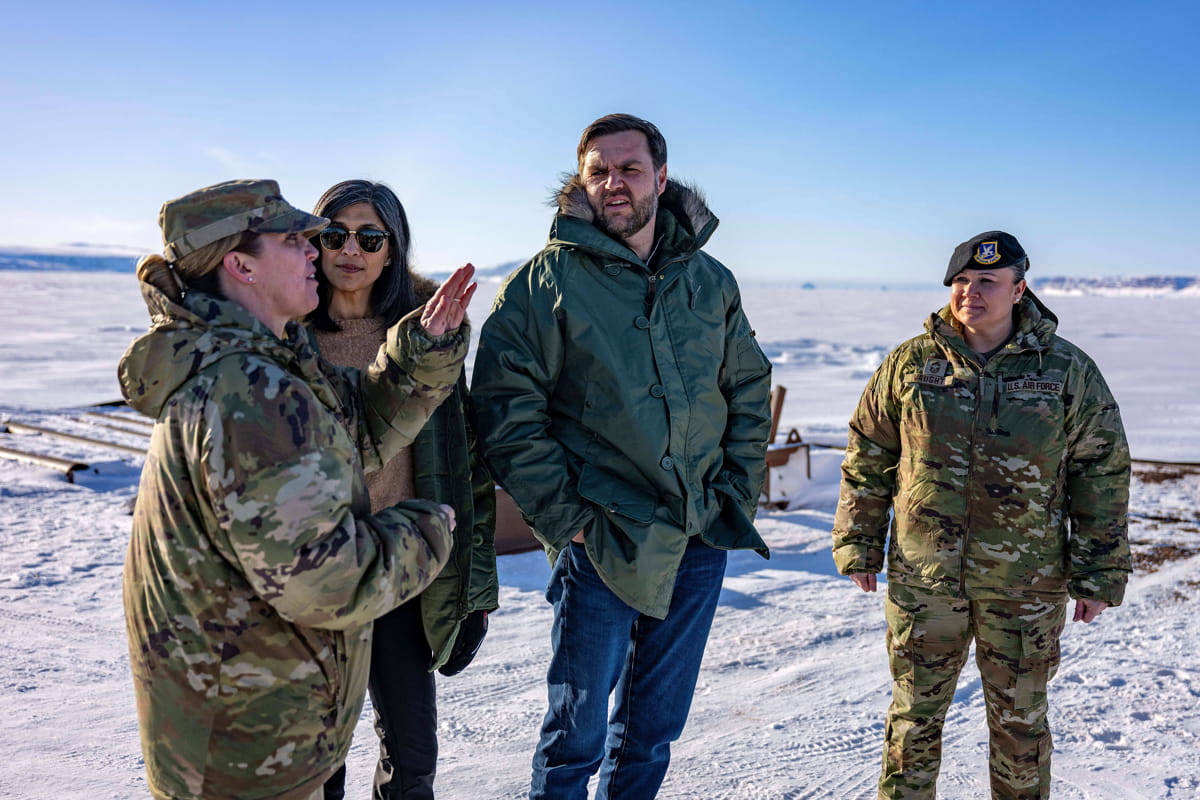
US Vice President JD Vance and Second Lady Usha Vance with Colonel Susan Meyers, formerly commander of Pituffik Space Base in Greenland, March 2025. | Jim Watson/AFP/Getty Images.

Any such attempt by the US to occupy Greenland sets a dangerous precedent for the subjugation of smaller states, violating Article 2 (4) of the UN Charter, which prohibits the threat or use of force against the territorial integrity and political independence of any state. Such actions are a blatant violation of international law, and they signal a disturbing revival of imperialistic ambitions and a colonial mindset of stronger nations in the 21st Century, disregarding the rights and interests of the Indigenous People of Greenland and their right to self-determination in the future.
Global attention has once again shifted towards Greenland following US President Donald Trump’s recent reiteration of his previous controversial claim that the United States ‘needs Greenland’ for its national security.1 Is there any merit in the American claim to acquire Greenland to protect its ‘national interest’? And what would the impact of such an acquisition be? These are some questions that need to be investigated to understand the issue at hand.
Greenland’s Strategic Importance
The strategic importance of Greenland is not a new phenomenon; it has always held a vital position in shipping and security calculations, particularly during the Second World War and the Cold War. However, it has gained renewed significance with the resurgence of great power rivalry between the global superpowers. The gradual erosion of American hegemony and the rise of multipolarity seem to bother the US, which intensifies the fear of strategic competition in the Arctic. Especially with weakened Arctic multilateral institutions, there is no functioning platform at the political level that can strengthen cooperation in the region. However, scientific cooperation amongst the member states continues to keep the Arctic Council functioning at a limited level. In fact, Greenland would be spearheading scientific research activities as Denmark is the current chair of the Arctic Council.2
Against this backdrop, the Trump Administration’s renewed interest in occupying Greenland will certainly make things even more complicated, as this appears to be part of the revived interpretation of the Monroe Doctrine. At the cost of multilateral cooperation in the Arctic, it is aimed at securing the entire Western Hemisphere under the influence of the US.
The Arctic itself is not a new area of interest for military strategists; it has always been one of high importance. It needs no reminder that the Arctic serves as the shortest parabolic trajectory for missiles from Russia, and the Greenland, Iceland and UK (GIUK) Gap serves as a key transit route in the North Atlantic Ocean. Greenland has been particularly important in securing the Gap and acts as an early warning location to detect any attack through the North Pole. To meet this requirement during the Cold War, the US built a series of distant early warning (DEW) radar stations across Alaska, Canada, and Greenland to counter any potential attacks from the Soviet Union by its B-29 bombers targeting important military installations and industrial targets in the US. ‘Regarding the DEW East, a United States Air Force (USAF)-Danish agreement was consummated on 19 March 1958, authorising four sites in Greenland. It was positioned across the Greenland Icecap along the 67th parallel, the four stations – separated by an average distance of 163 miles – were situated (West to East) at Holsteinsborg (Qaqatoqaq), Ice-cap Site No.1, Ice-cap Site No.2 and Kulusuk Island.’3
Cold War 2.0 in the Arctic?
In recent months, Cold War-style dynamics have once again re-emerged in the Arctic. The US had warned Russia that it would deploy nuclear submarines in the Arctic, while Moscow issued increasingly provocative statements, including the one by Dmitry Medvedev, the former Russian President and Prime Minister, suggesting that Russia could resort towards nuclear escalation if further pressured by the West. The counter threats by Trump through social media followed by the deployment of nuclear submarines at an undisclosed location near Russia were feared to shift the gear backwards to the era of arms race and space race.4 Russia’s testing of the nuclear-powered Burevestnik cruise missile, coupled with Trump’s social media post of resuming the nuclear testing program, effectively reignited conversations that reminded the world of the Cold War-style nuclear arms race in the Arctic, breaking the moratorium on nuclear testing that had been in place since the early 1990s.
Theoretically, nuclear submarines of Russia from the Kola Peninsula can pass through the Bear Gap (between Norway and Svalbard) undetected under the thick Arctic Sea ice and enter the GIUK Gap, which is a strategic location for trans-Atlantic shipping. The Arctic bastion of Russia’s Northern fleet in the Barents Sea region (Bear Gap) is one of two important bastions, with the other being the Pacific bastion near the Sea of Okhotsk. Therefore, Greenland undeniably occupies a significant strategic position. But this in no way can justify the American claim on Greenland.
In fact, the effective defence of the GIUK Gap depends less on the sovereignty of Greenland but more on coordinated monitoring and lasting sea control in the Bear and GIUK Gaps, which requires full cooperation and support from the European NATO partners.5
To detect the presence of Russian submarines in the Arctic, NATO regularly deploys Boeing P-8 Poseidons and uses sophisticated radars, sonobuoys and electronic surveillance systems from NATO’s Keflavik airbase. This simply means that a strong NATO alliance with the European Arctic states (including Norway, Iceland, and Denmark) and even with those in the Baltic region is extremely important for US national security. In this context, it is debatable whether occupying Greenland would meaningfully advance US security interests, especially if such a controversial approach alienates partner NATO allies.
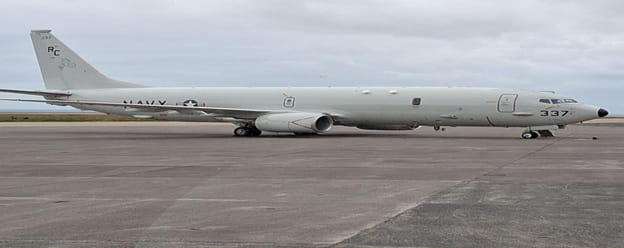
Keflavik Air Base, Iceland, 2025. | Kanagavalli Suryanarayanan.
Frictions within NATO
Also, there are additional sources of friction that already exist within the alliance, especially with Canada, the Western Hemisphere NATO partner of the US in the Arctic. Canada claims the Northwest Passage as internal waters, while the US views it as an international strait subject to right of transit passage. The US-Canada relationship has not been normal, especially due to the ongoing trade disputes and provocative political rhetoric, including the reference to Canada as the 51st state of the US.
It is important to point out that the Inuit of Canada and Greenland share common ancestry and strong historical ties. The provocation by the US to occupy Greenland has created a sense of disbelief and concern within the Arctic Six (European Arctic states and Canada), all of whom are under the NATO collective defence framework umbrella. The recent meeting between the Danish Prime Minister and her Canadian counterpart, following Trump’s remarks on Greenland, along with the expression of support and solidarity received from Nordic and other European states,6 should raise concerns in Washington about potential regional isolation.7
If all five European Arctic States [Denmark (Greenland), Norway, Sweden, Finland and Iceland] and Canada (the largest Western Hemisphere Arctic state) and the Indigenous People of the Arctic perceive US actions as threatening, then the strategic costs would outweigh any benefits that the US will gain by securing Greenland. Hence, this misstep by the US does not seem to be a prudent action, particularly at the time of a global power shift that is eroding American-dominated unipolarity. Thus, the normative, political, and strategic costs seem to outweigh any prospective gain that the US can secure by occupying Greenland.
It is also important to point out that the United States already maintains a significant military presence in Greenland. The March 2025 visit of Vice President JD Vance to the base after the strong pushback received from the people and Government of Greenland against the planned cultural visit of Second Lady Usha Vance to attend the Avannaata Qimussersu National Dogsled race, shall remind us that the US holds a permanent military base – Pituffik Space Base – in the north of Greenland, which was secured under long-standing bilateral agreement between the US and Denmark.8
This base, formerly known as Thule Air Base, was established under the US-Denmark Defense Agreement of 1951 and was further revised in 2004. With the recent defence cooperation agreement that was signed in 2023, the US already enjoys ample strategic options that it can leverage to protect its interests. Also, beyond the DEW Line across the Arctic, President Trump in January 2025 has signed an executive order authorising the Golden Dome Missile Defense System, an ambitious military project aimed at building a technologically advanced defence system covering a large landmass, modelled on Israel's Iron Dome System.9 While Greenland continues to plan for its independent future, it is still an autonomous self-governing territory within the Kingdom of Denmark, by which it is very much under NATO's collective defence umbrella. Both Greenland and Denmark are open to accommodating further legitimate requests by the US towards strengthening American interest in Greenland.10
Against this backdrop, should the US continue its plan to occupy Greenland, then it can no longer promote itself as the custodian of a rules-based international order and champion of democratic values while undermining those very values and principles. American inconsistency in this regard has long been felt by the rest of the world but it is quite a new and unsettling development in the Global North.
Any attempt to violate NATO’s Article 5 and Article 51 of the UN Charter will fundamentally weaken NATO’s collective defence, which could potentially encourage both Moscow and Beijing to deepen their cooperation and expand their reach in the region. It also promotes other large states to occupy smaller states within their own regional sphere of influence. According to NATO’s Article 5, any armed attack against one NATO member shall be treated as an attack on all members.
In this context, Danish Prime Minister Mette Frederiksen has cautioned the US that any such attempt would effectively bring an end to NATO itself, which would also mean the end of the Western alliance. However, the statement needs to be read with caution as Europe is facing a war in its own backyard. Denmark’s pragmatic idealism is being put to the test as it needs to defend its sovereignty and simultaneously ensure protection under NATO’s collective defence umbrella to defend against Russian aggression in Ukraine. This places all parties involved in a difficult and delicate position.
Greenland’s History
While discussing the future of Greenland, understanding a small portion of Greenlandic history would throw light on the profound human cost incurred due to the expansion of Thule Air Base in the 1950s.
After all, the Arctic cannot just be all about military security; the governance framework (Arctic Council) in the region was built to focus on human security, yet these priorities seem completely sidelined in changing times. The expansion of the base required the forced relocation of the Thule people (Inughuit) from Uummannaq to Qaanaq, uprooting a community whose lifestyle depended on fishing, hunting and trapping.
The displaced Thule people went through extreme hardship as their houses were burnt down and they were forcibly relocated to a site lacking similar resources to sustain their traditional way of life. During the peak of the Cold War, the expanded Thule Air Base had hosted around 6,000 American soldiers, as it was considered as an important forward base for the American military in the High Arctic.
Meanwhile, the community fought a legal battle spanning several decades, eventually concluding in the 1990s with only modest compensation for relocation and associated hardships, resulting in enduring social, economic, and cultural consequences. Another serious adverse impact stemmed from radioactive contamination following the 1968 crash of a US B-52 aircraft carrying four hydrogen bombs.11 These incidents are still fresh in the memory of Greenlanders, who fear renewed risks to their environment, indigenous lifestyle and their aspiration to an independent future.
Hence, the question the world should be asking now is not whether Greenland should become part of the US to protect the interests of the global superpower, but rather: ‘Should Greenland not be for Greenlanders?’
Greenland is a wholly indigenous territory that has suffered a series of colonisations since the early Norse settlement in the 9th Century to become a Danish colony in the 18th Century. This tiny community of Indigenous People has fought a long way to gain some level of political autonomy while protecting their indigenous identity. Greenland attained limited autonomy under the Home Rule Act of 1979, only to become a self-governing autonomous territory in 2009. The indigenous subsistence practices in Greenland rely heavily on marine and terrestrial wildlife such as narwhals, seals, Arctic fox and other Arctic species, which are not just important for their nutrition but also for their cultural identity. Their nutrition and cultural identity could be deeply affected by the expanding military operations in the region. Large-scale naval exercises, marine traffic and sonar use would generate underwater noise that would disrupt the behaviour and migration patterns of marine mammals, thereby threatening the sustainable lifestyle of the Greenlandic Inuit.
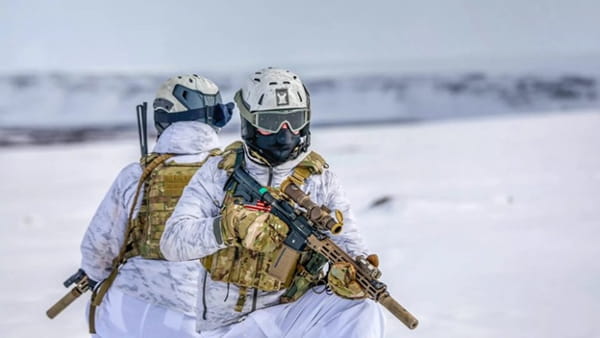
US Army training at Pituffik Space Base, Greenland, May 2023. | Polaris/Newscom
Increased militarisation or expanded US operations in Greenlandic waters could exacerbate these impacts, compromising not only the food security of local communities but also the continuity of traditional cultural practices central to Greenlandic identity, while posing a risk to the fragile ecosystem. It is also noteworthy to point out that President Trump, in the past, had expressed scepticism regarding climate change, which has far-reaching impacts both in the Arctic and outside the region.
While the Cold War and the expansion of the Thule Air Base created huge difficulties for the Thule people of Greenland under the guise of national and allied security – contemporary debates over Greenland, including President Trump’s rhetoric and potential American military expansion – demonstrate that the Arctic remains a space where strategic ambitions continue to pose severe challenge to the indigenous sovereignty and cultural preservation of the Inuit.
Any change to Greenland’s sovereignty would affect the identity of the Greenlandic Indigenous People, their collective ownership of land and resources, and the broader aspiration to see ‘Kalaallit Nunaat’ (Greenland) as an independent sovereign state in the future.
Thus, Greenland cannot be treated as a sacrificial pawn in great-power rivalry, particularly when American strategic interests are already substantially secured through various agreements, radar stations, and an air and space base in Greenland. The Greenlanders themselves have been very open to expanding economic cooperation with the US while remaining cautious in engagements with China. Some notable examples are the recent construction of the new Nuuk Airport or putting a halt to the uranium mining, both of which attracted Chinese interest but were stopped by the Greenlandic and Danish Governments.12
Conclusion
Greenlandic Prime Minister Jens Frederik Nielsen has spoken on behalf of the people of Greenland: ‘they are open to dialogue and discussion with US in accordance with the rules of international law.’13 It is in the interest of all parties that the US respects this position and discusses their concerns through dialogue with both Greenland and Denmark. Nevertheless, the future of Greenland cannot and should not be decided by external actors or factors alone. As Greenlanders proudly assert, ‘Nothing without us, about us’, any decision affecting Greenland must be grounded in the will and consent of its people.
Any such attempt by the US to occupy Greenland sets a dangerous precedent for the subjugation of smaller states, violating Article 2 (4) of the UN Charter, which prohibits the threat or use of force against the territorial integrity and political independence of any state. Such actions are a blatant violation of international law, and they signal a disturbing revival of imperialistic ambitions and a colonial mindset of stronger nations in the 21st Century, disregarding the rights and interests of the Indigenous People of Greenland and their right to self-determination in the future.
(Exclusive to NatStrat)
Endnotes
Separating Reality from the Rhetoric: Facts, Fiction, and the Indus Waters Treaty