


People protest against Trump's policy towards Greenland in front of the US consulate in Nuuk, Greenland, Saturday, Jan. 17, 2026. | AP Photo/Evgeniy Maloletka.

It is notable that Arctic cooperation is a feature of India-Russia ties but not India-US ties. The India-Russia Arctic Joint Working Group was established in 2024, although the two sides have been cooperating on the Arctic issues even before 2024. The recent Reciprocal Exchange of Logistics Support (RELOS) agreement between India and Russia gives India access to Russian facilities in the Arctic. However, the Logistics Exchange Memorandum of Agreement (LEMOA) pact between India and the US does not mention India's access to American facilities in the Arctic.
Introduction
The United States has renewed its focus on Greenland. This desire for acquisition by the US is not unprecedented, having been seriously explored by American policymakers in 1867, 1910, 1946 and 1955. Contrary to initial perceptions that US President Donald Trump's interest was merely frivolous, evidence[1] suggests that this could be a firm decision already made by the US Administration, at least under his leadership, one which they could be determined to execute in future.
Why does Trump want Greenland?
Washington's official position is clear: this is necessary for the strategic defence of the United States from various threats, primarily from those allegedly emanating from Russia and China. Thus, once again clarifying the essence of American claims to the island, Donald Trump stated[2] that ‘Greenland is covered with Russian and Chinese ships all over the place’, and that Russia or China could even seize Greenland, a challenge the Americans will not tolerate.
The fallacy of this argument is obvious. Not only because Russia and China have absolutely no plans to occupy the island, citing its complete military and political futility, but also because President Trump is understating the point: the United States has maintained a military presence in Greenland since World War II.
The Danish-American agreement on the defence of this territory, signed in 1951, remains in effect, and according to it, Washington has the right to send an unlimited number of troops to Greenland. Moreover, the northernmost existing American military base, Pituffik, is already located there, currently belonging to the US Space Force, which controls the maritime and air sectors of the Arctic Ocean at the junction with the Atlantic. If the Americans really want to expand their presence in Greenland, they can do so today without violating Danish sovereignty.
What, then, is the true motivation behind the actions of the United States?
The primary goal is to initiate a novel era of global territorial realignment, establishing dominance over this process and maximizing its advantages. Following the dissolution of the Soviet Union, the United States aimed to secure its position as the sole global hegemon, imposing a "new world order" predicated on American hegemony upon the international community. As long as this served Washington's interests, state borders were considered immutable. However, the secession of Kosovo from Serbia, undertaken in defiance of international law and orchestrated by the United States, signaled the erosion of this principle. Now we are witnessing a new milestone: relying on its ‘might makes right’,[3] Washington is moving toward the direct seizure of territories for its own jurisdiction. It is possible that this trend could extend beyond Greenland.
Another goal is the practicalimplementation of the new ‘Monroe Doctrine’ by the Trump Administration.[5] At the core of this doctrine, adopted by the Americans in the first quarter of the 19th century, lies the principle of the unacceptability of European powers interfering in the affairs of the Western Hemisphere. Now, it seems, the Trump administration intends to make a show of ousting all ‘external’ players from ‘its’ half of the globe, or at least significantly limit their freedom of action in the macro-region. Greenland, formally under the control of the European state of Denmark, seems a good first step toward realizing these aspirations: Europe is weak, politically heterogeneous, deeply dependent on the United States, and effectively lacks the means to neutralize American plans.
Direct US access to the high Arctic is also an important strategic goal. Greenland serves as a ‘geographical springboard’ to the North Pole and the Russian Arctic.[6] Seizing the island would allow the Americans to significantly reduce the reach of their military logistics aimed at the world's polar regions, which would fundamentally alter the balance of power in the Arctic. The Americans would be able to extend their sovereign military infrastructure deep into the Arctic region, creating leverage over northern maritime traffic.
Furthermore, fully incorporating Greenland into the US military network would enable the US to significantly reduce the time it takes to deliver weapons of mass destruction to targets located inside Russia.
President Trump has also argued that American control of Greenland is essential for the success of Golden Dome, his planned missile defence shield.[7]
An equally significant strategic goal of the United States is to get access to the resources on the Arctic shelf. It contains enormous oil and gas reserves (more than 13 percent of the world's undiscovered oil reserves and 30 percent of its natural gas), deposits of rare earth metals, and volumes of marine biomass.[8] In 2013, Denmark (and Greenland) submitted an application to the United Nations Commission on the Limits of the Continental Shelf seeking control over a vast expanse of 895,000 square kilometers of the Arctic seabed.[9] This claim overlaps with a similar assertion made by Russia in 2015, creating potential for geopolitical friction. Should Greenland alter its national emblem, the United States is likely to assert its own interests in this strategically important region, a scenario that could pose a direct challenge to Russia.
Expectations
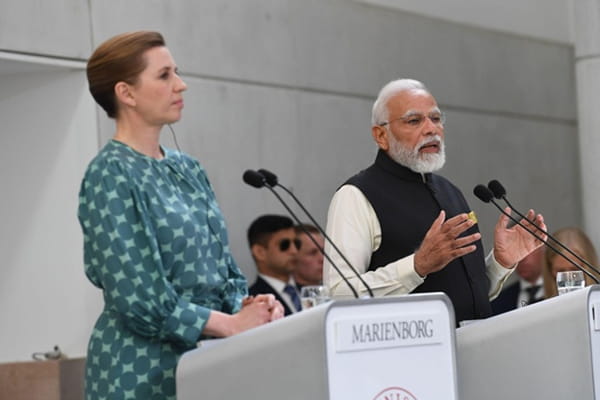
Prime Minister of India, Narendra Modi and Prime Minister of Denmark, Ms. Mette Frederiksen led India-Denmark Delegation Level Talks in Copenhagenin May 2022. | Embassy of India in Copenhagen.
Some signs are clear. The long held belief that the Arctic region is shielded from geopolitical rivalries and conflicts (Arctic Exceptionalism) has been broken by President Trump.
It can be assumed that Greenland's annexation could create a very favorable precedent for the United States. From their perspective, they will confirm their moral right to expel all ‘non-American jurisdictions’ from the Western Hemisphere.
The Cold War will return to the Arctic but with a twist of multi-polarity. The US, Russia, Europe and China could be the new poles in the Arctic, all trying to manage their security and economic interests at the cost of one-another. This could determine the functioning of existing international institutions, including the Arctic Council, and decide the level of participation from non-Arctic stakeholders in prospective projects. Given President Trump's dislike for multilateral institutions itself,[10] American withdrawal from the Arctic Council cannot be ruled out in the future. This will be a big blow to Arctic governance.
The United States may leverage its influence to exclude Chinese investments and initiatives from the Russian Arctic, while simultaneously challenging Russia's navigational rights along the Northern Sea Route. A more assertive American presence in the Arctic would heighten Russia’s security dilemma, pushing it to expand its regional military presence.
Impact on Russia-India Arctic Cooperation
The growing polarization between the United States, Europe, Russia and China will pose a dilemma for India which has been following a multi-alignment foreign policy among major powers. It is notable that Arctic cooperation is a feature of India-Russia ties but not India-US ties. The India-Russia Arctic Joint Working Group was established in 2024, although the two sides have been cooperating on the Arctic issues even before 2024. The recent Reciprocal Exchange of Logistics Support (RELOS) agreement between India and Russia gives India access to Russian facilities in the Arctic. However, the Logistics Exchange Memorandum of Agreement (LEMOA) pact between India and the US does not mention India's access to American facilities in the Arctic.[11]
The intensification of Russia-US contradictions will hinder collaboration between Russia and India in the Arctic as the Trump Administration would expect India to limit its cooperation with Russia. Sidelining of the Arctic Council will reduce the significance of non-Arctic States like India by impacting ‘rules based scientific cooperation’.
Due to America’s Greenland push, Denmark’s Arctic priorities could shift towards security and defence from science and climate change. This will impact India-Denmark strategic partnership as well, as the two countries have signed a Green Strategic Partnership in 2020. This is also likely to impact India-Denmark cooperation within the Arctic Council. Denmark has already expressed hope that India will support it against the Trump administration.[12] The breakdown of the Arctic governance and security architecture signifies that the region would experience chaotic multi-polarity, mirroring the ongoing geopolitical order in global politics.
Conclusion
India has enjoyed Observer status of the Arctic Council since 2013, signifying its contribution and interest in Arctic affairs. In 2022, India unveiled its Arctic Policy, which was a milestone in its approach to Polar studies. The Policy identified six pillars - science and research, climate and environmental protection, economic and human development, transportation and connectivity, governance and international cooperation and national capacity building.[13]Significantly, the Policy for the first time, went beyond the conservative scientific focus, with two of its pillars - Transportation and Connectivity, and Governance and International Cooperation devoted to the geopolitical aspects of the Arctic.
India is concerned about the renewed escalation in tensions and strategic competition surrounding the Arctic, which have already led to the crippling of the Arctic Council. India would like to keep its channels of cooperation open with all Arctic States and prevent, to the extent possible, major power contestation from affecting its role and interests in that region, such as for example, the impact of ice melt on climate in the Indian Ocean.
India is also following closely the evolution of the Northern Sea Route which has major ramifications for international security, trade and commerce.
(Exclusive to NatStrat)
Endnotes
Separating Reality from the Rhetoric: Facts, Fiction, and the Indus Waters Treaty