

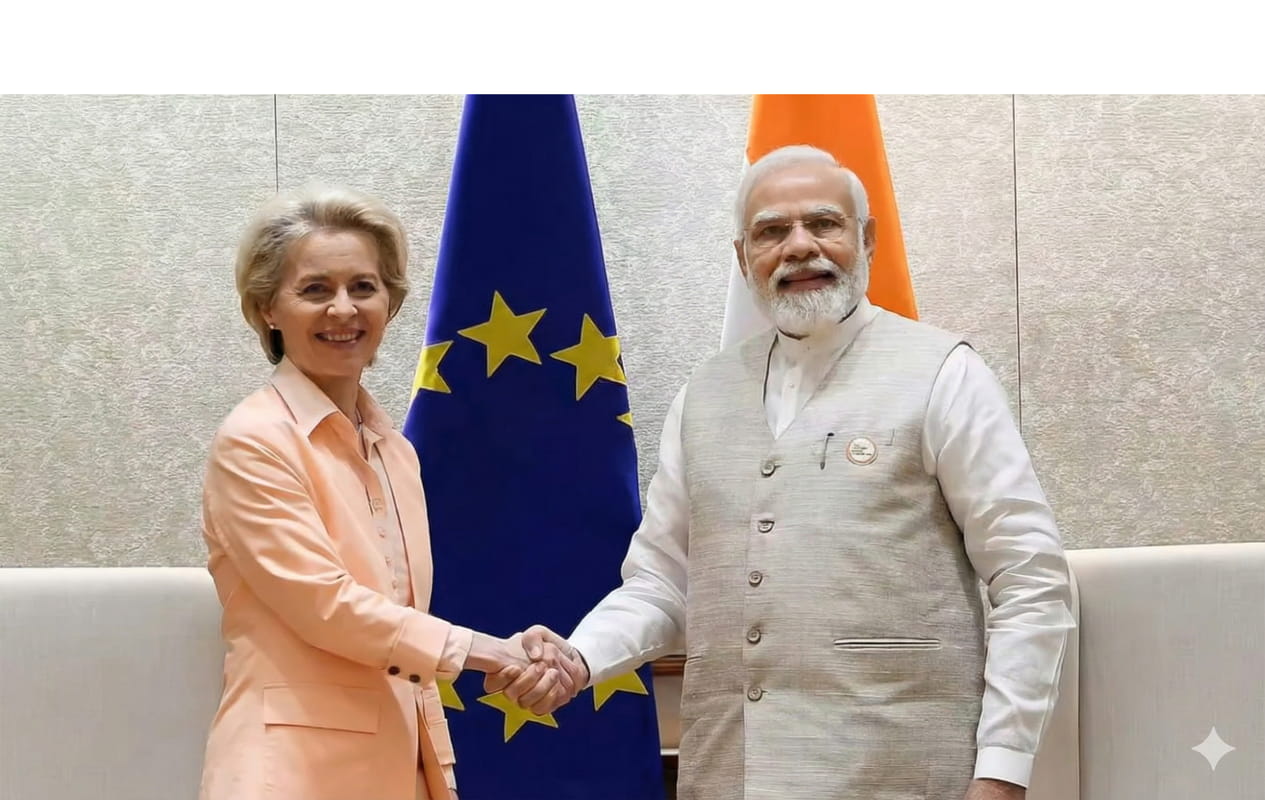
European Commission President Ursula von der Leyen and Indian Prime Minister Narendra Modi. | The Independent / EPA

Unless Europe engages more seriously with India’s sovereignty concerns, threat perceptions and strategic priorities, the free trade agreement (FTA) risks becoming a commercially impressive but strategically shallow arrangement: profitable yet uneasy.
Introduction
On 27 January 2026, the European Union (EU) and India will sign their long-awaited bilateral trade and investment agreement, concluding negotiations first launched in 2007. The agreement marks a notable step forward in a relationship that has expanded steadily in scope and ambition, despite periods of hesitation and political drift. A day prior, EU leaders António Costa, President of the European Council, and Ursula von der Leyen, President of the European Commission, will attend India’s 77th Republic Day celebrations as chief guests: a rare diplomatic signal of the political importance both sides now attach to the partnership. Alongside the FTA, the EU and India will also sign a Security and Defence Partnership, a framework the EU has extended to only a small number of partners.
Once implemented, the FTA is expected to boost bilateral trade by tens of billions of euros, deepen supply-chain integration, and anchor the EU more firmly in one of the world’s fastest-growing major economies. For Brussels, it also reflects an effort to diversify economic partnerships beyond an increasing dependence on authoritarian China and an unreliable USA. For New Delhi, the agreement promises greater market access and investment flows as India positions itself as a global manufacturing, technology, and defence hub.
Yet significant as these developments are, they will not by themselves repair a relationship whose foundations remain structurally brittle. Commercial success alone cannot compensate for unresolved political and security frictions. Unless the EU engages more seriously with India’s sovereignty concerns, threat perceptions, and strategic priorities, the partnership risks becoming commercially impressive but strategically uneasy.
Strategic Priorities: A Mismatch
Over the past decade, EU-India ties have strengthened through cooperation in climate, energy, urban development and security, particularly in the Indo-Pacific. Yet fundamental asymmetries continue to shape the relationship. A persistent challenge is the disconnect between the EU’s strategic priorities and India’s core foreign policy concerns. India has also grown increasingly wary of what it perceives as EU interference in its internal affairs.
Russia: The Strategic Litmus Test
Since the outbreak of the Russia-Ukraine War, EU-India relations have been strained by EU pressure on India to align with sanctions against Moscow. For India, however, Russia is not simply another partner but a long-standing ally –one that has consistently defended Indian interests in international forums, stood by New Delhi during pivotal conflicts including the Bangladesh Liberation War and supplied critical defence capabilities and nuclear energy cooperation during periods of vulnerability. Energy security has further reinforced this relationship, with Russian oil providing affordable supply for a population of 1.4 billion.
EU criticism rings hollow in New Delhi because it is accompanied by evident double standards. While urging India to curb Russian energy imports, the EU has simultaneously benefited from them. In 2023 alone, EU member states purchased approximately €5.6 billion worth of refined fuels from India, much of it produced from Russian crude. By 2024, India had become one of the EU’s largest suppliers of refined petroleum products. Such inconsistencies weaken the EU’s moral standing and deepen Indian scepticism about its long-term intentions.
Security Blind Spots
The EU has also been reluctant to align with India on its most pressing security concerns.
It remains largely silent on Pakistan-sponsored terrorism despite repeated cross-border attacks targeting Indian civilians and security forces. At the same time, Pakistan continues to receive EU financial assistance and preferential market access under the GSP+ scheme, a contradiction not lost on New Delhi.
A similar asymmetry characterises EU policy toward China. While India confronts persistent military pressure along its Himalayan border, the EU has continued largely unaffected in its trade and political engagement with Beijing, an approach that contrasts sharply with the firmness it expects from India on Russia.
Bangladesh presents a comparable case. India has repeatedly raised concerns over attacks on minorities and democratic backsliding under the caretaker administration, yet EU responses have remained narrowly trade-focused. To New Delhi, this selective engagement signals inconsistency rather than principled diplomacy.
Navigating Sovereignty: When the EU Oversteps
India’s unease is further compounded by what it perceives as EU overreach into domestic affairs. In 2023, the European Parliament adopted a resolution on violence in Manipur that directly criticised India’s ruling Bharatiya Janata Party (BJP) and called for the repeal of the Armed Forces Special Powers Act (AFSPA). In New Delhi, the move was widely viewed as interference in a complex internal security matter.
The EU has also questioned India’s regulatory framework governing foreign-funded NGOs through criticism of the Foreign Contribution Regulation Act (FCRA) and the Unlawful Activities Prevention Act (UAPA). EU commentary following the arrest of former Delhi Chief Minister Arvind Kejriwal in 2024 on corruption charges further reinforced Indian perceptions that the EU applies political scrutiny unevenly, and often without sufficient contextual grounding.
Defence Cooperation: Upgraded Ties, Limited Impact
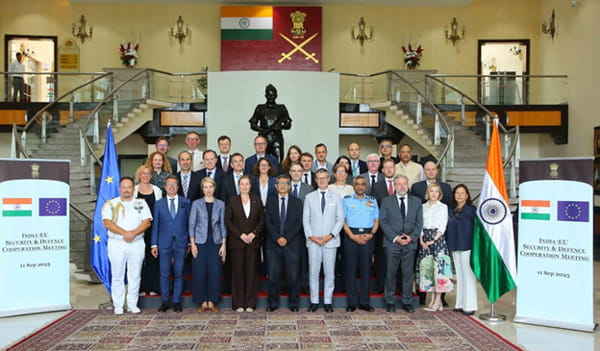
India-EU Security and Defence Cooperation meeting, New Delhi, September 2025. | Ministry of Defence.
The EU visit also culminates in the signing of a Security and Defence Partnership with India, placing New Delhi within a framework the EU has thus far extended only to a limited group of partners, including Japan and South Korea. The partnership provides an institutional platform for advancing security cooperation at a moment when both sides are reassessing their long-term defence and policy priorities.
However, the framework would be most valuable if it could be used to underpin the joint build-up of defence capabilities and industrial capacity.
The EU is preparing for a sustained defence build-up through EU-level initiatives –including the ReArm Europe framework announced in 2024 –alongside expanding national investment programmes across member states. India, meanwhile, is emerging as a defence producer and exporter. Its BrahMos missile systems and layered air-defence architecture –which performed with notable effectiveness during Operation Sindoor –India’s 2024 military response to cross-border attacks –underscore its growing technological maturity.
This convergence offers a strategic opening. The EU could benefit from co-production and co-development models with India, reducing costs, diversifying procurement, strengthening interoperability and anchoring cooperation in long-term interests rather than episodic political alignment.
Beyond the FTA: From Transaction to Strategic Trust
India’s experience with FTAs has been mixed. Of the 13 it has signed, most have resulted in rising imports with limited export gains. Between 2017 and 2022, India’s exports to FTA partners grew by around 31 per cent, while imports increased by over 80 per cent, significantly widening the trade deficit. India’s FTA utilisation rate stands at roughly 25 per cent, compared to 70-80 per cent in developed economies. This record explains New Delhi’s caution and its reluctance to treat trade agreements as strategic solutions in themselves.
For the FTA to succeed, it must be institutionally functional. Beyond its formal steering council, the EU and India should consider establishing a Joint FTA Performance Forum: a standing body tasked with identifying underperforming sectors, pre-empting regulatory divergence and addressing trade frictions before they erode confidence in the agreement.
To underpin a genuine strategic partnership, the EU must rethink how it engages India. Strategic partners demonstrate a willingness to stand by one another when costs and risks are involved. The EU cannot expect alignment on Russia while remaining hesitant on India’s most pressing security concerns. If the EU views Russia as a systemic threat while Russia remains India’s closest defence ally, what is required is not pressure but sustained dialogue and a search for workable middle ground. Trust also requires coherence across Pakistan, China and South Asia more broadly. India takes note when solidarity is absent, and when financial or political support flows to actors that directly undermine its security.
A Partnership Still in the Making
The EU–India FTA will be a significant commercial achievement. But it will not, by itself, demonstrate strategic convergence. Without greater dependability, consistency and willingness to shoulder mutual risks, the relationship will remain commercially profitable yet strategically uneasy.
Trade has opened the door. Whether the EU and India step through it as genuine partners – rather than cautious counterparts – remains the real test.
(Exclusive to NatStrat)
Separating Reality from the Rhetoric: Facts, Fiction, and the Indus Waters Treaty