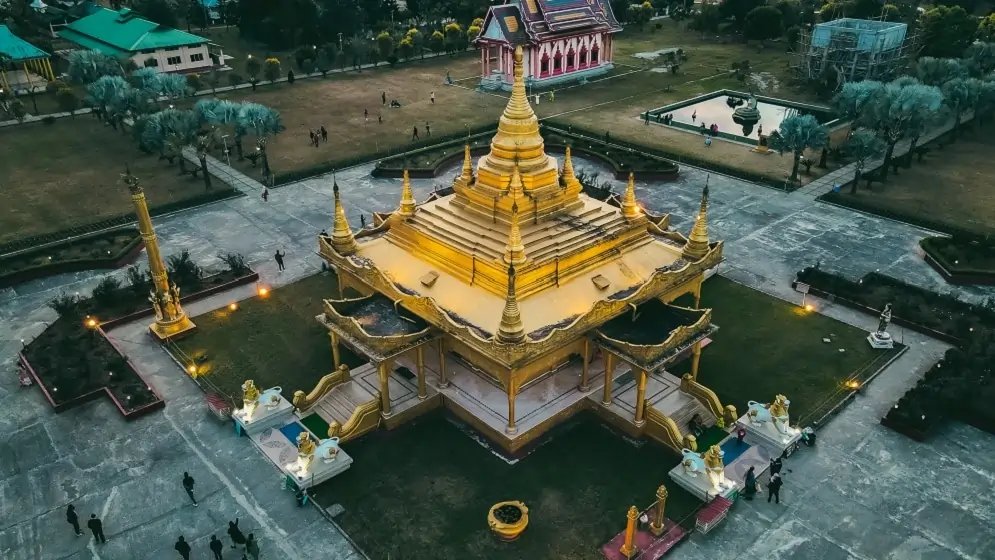


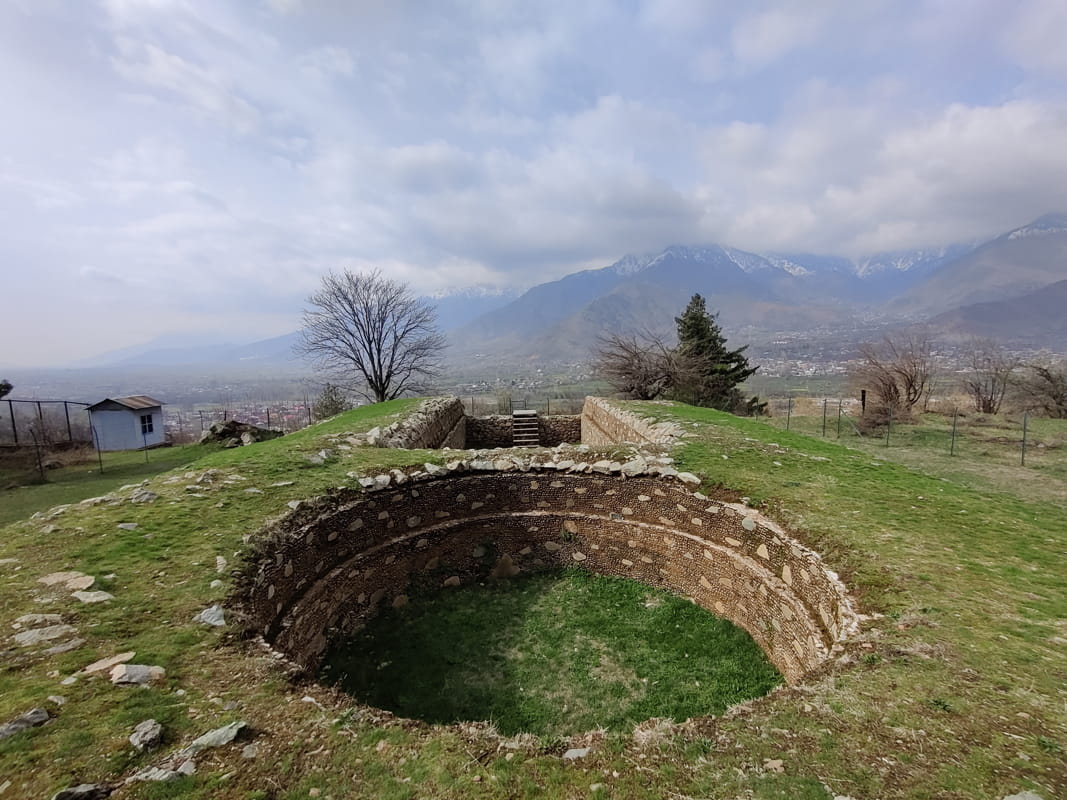
An apsidal shrine on the second terrace of the monastery complex. | Manan Shah / World History Encyclopedia

In the current context of India’s Connect Central Asia policy, there is a need to encourage people to people connections between Kashmir and Central Asia. The Indian Council of Social Science Research should provide more grants and scholarships to research scholars from Jammu and Kashmir who are engaged in research on the Central Asian region. At the same time, flight connectivity between the two regions will also help in further expanding people centric connectivity. Due to geopolitical reasons, the historical connection between Kashmir and Central Asia has weakened somewhat. However, it is an asset that should be preserved through India’s Connect Central Asia policy.
Introduction
Until the implosion of the erstwhile Soviet Union in 1991, Central Asia remained isolated from the outside world. Due to its centralised nature, the Soviet system did not allow its constituent Republics to enjoy freedom while conducting its foreign relations.
Much of the world remained largely unaware of the Central Asian Republics (CARs). India was no exception. The rich history of Indo-Central Asian relations, from ancient times to the dissolution of the Soviet Union, remained largely unknown to most Indian intellectuals and many in Russia.
Kashmir and Central Asia Links
Kashmir’s relations with Central Asia are well documented and have been a reality from ancient times. Kashmir has a distinction of being a meeting ground for people and ideas in the Indian Sub-continent, leaving a deep mark on its political, economic, social and cultural landscape.
The Vedas, particularly the Rig Veda, provide numerous clues about various geographical sites in Central Asia, highlighting the cultural relationship between India and Central Asia. One of the most notable interactions is the dispersal of the Aryans from their Central Asian habitat to the Iranian and Indian regions. Some groups settled in the Kashmir region and prospered over time. Traditions from these ancient Aryans persist among some communities in Kashmir even today.
The migration of saints, artisans and traders through the ages had a lasting effect on the cultural landscape of this region. For example, the message of Lord Buddha spread from India to Central Asia via Kashmir during the days of the Silk Road. Apart from the Silk Road, there were three other routes that connected Kashmir and Central Asia: via Baramulla and Muzaffarabad, through Gilgit and Chitral and through Tibet and Xinjiang.
Buddhism had an important impact on pre-Islamic Central Asia in terms of culture, art and philosophy. The famous monk from China, Hieun Tsiang, who visited India from 629-645 AD, has mentioned four important Buddhist centres in Central Asia: Shan-shan (Kroraina), Khotan, Kucha, and Turfan. Kashmir was instrumental in introducing Buddhism to Khotan which, later in turn, was central to transmission of Buddhism to China.
The most significant era of interaction between Central Asians and Kashmiris began with the advent of Islam in Central Asia. This led Muslim missionaries from Iran and Turkestan to travel to Kashmir to propagate the new faith and its traditions. One prominent missionary was Mir Sayyid Ali Hamadani, known as Shah-i-Hamadan among Kashmiri Muslims.
He is known to have brought Sufism to Kashmir via Tajikistan and Iran. Originally from Hamadan in Western Iran, his area of activity was Kulob province in Tajikistan, where he was buried after his death. Hundreds of Iran and Turkestan missionaries followed Mir Sayyid Ali's footsteps in Kashmir. As a result, a solid and lasting connection was established between Central Asian missionaries and Sufi schools in Kashmir.
With the spread of Islam in Central Asia, the region emerged as a great knowledge hub of medieval times, giving impetus to path breaking developments in different disciplines of knowledge alongside religious sciences and architecture.
The woodwork in Kashmir’s architecture has a Central Asian imprint, like the Kadals (wooden bridges) and Ziarats (wooden shrines). In the 16th and 17th century, the Mughals not only developed the specific wooden architecture but also tried to restore stone building art in Kashmir. Mughal Gardens are a group of gardens constructed by the Mughal rulers in Central Asian architecture style. This architecture style has been influenced by Central Asia, especially the Char Bagh structure.
Recently, Jammu and Kashmir’s Forensic Science Laboratory conducted the first ever genetic study which confirmed the considerable genetic relationship between different districts of Kashmir and Central Asia.
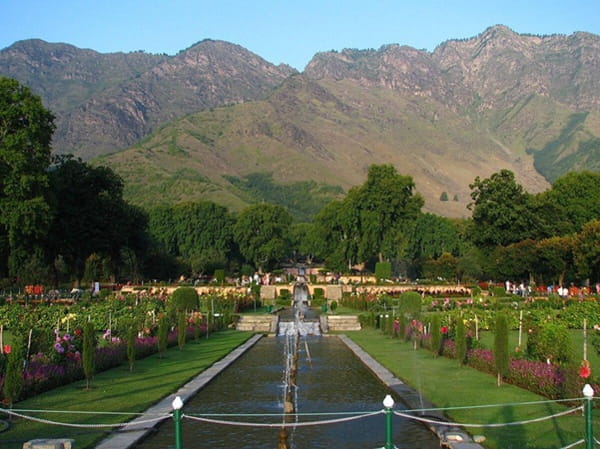
A View of Nishat Bagh, Mughal Garden, Srinagar.
Educational Connections
It was with the establishment of the Central Asian Studies Centre at Kashmir University in 1976, initiated by Sheikh Muhammad Abdullah, the then Chief Minister of Kashmir, that new avenues for interaction between academics from Central Asia and Kashmir were revived. In 1982, Muhammad Asimi, then President of the Tajik Academy of Sciences, visited Srinagar for about a week, delivering a speech to a large gathering of students, teachers, researchers, and university officials. The Central Asian media extensively covered this event.
In 1982, the Indian Council for Cultural Relations organised millennium celebrations for the great Central Asian intellectual, philosopher, and physician Abu Ali Ibn Sina (Avicenna) throughout India in collaboration with the Central government. In addition, the Centre for Central Asian Studies at Kashmir University had the privilege of hosting a five-member delegation led by Professor Asimov during their visit.
Over time, Central Asian countries have achieved political and economic stability. They became members of the United Nations as independent sovereign states. India responded by opening Embassies in all the former Republics, rapidly increasing bilateral interactions. This shift also initiated a process of educational exchange. Many Kashmiri students pursued admission to various academic and professional institutions in Uzbekistan, Kazakhstan, and Tajikistan. To do so, they had to learn the Russian language, the medium of instruction in Central Asian universities.
Conclusion
Contacts with Central Asia have played a significant role in the development of an Islamic civilisation in Kashmir that has rejuvenated the prevalent trends in art, architecture, literature and thought. The influx of scholars and literary personalities from the Central Asian region into Kashmir and other Indian centres of culture and learning supplemented indigenous culture and led to the strengthening of the values of co-existence, mutual understanding and tolerance.
In the current context of India’s Connect Central Asia policy, there is a need to encourage people to people connections between Kashmir and Central Asia. The Indian Council of Social Science Research should provide more grants and scholarships to research scholars from Jammu and Kashmir who are engaged in research on the Central Asian region.
At the same time, flight connectivity between the two regions will also help in further expanding people centric connectivity. Due to geopolitical reasons, the historical connection between Kashmir and Central Asia has weakened somewhat. However, it is an asset that should be preserved through India’s Connect Central Asia policy.
(Exclusive to NatStrat)
Endnotes
Separating Reality from the Rhetoric: Facts, Fiction, and the Indus Waters Treaty

Hedging Without Punishment: Vietnam, India, and the Unequal Burden of Strategic Autonomy